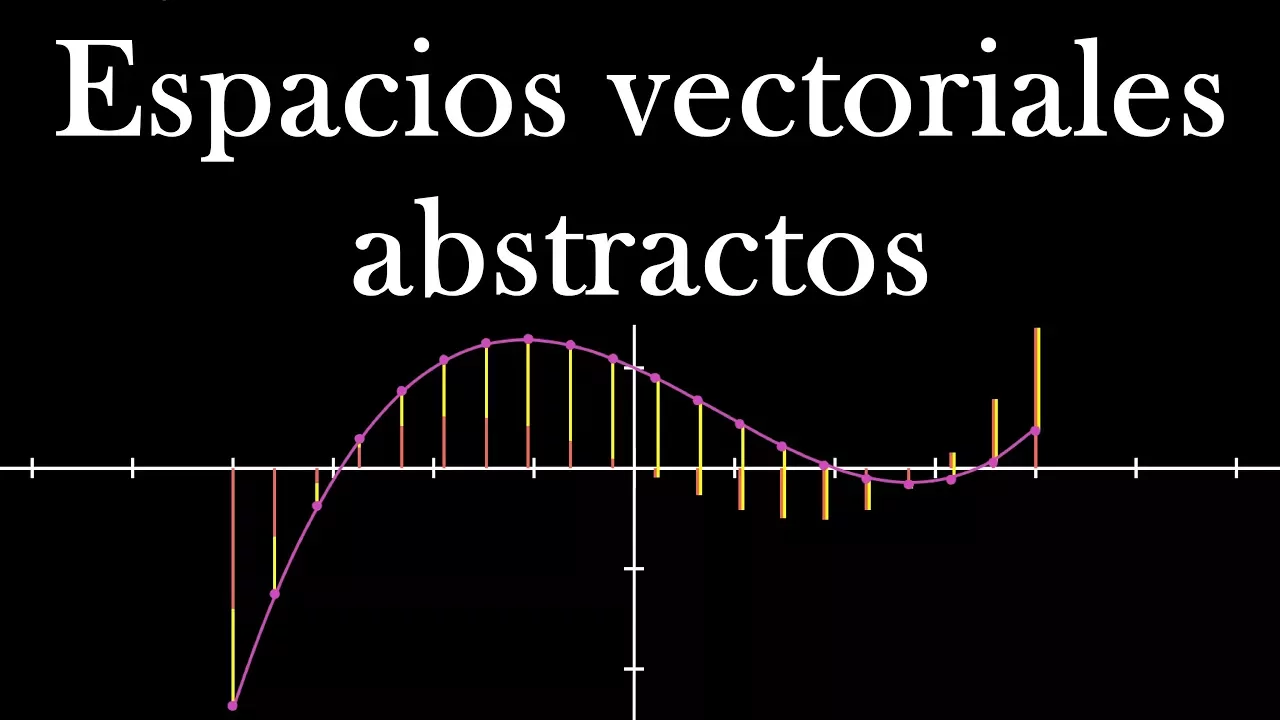
Vectores en un espacio abstracto | Esencia del álgebra lineal, capítulo 11

Vectores en un espacio abstracto | Esencia del álgebra lineal, capítulo 11

New Section

In this section, the speaker discusses the fundamental concept of vectors and their representation in mathematics.

Understanding Vectors

  • : Vectors can be defined as lists of numbers, providing a clear and unambiguous way to work with multidimensional concepts.
  • : Algebraic concepts like determinants and eigenvectors remain consistent regardless of the coordinate system chosen, emphasizing the spatial nature of vectors.
  • : Vectors are not merely numerical lists but have a spatial essence, raising questions about the meaning of terms like "space" in mathematics.

Functions as Vectors

The discussion shifts towards functions as another form of vectors with specific operations that mirror traditional vector manipulations.

Functions as Vectors

  • : Functions exhibit vector-like qualities, allowing for sensible addition and scaling similar to traditional vectors.
  • : Scaling functions by real numbers parallels scaling vectors, highlighting an infinite-dimensional aspect in function spaces.

Linear Transformations for Functions

Linear transformations applied to functions are explored, drawing parallels between algebraic techniques for vectors and functions.

Linear Transformations

  • : Linear transformations for functions preserve vector addition and scalar multiplication properties akin to traditional vector spaces.

Understanding Parallels between Derivatives and Matrices

The section discusses the concept of parallelism between derivatives and matrices by using polynomials as examples.

Basis Functions for Polynomials

  • : Introduces the idea of representing derivatives with matrices in infinite-dimensional function spaces.
  • : Explains how polynomials, despite having a finite number of terms, can be represented in an infinitely large space using powers of x as basis functions.
  • : Describes choosing powers of x as base functions for polynomials to assign coordinates in the function space.

Infinite Coordinates for Polynomials

  • : Compares the role of base functions in polynomial spaces to vectors in vector spaces, highlighting that polynomials have infinitely many coordinates due to their potentially large degrees.
  • : Illustrates how a polynomial like x^2 + 3x + 5 can be represented with coordinates (5, 3, 1) in this system.

Derivative Matrix Representation

Explores how derivatives can be represented using matrices through examples with polynomial functions.

Derivative Calculation Using Matrices

  • : Demonstrates finding the derivative matrix by multiplying the coordinate representation of a polynomial by a specific matrix.
  • : Shows how each term contributes to different coordinates in the derivative matrix when calculating derivatives of polynomials.

Connection Between Vectors and Matrices

  • : Highlights the linearity of derivatives and how it relates to matrix multiplication, emphasizing that both concepts are part of the same mathematical family.
  • : Discusses how concepts from vector spaces apply to functions as well, drawing parallels between operations like dot products and eigenvalues.

Understanding Vector Spaces Axioms

Discusses vector spaces and their axioms essential for applying algebraic concepts universally.

Axioms for Vector Spaces

  • : Emphasizes that various objects like arrows, lists of numbers, or functions can form vector spaces if they adhere to specific rules known as axioms.
  • : Explains that defining rules for vector addition and scalar multiplication ensures consistency across different types of vector spaces.

Importance of Axioms in Algebraic Theory

  • : Introduces eight axioms that any vector space must satisfy for algebraic theories to apply universally across diverse types of vector spaces.

New Section

The concept of vectors and linear transformations is discussed, emphasizing the abstraction in mathematics.

Understanding Vectors and Linear Transformations

  • Vectors are defined abstractly as arrows or functions that follow specific rules for addition and scaling.
  • Mathematics abstracts vectors into a unique notion of a vector space, allowing reasoning about various possibilities using a single idea.
  • Initially visualized in 2D space with arrows rooted at the origin, understanding expands to apply more generally across algebraic contexts.

New Section

Concluding thoughts on the essence of linear algebra and its practical application.

Essence of Linear Algebra

  • Encourages reasoning about vectors in concrete, visualizable settings before applying them more broadly across mathematical concepts.
Video description

Las herramientas del álgebra lineal son extremadamente generales, y se aplican no solo a los vectores familiares que representamos como flechas en el espacio, sino a todo tipo de objetos matemáticos, como por ejemplo las funciones. Esta generalidad se captura con la noción de un espacio vectorial abstracto. Mira la lista de reproducción completa de la "Esencia de álgebra lineal" aquí: https://goo.gl/id9PEB ------------------ 3blue1brown Español es un canal de doblaje al idioma español del canal en inglés 3Blue1Brown que trata de animar las matemáticas, en todos los sentidos de la palabra "animar". Y ya sabes cómo funciona YouTube, así que si deseas estar al tanto sobre los nuevos vídeos, suscríbete, y haz clic en la campana para recibir notificaciones (si te gusta eso). Si eres nuevo en este canal y quieres ver más, un buen lugar para comenzar es aquí: https://goo.gl/mas28R Si deseas apoyar o contribuir con el canal no dudes en compartir los videos. Y si quieres ir más allá, puedes dejar un mensaje o comentario, o también contactar en alguna de las siguientes redes sociales en inglés: Algunas redes sociales en inglés: Página web: https://www.3blue1brown.com Twitter: https://twitter.com/3Blue1Brown Patreon: https://patreon.com/3blue1brown Facebook: https://www.facebook.com/3blue1brown Reddit: https://www.reddit.com/r/3Blue1Brown ➡️ Traducción y doblaje del video por Pedro F. Pardo y Jesus E. Montes. Email: jesusernesto.montes@hotmail.com