ANATOMIA MACROSCÓPICA DO TRONCO ENCEFÁLICO - PARTE 1
Understanding the Brainstem
Overview of the Brainstem Structure
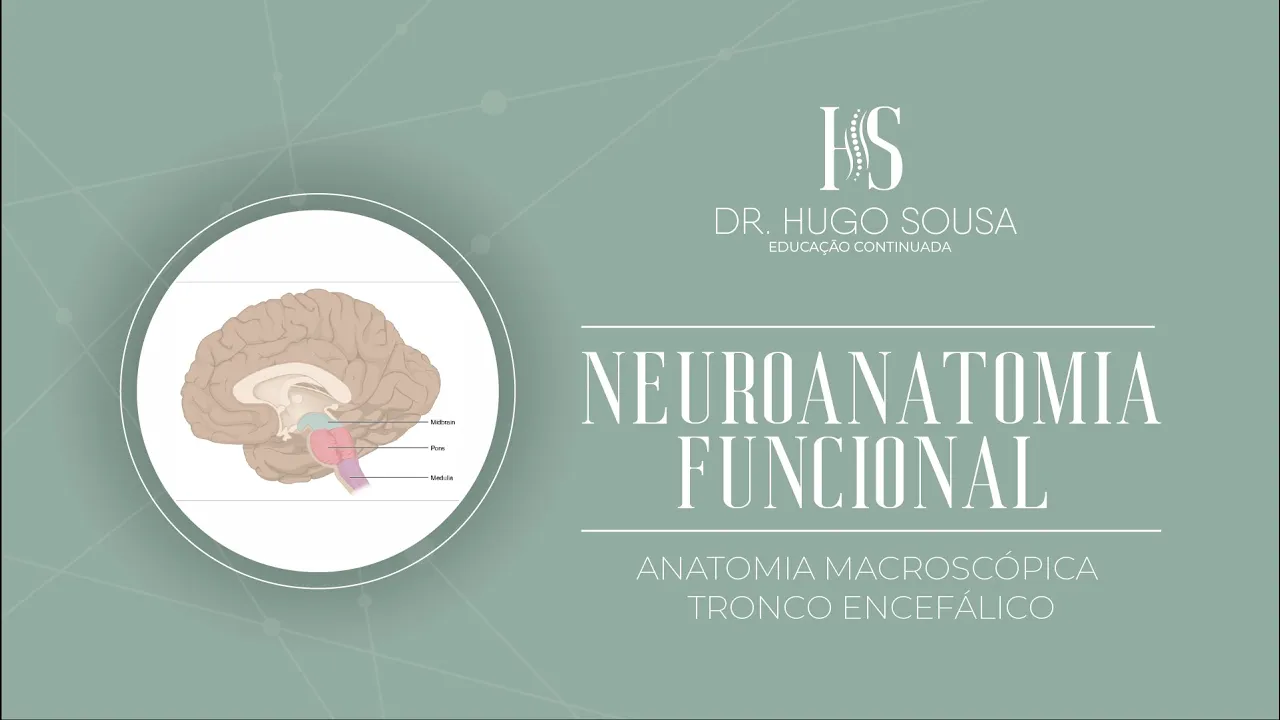
- The brainstem is composed of three main parts: mesencephalon (midbrain), pons, and medulla oblongata. It connects the spinal cord to the brain, situated ventrally to the cerebellum and superiorly to the cerebral hemispheres.
- The brainstem plays a crucial role in integrating various neural pathways between the spinal cord and higher brain centers, facilitating communication within the central nervous system.
Nuclei and Their Functions
- Within the brainstem are numerous nuclei, which are clusters of neuron cell bodies that serve specific functions, including cranial nerve connections essential for sensory and motor functions.
- These nuclei can be categorized into two types: those associated with cranial nerves and those involved in autonomic functions such as respiration and cardiovascular regulation.
Reticular Formation
- The reticular formation is a complex network within the brainstem responsible for vital functions like respiration, cardiovascular control, sleep regulation, and maintaining wakefulness through its activation of higher brain regions.
- This structure also plays a significant role in memory consolidation during sleep by influencing consciousness levels throughout different periods.
Neural Pathways
- The brainstem contains various nerve fibers that form tracts (fasciculi) connecting different parts of the nervous system; these include ascending pathways from the spinal cord to higher centers like the thalamus.
- For example, spinothalamic tracts carry sensory information from peripheral receptors to thalamic relay stations before reaching cortical areas for processing.
Cranial Nerves Originating from Brainstem
- Ten out of twelve pairs of cranial nerves originate from nuclei located in the brainstem; these include both motor nuclei (red) and sensory nuclei (blue). Each nucleus has distinct roles related to muscle control or sensory input processing.
- The trigeminal nerve serves as an example where it receives peripheral sensory information before transmitting it through its respective pathways back into central structures for further processing.
This structured overview provides insights into key aspects of brainstem anatomy and function while linking directly to relevant timestamps for deeper exploration of each topic discussed in detail within this segment.
Bulbo e suas Estruturas
Estrutura do Bulbo
- O bulbo é uma estrutura importante, com um limite superior no sulco bulbo-pontino e um limite inferior no forame magno do osso occipital.
- A imagem apresentada mostra o osso occipital, destacando o forame magno em um corte sagital da cabeça.
- O plano horizontal que passa pelo forame magno ajuda a entender a topografia do bulbo e sua relação com a medula espinal.
Fissura Mediana Anterior
- A fissura mediana anterior se projeta ao longo do bulbo, terminando na intersecção com o sulco bulbo-pontino, formando o chamado forame cego.
- No aspecto anterior do bulbo, observam-se duas massas triangulares conhecidas como pirâmides bulbares.
Função das Pirâmides Bulbares
- As pirâmides bulbares são densificações das fibras do trato córtico-espinhal, responsáveis pela motricidade.
- Essas estruturas cuidam da inervação da musculatura axial e apendicular, sendo altamente relevantes para testes motores.
Decussação das Pirâmides
- A decussação das pirâmides refere-se ao cruzamento das fibras do trato córtico-espinhal; as fibras laterais cruzam enquanto as anteriores não.
- O sistema motor é considerado cruzado devido à maioria das fibras que influenciam a atividade motora virem do trato córtico-espinhal.
Lesões e Suas Manifestações
- Lesões acima da decussação manifestam-se contralateralmente (do lado oposto), afetando áreas como pescoço e membros superiores/inferiores.
- Lesões na medula espinal abaixo da decussação resultam em manifestações ipsilaterais (do mesmo lado).
Topografia Lateral
- O sulco lateral anterior é observado lateralmente às pirâmides; atrás dele está a oliva, relacionada ao controle dos movimentos.
- A oliva conecta-se com o cerebelo e influencia padrões de controle motor.
Neuroanatomy of the Brainstem
Overview of the Bulb and Rhomboid Fossa
- The open portion of the bulb and pons contributes to forming the rhomboid fossa, which is associated with the fourth ventricle.
- The posterior topography reveals a posterior lateral sulcus leading to the cuneate fasciculus, which projects from two spinal fasciculi: a lateral and a medial one.
Cuneate Fasciculus and Tubercle
- The cuneate tubercle arises from converging fibers of the cuneate fasciculus, receiving sensory information projected from the spinal cord to the brainstem.
- This structure processes conscious proprioception, vibratory sensitivity, and discriminative touch for upper limbs.
Gracile Fasciculus
- Medially adjacent to the posterior intermediate sulcus lies the gracile fasciculus, which also culminates in a tubercle known as gracile tubercle.
- Similar to its counterpart, it transmits sensory information regarding vibratory sense and discriminative touch for lower limbs.
Pathways to Higher Centers
- Sensory fibers from both gracile and cuneate tubercles project into deeper nuclei (gracile and cuneate nuclei), crossing over at midline to form medial lemniscus.
- These pathways ascend towards higher centers like thalamus before reaching cerebral cortex.
Cranial Nerves Originating from Bulb
- Discussion on cranial nerves originating from medulla includes glossopharyngeal (IX), vagus (X), accessory (XI), and hypoglossal (XII).
- These cranial nerves are crucial for various functions including swallowing, heart rate regulation, and tongue movement.
Anatomical Boundaries of Pons
Superior Limitations
- The superior limit of pons is defined by its base at cerebral peduncles; these structures belong to mesencephalon rather than pons itself.
Inferior Boundaries
- The inferior boundary is marked by bulbo-pontine sulcus; this demarcation helps identify anatomical regions within brainstem.
Key Anatomical Features
- Basilar sulcus runs along anterior surface where basilar artery traverses; this artery is vital for vascularizing brainstem structures.
Transverse Striations
Cerebellar Connections and Cranial Nerves
Overview of Cerebellar Fibers
- The pontine nuclei receive signals from the cerebral cortex, which then send fibers to the cerebellum. This connection is crucial for motor control.
- A significant quantity of fibers exists because the cerebellum plays a vital role in controlling motor activities, with ongoing discussions about its involvement in psychological functions.
Peduncles of the Cerebellum
- The middle cerebellar peduncle is formed by the convergence and densification of transverse fibers originating from the cerebral cortex.
- In addition to the middle peduncle, there are superior and inferior cerebellar peduncles that collectively facilitate communication between different brain regions.
Cranial Nerves Originating from the Pons
- Four cranial nerves originate from the pons:
- Trigeminal nerve (V)
- Abducens nerve (VI)
- Facial nerve (VII)
- Vestibulocochlear nerve (VIII)
Detailed Anatomy of Cranial Nerves
- The trigeminal nerve has two roots: a thinner motor root responsible for mastication muscles and a thicker sensory root supplying sensation to much of the head.
- The abducens, facial, and vestibulocochlear nerves can be observed in the bulbo-pontine sulcus; they play critical roles in eye movement and facial expressions.
Functions and Clinical Relevance
- The facial nerve innervates muscles responsible for facial expressions; damage can lead to conditions like facial paralysis due to peripheral neuropathy.
- The vestibulocochlear nerve is located laterally in relation to other cranial nerves; it is essential for balance and hearing.
Tumors in Bulbo-Pontine Angle
Overview of the Vestibulocochlear Nerve
Understanding the Vestibulocochlear Nerve Structure
- The vestibulocochlear nerve, also known as cranial nerve VIII, consists of two main components: the vestibular and cochlear nerves.
- The vestibular portion is responsible for balance and equilibrium, linked to the semicircular canals in the inner ear.
- The cochlear part is associated with hearing, connecting to the cochlea which processes sound.
- These two nerves converge to form a single pathway that transmits sensory information from the inner ear to the brain.
Turn any video into a summary like this
YouTube links, meetings, lectures — with transcripts, search, and chat.