Ecuaciones diferenciales de 1° orden
Introduction to First Order Differential Equations
Overview of Differential Equations
- The unit begins with the study of first-order differential equations, which model problems across various sciences, aiding engineers in their professional tasks.
- Applications include mechanics (Newton's laws), electrical circuits, growth problems, heat flow, and beam deflection.
Example of Motion
- An example is provided where a function describing position (x) as a function of time (t) for uniformly accelerated motion is discussed.
- The final velocity equation leads to recognizing that velocity is the derivative of x concerning t, indicating the presence of a differential equation.
Definition and Classification of Differential Equations
Understanding Differential Equations
- A differential equation relates an independent variable (x), a dependent variable (y), and their derivatives; solving it means finding the relationship between these variables.
Types of Differential Equations
- Focus will be on ordinary differential equations where the unknown function depends on one independent variable.
- Partial differential equations involve functions depending on two or more independent variables but are not covered in this course.
Classifications by Order and Degree
Order Classification
- The order refers to the highest derivative present; examples illustrate how to determine if an equation is second or third order based on its derivatives.
Degree Classification
- The degree indicates the power of the highest derivative; examples clarify how to classify equations based on both order and degree.
Solutions to Differential Equations
Defining Solutions
- A solution transforms a differential equation into an identity when substituted back into it.
Uniqueness of Solutions
- An example checks if y = 3x is unique by substituting it into the given equation; another function y = 2x also satisfies it, indicating non-uniqueness.
Types of Solutions
General Solutions
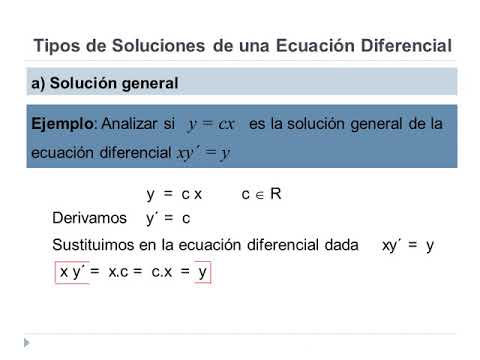
- General solutions consist of families of functions satisfying a given differential equation characterized by arbitrary constants corresponding to its order.
Particular Solutions
- Particular solutions arise from general solutions by assigning specific values to constants based on initial or boundary conditions.
Singular Solutions
Understanding Singular Solutions
- Singular solutions do not fit within general solutions yet still satisfy the original differential equation. Not all equations have singular solutions.
Example Analysis
- An example examines whether y = ax^2 serves as a singular solution while confirming that y = ax represents general solutions through substitution checks.
Graphical Representation
Envelopes in Functions
- The quadratic singular solution acts as an envelope for linear functions from the general solution family, demonstrating tangential relationships at certain points.
Deriving Differential Equations from Known Solutions
Process Overview
- To derive a differential equation from known general solutions, differentiate multiple times according to essential constants present until reaching necessary orders.
Example Derivation Steps
- First Step: Differentiate once for each constant in your solution.
- Formulate systems using both original functions and their derivatives.
- Second Step: Eliminate constants through substitution leading to an expression involving only x, y, and their derivatives without constants remaining.
- This process yields specific forms like y' = y/x.
Final Examples
- Circles: Deriving from circle equations involves implicit differentiation followed by eliminating constants through systematic substitutions.
- Family Functions: For families like c_1 x + c_2 e^-x, similar steps apply with multiple differentiations leading towards simplified expressions devoid of essential constants.
With this structure complete, we conclude our exploration into first-order differential equations and their applications within engineering contexts.
Turn any video into a summary like this
YouTube links, meetings, lectures. With transcripts, search, and chat.