Interprocess Communication
Inter-Process Communication Overview
Understanding Inter-Process Communication
- Inter-process communication (IPC) refers to the methods by which processes in an operating system communicate with one another.
- Processes may need to share information or coordinate actions, necessitating effective IPC mechanisms.
Types of Processes
Independent vs. Cooperating Processes
- Independent Processes: These processes do not affect each other; they operate without sharing data or resources.
- Cooperating Processes: These processes can influence one another and often share data, making IPC essential for their interaction. Examples include processes that read from or write to shared files.
Importance of Process Cooperation
Reasons for Allowing Process Cooperation
Information Sharing
- Environments must support concurrent access to shared information, such as files, allowing multiple users to interact with the same data simultaneously.
Computational Speed Up
- Tasks can be divided into subtasks that run concurrently across different processes, enhancing overall system performance and efficiency. This requires cooperation among the involved processes.
Modularity
- Systems are designed in modules that require inter-module communication for cohesive functionality, promoting a structured approach to software development and maintenance.
Convenience for Users
Understanding Process Cooperation and Inter-Process Communication
Importance of Process Cooperation
- Processes run concurrently and must cooperate to ensure smooth task execution without conflicts.
- An environment that facilitates process cooperation is essential for effective communication between processes.
Mechanisms for Process Cooperation
Inter-Process Communication (IPC)
- IPC mechanisms are necessary for processes to exchange data and information, enabling cooperation.
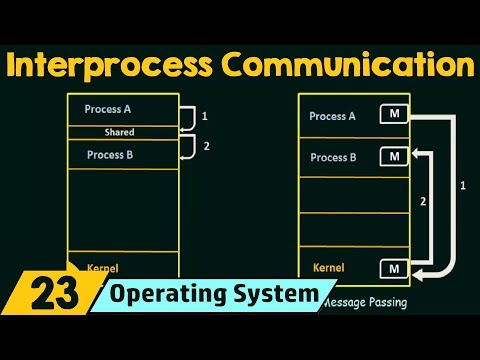
- There are two fundamental models of IPC: shared memory and message passing.
Shared Memory Model
- In the shared memory model, a specific region of memory is established for cooperating processes to share.
- Processes communicate by reading from and writing data to this shared memory region.
- One process writes information into the shared memory, which another process can then read to understand the communication.
Message Passing Model
- The message passing model involves communication through messages exchanged between processes.
- Messages facilitate interaction, allowing processes to send and receive information effectively.
Visual Representation of IPC Models
Shared Memory Communication Model
- Figure A illustrates two cooperating processes (A and B), sharing a common memory region for communication.
- Process A writes information into the shared memory, which Process B reads to comprehend the intended message.
Message Passing Communication Model
- Figure B depicts how messages flow between two processes (A and B), mediated by a kernel.
- When Process A wants to communicate with Process B, it sends a message via the kernel, which delivers it accordingly.
Turn any video into a summary like this
YouTube links, meetings, lectures. With transcripts, search, and chat.