Solución de problemas con Conjuntos | Ejemplo 1
Introduction to the Course
In this section, the speaker introduces the topic of solving problems with sets and explains that they will start with a simple exercise.
Exercise on Sets in a Classroom
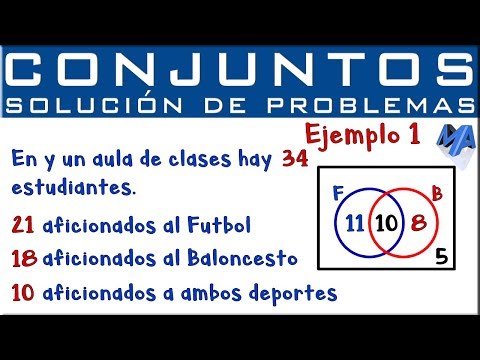
- There is a class with 34 students.
- The universal set represents all the students in the class.
- There are 21 students who are football fans.
- There are 18 students who are basketball fans.
- There are 10 students who like both sports.
Solving the Exercise Using Diagrams
- Represent the universal set as "U" for all students.
- Represent the set of football fans as "F".
- Represent the set of basketball fans as "B".
- Use different colors to differentiate between sets.
Correcting Misconceptions
- Avoid common mistakes such as adding numbers from different sets together.
- The total number of students should be equal to 34.
Recommendations for Problem Solving
- Start by placing values in intersections (students who like both sports).
- Then place values in individual sets (football and basketball fans).
- Double-check that the total number of students matches the given information.
Completing Sets and Checking Accuracy
This section focuses on completing sets and verifying if they have been correctly organized.
Verifying Total Number of Students
- Read through the problem statement again to ensure accuracy.
- Confirm that there are indeed 34 students in total.
Completing Sets
- If there are missing numbers, it means those students do not belong to any specific set.
Final Verification
- Re-read the problem statement and compare it with our completed sets to ensure accuracy.
Understanding the Number of Sports Enthusiasts
In this section, the speaker discusses the number of students who are fans of different sports.
How many students are not fans of any sport?
- There are 5 students who are not fans of either football or basketball.
How many students like only one sport?
- There are 19 students who like only one sport.
- Out of these, 14 students like football only, and 5 students like basketball only.
Exercise for Practice
The speaker presents an exercise for practice related to sets and asks viewers to solve it.
Exercise:
In a classroom, the following information is observed:
- 36 students have books on mathematics and history.
- 42 students have books on mathematics.
- 10 students have books on history only.
The questions to be answered based on this information are:
- How many students are in the class?
- How many students have only one book?
Solving the Exercise
The speaker explains how to solve the exercise presented earlier.
Solution:
- Number of Students in Class:
- Since every student has at least one book, there is no student without a book. Therefore, there are a total of 52 students in the class.
- Number of Students with Only One Book:
- There are 6 students who have only a mathematics book.
- There are 10 students who have only a history book.
The exercise differs slightly from previous examples as it explicitly states that each student has at least one book.