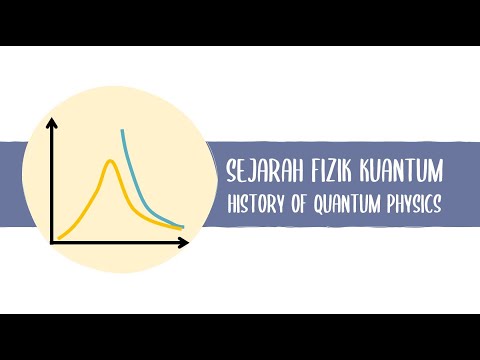
Graf & Jasad hitam (Black body) 7.1: Teori Kuantum Cahaya | Fizik Kuantum (Fizik KSSM Tingkatan 5)
Introduction to Quantum Physics and Scientists
Overview of Scientists in Physics
- The discussion begins with an introduction to various scientists, categorized into those associated with classical physics and modern physics.
- It is noted that exam questions often ask for the names of scientists along with their contributions to the field.
- An example question might involve matching a scientist's name with their contribution, emphasizing the importance of understanding both.
Contributions of Notable Scientists
- A specific scientist mentioned is Broglie, known for his hypothesis regarding wave-particle duality.
Understanding Black Bodies in Physics
Definition and Characteristics
- The term "black body" refers to an idealized object that absorbs all electromagnetic radiation falling on it without reflecting any light.
- A green object is used as an analogy; it absorbs all colors except green, which it reflects. In contrast, a black body does not reflect any light at all.
Emission of Radiation
- Despite absorbing radiation, a black body does not emit anything unless influenced by temperature; it emits thermal radiation based on its temperature.
- The concept emphasizes that while a black body absorbs energy, it can also emit radiation depending on its thermal state.
Graphical Representation in Classical Physics
Graphing Black Body Radiation
- The discussion transitions to how classical physics theorizes about black bodies through graphical representations showing wavelength versus intensity.
Recap of Key Concepts
- A recap includes the relationship between wavelength (λ), frequency (f), and their inverse correlation: higher frequency corresponds to shorter wavelengths.
Classical Physics Predictions
Intensity and Frequency Relationship
- Classical physics posits that as frequency increases, so does the intensity or brightness of emitted radiation from a black body. This relationship is crucial for understanding early theories before quantum mechanics was established.
Understanding Classical Physics vs. Experimental Results
Discrepancies Between Classical Theory and Experimentation
- The discussion begins with a comparison between classical physics theory and experimental results, highlighting that while classical theory predicts an increase in observation with frequency, experiments yield different outcomes.
- The speaker questions the alignment of classical physics predictions with experimental findings, noting discrepancies particularly when observing frequencies at point D.
- It is explained that according to classical physics, lower frequencies correspond to longer wavelengths (lambda), while higher frequencies should correlate with shorter wavelengths.
- A surprising drop in observations is noted despite increasing frequency, indicating a significant deviation from expected results.
- Initial increases in frequency do align with increased observations; however, this trend reverses at ultraviolet (UV) frequencies, leading to confusion among scientists.
Emergence of Quantum Physics
- The unexpected decrease in observations at UV frequencies prompts the introduction of quantum physics as an explanation for these anomalies.
- Quantum physics emerges as a framework to clarify why experimental graphs differ from classical expectations, specifically addressing the behavior observed beyond UV light.
- The essence of quantum physics is described as providing explanations for phenomena that classical theories cannot account for effectively.
Key Takeaways on Black Body Radiation
Understanding Black Body Radiation
- Classical theory posits that intensity increases with frequency; however, experiments reveal this only holds true up until UV light before intensity drops again.
- The term "UV catastrophe" is introduced to describe the shock experienced by scientists upon discovering this phenomenon where intensity decreases unexpectedly at high frequencies.
Graphical Representation and Predictions
- A graph illustrating black body radiation curves demonstrates how theoretical predictions based on classical physics diverge from actual experimental data across various temperatures.
- Observations indicate that as temperature increases, so does the intensity of radiation emitted by black bodies—this aligns with both classical and modern interpretations but highlights limitations within classical frameworks.
Implications of Temperature on Intensity
- Questions arise regarding what happens to radiation intensity as temperature rises; it becomes clear that regardless of theoretical background, increased temperature correlates with heightened intensity levels observed experimentally.
- This relationship emphasizes a fundamental principle: when the temperature of a black body increases, its emitted radiation's intensity also escalates significantly.
Limitations of Classical Theory
Inability to Explain Observed Phenomena
- A critical examination reveals that classical theory fails to accurately explain black body radiation patterns observed experimentally—highlighting its inadequacies compared to emerging quantum theories.
Evidence Against Classical Theory in Black Body Radiation
Key Insights from the Graph
- The graph indicates that classical theory fails to accurately explain black body radiation at high temperatures, particularly when observing the frequency spectrum reaching UV levels.
- As frequency increases, the intensity of radiation decreases contrary to classical expectations; this is a critical observation that challenges classical theories.
- The discrepancy arises specifically at UV frequencies where, despite increasing frequency, intensity does not follow suit as predicted by classical physics.
Max Planck's Contribution
- Max Planck introduced the concept that energy exists in discrete packets called quanta, which fundamentally alters our understanding of energy distribution in black body radiation.
- Planck's assertion emphasizes that energy is not continuous but rather quantized, marking a significant departure from classical physics assumptions.
Understanding Quantum Energy
- The notion of quantized energy suggests that as frequency increases, one would expect an increase in intensity according to classical physics; however, this expectation is contradicted by experimental results.
- While the concept of quanta will be explored further in subsequent lessons, it serves as a foundational idea for understanding why classical theories fail under certain conditions.