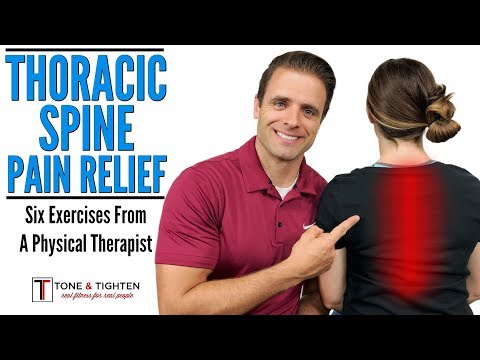
Thoracic Spine Pain | Upper Back Exercises From A Physical Therapist
Upper Back Pain Relief: Effective Home Exercises
Introduction to Upper Back Pain
- Jared Beckstrand, a Doctor of Physical Therapy, introduces himself and the topic of upper back pain relief through home exercises.
- He expresses excitement about sharing knowledge to help viewers alleviate their pain and encourages subscriptions to his channel for more health-related content.
Understanding Spine Mobility and Stability
- Beckstrand emphasizes the importance of spine mobility and stability in managing upper back pain, noting that the spine is designed for high mobility.
- He explains the continuum between mobility (flexibility) and stability (strength), highlighting that both are crucial for spinal health.
- Common issues arise when individuals are either overly mobile without strength or too stable with limited mobility, leading to pain.
Goals for Treatment
- The aim is to achieve a balance between mobility and strength in order to create a healthy, pain-free system.
- Beckstrand plans to share three mobility exercises followed by three stability exercises targeting the thoracic spine.
Thoracic Mobility Exercises
Exercise 1: Thoracic Rotation Stretch
- The first exercise demonstrated involves lying on one side with knees bent high; this position helps isolate movement in the upper back rather than lower back.
- The participant uses their right hand to stabilize their knees while rotating their left shoulder towards the floor, holding for 15–20 seconds.
Advanced Variation
- For an intensified stretch, participants can reach back with their arm during rotation, utilizing body weight for deeper engagement. This should also be held for 15–20 seconds.
Conclusion of Demonstration
Thoracic Mobility and Stability Exercises
Thoracic Extensions Over a Chair
- The second mobility exercise involves thoracic extensions using a sturdy chair, emphasizing safety by avoiding chairs with wheels or that swivel.
- Camille demonstrates the exercise by placing her hands behind her head and extending backward over the chair to achieve a stretch in her back, which may result in pops and cracks for those who are stiff.
- The extension should be held for about three to five seconds, focusing on hinging at the correct point of the back to maximize mobilization.
- Adjusting body position by sliding forward can change where the mobilization occurs, allowing for targeted stretching along different vertebral levels.
- It is recommended to explore various heights on the chair while holding each position for three to five seconds to enhance overall thoracic mobility.
Foam Roller Thoracic Mobilizations
- The final thoracic mobility exercise utilizes a foam roller; it is suggested that individuals acquire one as it significantly aids in improving mobility.
- Camille lies on her back with the foam roller positioned perpendicular to her spine, supporting her head with her arms during the exercise.
- A common mistake is bracing the neck and abs instead of relaxing them; proper technique requires letting go of tension for effective mobilization of the thoracic spine.
- As she rolls on the foam roller, it's crucial not to brace against it but rather allow natural extension through each vertebral segment during movement.
- A timer set for 60 seconds is recommended for rolling up and down about 10 to 15 times, ensuring thorough engagement of thoracic muscles.
Strength and Stability Exercises
Rows with Bands or Cable Machines
- The first strength exercise involves performing rows using bands or cable machines; Camille starts with hands extended in front while bracing her core before pulling back into elbows.
- Emphasis is placed on engaging back muscles rather than biceps during this motion; shoulder blades should squeeze together upon contraction for optimal stabilization of the thoracic spine.
- To incorporate mobility into this stability exercise, single-arm rows are introduced, promoting rotation through both strength training and core engagement.
- This method activates scapular stabilizers while also enhancing thoracic rotation alongside muscle strengthening.
Exercise Techniques for Thoracic Spine Mobility and Stability
Wall Angel Exercise
- The Wall Angel is an effective exercise that requires no equipment, targeting muscles between the shoulder blades to support the thoracic spine.
- Proper positioning involves having the butt, shoulder blades, and back of the head against the wall while keeping feet about 8-10 inches away for easier execution.
- Participants should slide their knuckles up and over their heads and then back down; this movement promotes scapular activation and helps improve posture.
- A timer set for 1 to 2 minutes can be beneficial; initial reps may feel easy but fatigue sets in after multiple repetitions, enhancing muscle strength in the upper back.
Prone W Exercise
- The Prone W exercise focuses on lifting the chest off the floor while tucking elbows into "back pockets," resembling a 'W' shape with arms.
- This exercise encourages scapular retraction, promoting extension through the thoracic spine while activating interscapular muscles effectively.
- It’s important to hold each position (chest up, elbows tucked) for a few seconds to maximize engagement of shoulder blade stabilizers during repetitions.
- Recommended practice includes performing two to three sets of ten reps to enhance strength and stability in the thoracic region.
Conclusion