PLEXO LUMBAR SACRO (DESCARGA la presentación GRATIS)
New Section
In this section, the speaker introduces the topic of the lumbar plexus and sacral plexus, emphasizing their importance in providing innervation to the lower limb. The complexity of these plexuses is highlighted, with a recommendation for repeated viewing to aid understanding.
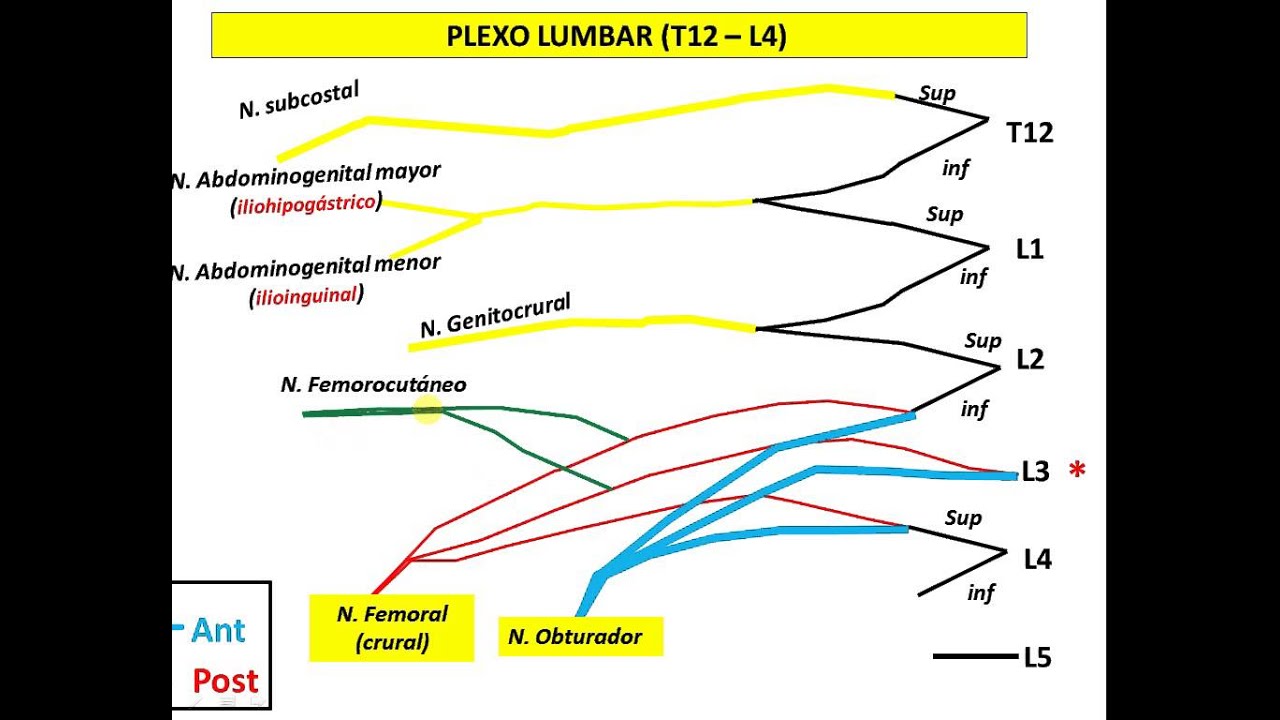
Lumbar Plexus
- The lumbar plexus originates from spinal roots L1 to L4. Each root gives rise to two branches, a superior and an inferior branch.
- Notably, the E3 root does not follow this pattern of division into superior and inferior branches.
- The superior branch of L2-L4 gives rise to the subcostal nerve, while the inferior and superior branches of L1 combine to form nerves such as iliohypogastric and ilioinguinal nerves.
New Section
This section delves into further details about nerve origins within the lumbar plexus, including terminologies and specific nerve formations.
Nerve Terminations
- Anterior and posterior divisions from all roots merge to form terminal nerves: obturator nerve from anterior divisions and femoral nerve (or saphenous) from posterior divisions.
- A collateral nerve arises from posterior branches of L2-L3 known as lateral femoral cutaneous nerve.
- Collaboration between L4-L5 results in the lumbosacral trunk formation.
New Section
Transitioning to discussions on the sacral plexus, this part explores its relationship with the lumbar plexus along with distinctions between anterior and posterior divisions.
Sacral Plexus Formation
- The sacral plexus extends from S1-S4 roots which divide into anterior (celeste) and posterior (rojo) branches.
- Four initial posterior branches unite while five anterior ones converge differently.
- Noteworthy names include sciatic (posterior), common peroneal/fibular (external), tibial (internal), forming a significant thick nerve - sciatic.
New Section
Focusing on ramifications within the sacral plexus, this segment elaborates on collateral nerves originating from different root combinations.
Nerve Branches
- Three initial posterior branches give rise to superior gluteal nerve while last three form inferior gluteal or pudendal nerves.
- Emanating from S2 is a minor branch serving piriformis muscle aiding in gluteal region reference for structures above/below it.