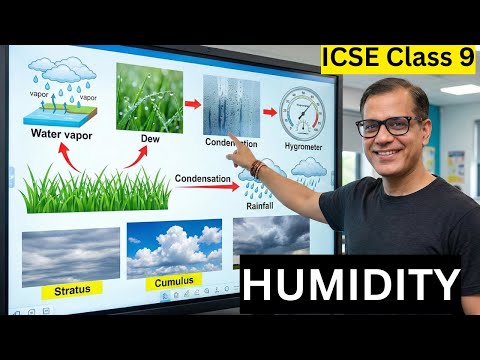
HUMIDITY ICSE Class 9 | Humidity Geography | Class 9 ICSE | @sirtarunrupani
Introduction to Humidity
Overview of the Session
- The speaker welcomes students back to the channel, emphasizing their role as a mentor and support system for Class 9 ICSC students.
- The focus of today's session is on the geography chapter about humidity, aiming for clarity in understanding this concept.
Definition and Importance of Humidity
- Humidity is defined as the amount of moisture present in the air, which significantly affects comfort levels in our environment.
- The speaker uses an air conditioner as an example to illustrate how it reduces moisture from warm air, thereby cooling a room and dehumidifying it.
Understanding Humidity Levels
Water Vapor Content
- Humidity varies based on location; approximately 1% water vapor is typically present in the air, influencing body conditions and climate.
- Dry air can absorb more moisture compared to humid air; thus, deserts have drier conditions that allow for greater evaporation. Conversely, areas with heavy rainfall have high humidity levels.
Factors Affecting Evaporation
- Evaporation refers to water turning into vapor; its rate depends on several factors:
- Humidity: High humidity limits additional water vapor absorption by the air.
- Heat: Higher temperatures increase evaporation rates due to more available energy for conversion from liquid to vapor.
- Wind: Strong winds enhance evaporation by increasing the capacity of air to hold moisture.
Types of Humidity
Absolute vs Relative Humidity
- Absolute Humidity: This term refers to a fixed measurement of water vapor held by air at a specific temperature and volume (e.g., at 20°C).
- Relative Humidity: It compares absolute humidity against maximum possible water vapor capacity at that temperature, indicating how saturated the air is with moisture. Understanding this helps gauge comfort levels effectively.
Impact of Humidity on Comfort
Effects on Human Body and Environment
- High humidity can lead to discomfort; individuals may feel oppressive or sticky due to excess moisture in the atmosphere affecting perspiration processes.
- When humidity is high, sweat does not evaporate efficiently from our bodies, leading to feelings of warmth and irritability instead of cooling relief through perspiration.
This structured overview provides insights into key concepts related to humidity while linking directly back to specific timestamps for further exploration within the video content.
Understanding Moisture Measurement and Condensation
Introduction to Hygrometers
- The concept of measuring moisture is introduced, highlighting the use of a device called a hygrometer, specifically the wet and dry bulb hygrometer.
- The hygrometer consists of two bulbs: one dry bulb containing mercury and another wet bulb attached to a water container.
Basics of Evaporation and Condensation
- A relatable analogy is made using tea preparation, where steam rising from boiling tea represents water vapor.
- The process of condensation is explained through an example involving placing a steel plate over rising water vapor, causing it to revert back to liquid form.
Mechanism of Condensation
- Condensation occurs when water vapor cools down, reversing the evaporation process by converting vapor back into liquid.
- During condensation, latent heat from the water vapor is released into the air; this can only happen when air becomes saturated with moisture.
Saturation and Absolute Humidity
- An explanation follows regarding how temperature affects air's capacity to hold moisture, introducing the concept of absolute humidity.
- If temperature decreases (e.g., from 25°C to 20°C), the air can hold less moisture, leading to some water vapor condensing back into liquid.
Conditions for Condensation
- For condensation to occur in the atmosphere, there must be existing moisture (water vapor).
- Additionally, tiny particles (referred to as "minuscule") are necessary for water vapor to condense upon; these could be dust or salt particles.
Role of Dew Point in Condensation
- The dew point temperature is crucial; condensation will not occur unless temperatures drop below this point.
Real-Life Examples of Evaporation and Condensation
- Everyday examples illustrate that evaporation and condensation are constantly happening around us without our awareness.
Formation of Clouds
- Water droplets in grass or bodies of water evaporate continuously; lighter water vapor rises due to its buoyancy.
Cloud Saturation and Rainfall
- Clouds become fully saturated at 100% humidity. When they reach this saturation point, they release precipitation as rain.
Temperature Effects on Air Movement
- Warm moist air rises because it expands. As it ascends higher into cooler regions of the atmosphere, it eventually cools down enough for condensation processes to begin.
Understanding the Formation of Clouds and Precipitation
The Role of Dust Particles in Water Formation
- Dust particles serve as condensation nuclei, essential for water vapor to condense into liquid water. This process continues until 100% moisture saturation is achieved.
- Without these nuclei, clouds cannot form, leading to no precipitation. The presence of mini particles is crucial for cloud formation.
Conditions Necessary for Cloud Formation
- In a vacuum devoid of air or moisture, cloud formation is impossible. For instance, the Moon lacks an atmosphere and thus does not experience rain.
- When condensation occurs on these nuclei, water vapor transforms into liquid water until it reaches a saturation point where it can no longer absorb more moisture.
Types of Clouds
- Various types of clouds exist in the sky:
- Cirrus Clouds: High-altitude clouds that do not cause significant rain but provide shade.
- Cumulus Clouds: Common during monsoon; they are dense and resemble cauliflower shapes, often associated with rainfall.
- Stratus Clouds: Layered clouds that stack upon one another.
Dew Formation Process
- Dew forms when temperatures drop and surrounding water vapor condenses on cooler surfaces.
- An experiment with ice cubes in a glass demonstrates this condensation process visually by showing droplets forming outside the glass due to temperature differences.
Effects of Temperature on Water Vapor
- Condensation requires nucleation; surfaces like a cold glass act as nucleation sites for dew formation.
- If temperatures fall below freezing (0°C), dew drops can freeze into frost, creating small ice crystals that can damage plants.
This structured overview captures key concepts regarding cloud formation and precipitation processes while providing timestamps for easy reference.
Cold Age Frost and Types of Condensation
Understanding Frost and Fog
- The term "frost" refers to harmful effects on plants, known in Hindi as "पाला पड़ना."
- Fog is defined as water vapor condensing into droplets that descend from clouds, becoming visible near the ground.
- When air temperature drops below the dew point due to cold land, moisture condenses and becomes fog or "कोहरा," which can hinder visibility while driving.
- If fog density is low, it is referred to as mist; high density results in limited visibility.
Precipitation Explained
- Precipitation encompasses any form of water returning to Earth, including rain, snow, and drizzle.
- Drizzle describes light rain with small droplets falling slowly over time.
- Snow occurs when water droplets freeze at temperatures below zero degrees Celsius, forming soft ice particles.
Distinguishing Between Snow and Hail
- Snow consists of microscopic ice particles that fall softly in cold climates like high mountains.
- Hail differs from snow; it comprises larger solidified ice chunks that can cause significant damage upon impact.
Types of Rainfall
Relief Rainfall
- Relief rainfall (orographic rainfall) is common during monsoon seasons and requires proximity to a water body near mountains for formation.
- Moisture-laden winds rise over mountains, leading to cloud formation primarily on the windward side where maximum rainfall occurs.
Windward vs. Leeward Sides
- The windward side receives abundant moisture while the leeward side experiences a rain shadow effect with minimal precipitation.
Conventional Rainfall
- Conventional rainfall occurs in regions with high temperatures such as the equator, characterized by intense heat leading to rapid evaporation and subsequent condensation.
Understanding Rainfall Patterns
High Temperature and Water Vapor
- High temperatures cause water vapor to rise, leading to cloud formation. This process is crucial for daily rainfall patterns, particularly in equatorial regions.
- The phenomenon of heavy rain at around 4 PM is common due to the accumulation of moisture throughout the day, often referred to as "4 o'clock showers."
Characteristics of Equatorial Regions
- Countries located near the equator experience consistent rainfall, contributing to their unique climate and biodiversity. Residents in these areas often have darker skin tones due to prolonged sun exposure. Examples include countries like Congo and Niger.
Cyclonic and Frontal Rain
- Cyclonic and frontal rains are caused by weather systems such as cyclones and depressions. Warm air rises from the heated ground while cold air sinks, creating boundaries known as fronts.
- Warm air is lighter and expands upward, whereas cold air is denser and moves downward, resulting in distinct weather patterns at their intersection (front). This interaction leads to cloud formation when warm air condenses above cold air.
Understanding Weather Fronts
- The boundary between warm and cold air masses creates fronts where significant weather changes occur; this includes cyclonic or frontal rain events that are more prevalent in cyclone-prone areas. Understanding these dynamics helps explain various precipitation types across different climates.
Conclusion of Humidity Chapter
- The discussion wraps up with a reassurance that diagrams related to humidity will be shared later for better understanding. Viewers are encouraged to revisit earlier parts of the video if they missed any content for comprehensive learning. Notes will also be made available on a Telegram channel for further study support.