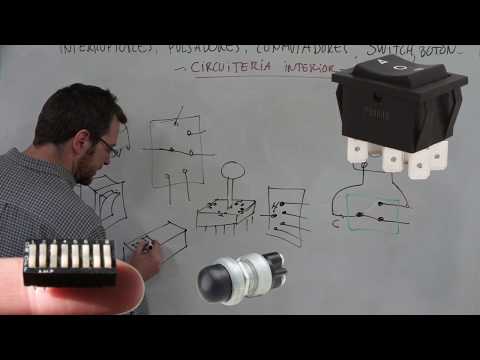
¿Cómo sé el patillaje de un interruptor, pulsador, conmutador...?
Understanding Switches and Multimeters
Basics of Switches
- The speaker discusses the simplicity of switches, emphasizing their functionality and how to wire them correctly.
- A specific type of switch is introduced, referred to as a "humutador," which has three terminals. The speaker prompts for identification of these terminals.
Testing with a Multimeter
- The use of a multimeter is explained; it beeps (or "pita") when testing connections in switches. This indicates whether the circuit is complete or open.
- Demonstrates testing two states of a switch using the multimeter, showing that one terminal beeps while another does not, indicating different states.
Understanding Circuit States
- The internal wiring of switches is discussed, explaining how certain configurations allow for continuity (beeping) while others do not.
- Introduction to push-button switches ("pulsadores"), highlighting their typical design and function—normally open until pressed.
Types of Push Buttons
- Explains the operation of push buttons with four terminals, where pressing connects specific pairs while others remain disconnected.
- Clarifies that some push buttons are normally open and only conduct electricity when pressed.
Advanced Switch Types
- Discusses double-pole switches and their configurations, emphasizing versatility in electrical circuits.
- Introduces SPST (Single Pole Single Throw), describing its common usage in various applications like elevators and machinery.
Final Thoughts on Sensors and Magnetic Switches
- Mentions end-of-travel switches used in elevators that prevent accidents by stopping at designated points.
- Describes magnetic sensors that activate based on proximity to magnets, illustrating their application in security systems.
Joystick Functionality and Design
Overview of Joystick Mechanics
- The speaker discusses the basic mechanics of joysticks, emphasizing that they are fundamentally just contact points or "busadores" that allow for input.
- A joystick is described as having multiple contact points, which can be positioned in various configurations to facilitate user interaction.
- The complexity of joystick designs is highlighted, mentioning variations such as those with four or eight contacts, indicating a range of functionalities.
- Different types of switches used in joysticks are noted, including common interruptors and SMD (Surface-Mount Device) types, showcasing the diversity in joystick technology.
Turn any video into a summary like this
YouTube links, meetings, lectures. With transcripts, search, and chat.