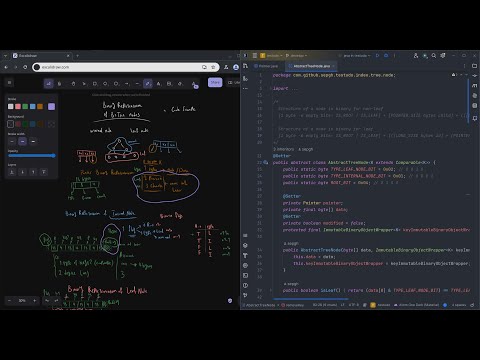
Write a database from scratch | Episode 4, B+Tree node binary representation
Understanding Binary Representation of B+ Tree Nodes
Types of B+ Tree Nodes
- The video introduces the concept of B+ tree nodes, which can be classified as either internal nodes or leaf nodes.
- In a B+ tree of degree four, each internal node contains three keys, with pointers to child nodes on either side.
- Leaf nodes in a degree four tree also have three keys but point directly to data locations on disk.
Pointer Binary Representation
- Pointers can either reference another node (internal nodes) or point to data on disk (leaf nodes).
- A pointer's binary representation consists of 13 bytes: 1 byte for type, 8 bytes for position (long), and 4 bytes for chunk (integer).
- Including a version flag in binary representation is recommended for future parsing needs; however, it is not used in the current implementation.
Pointer Class Structure
- The pointer class includes attributes for type, position, and chunk size; its total size is calculated based on these components.
- The first byte indicates whether the pointer references data (flag = 1) or a node (flag = 2).
Internal Node Representation
- Internal node representation begins with a flag byte indicating if it's root and its type (leaf/internal).
- Key types must be comparable; if using integers as keys in a degree-three tree, each key takes up four bytes.
Bitwise Flags Concept
- Bitwise flags are utilized to represent different properties of nodes: root status and type (leaf/internal).
- Various combinations of bits indicate specific characteristics such as being an internal node that is also a root.
Abstract Node Class Implementation
- An abstract class represents B+ tree nodes generically with comparable key types.
- Methods within this class utilize bitwise operations to check flags and determine node types efficiently.
Leaf Node Binary Representation
- Leaf node binary representation mirrors that of internal nodes but starts directly with the first key instead of pointers.
- Each key in leaf nodes pairs with pointers leading to data locations; padding may be included at the end for alignment purposes.
Conclusion & Next Steps
- Future videos will cover reading/writing binary data on disk and further explore positions and chunks within pointers.
Turn any video into a summary like this
YouTube links, meetings, lectures. With transcripts, search, and chat.