Potencial de Ação Cardíaco, Animação. Alila Medical Media Português
Heart Contraction and Electrical Activity
This section discusses the basic functioning of the heart, focusing on muscle contraction and electrical impulses.
Heart Muscle Contraction
The heart is a muscle that contracts and pumps blood. It consists of specialized muscle cells called cardiac myocytes.
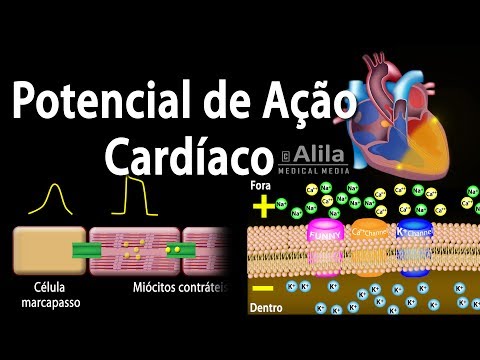
Contraction is initiated by electrical impulses known as action potentials, starting from a group of cells called pacemaker cells in the sinoatrial node.
Pacemaker cells generate spontaneous action potentials that spread to the contractile myocytes of the atria through gap junctions.
Pacemaker Cells and Action Potentials
Pacemaker cells in the sinoatrial node fire around 80 action potentials per minute, initiating heartbeats without a true resting potential.
Voltage starts at -60mV, moves spontaneously upwards to -40mV due to "funny" currents unique to pacemaker cells, leading to depolarization known as pacemaker potential.
At threshold, calcium channels open, allowing calcium ions to flow in, further depolarizing the membrane and causing an upward phase.
Cardiac Action Potential Phases
This section explains the phases of cardiac action potentials in detail.
Phases of Cardiac Action Potential
The upstroke involves calcium channels opening at threshold, leading to more depolarization. Potassium channels then open at peak repolarizing the cell back to -60mV.
Contrary to pacemaker cells, contractile myocytes have different ion channel sets for their stable resting potential of -90mV.
Role of Calcium in Muscle Contraction
Discusses how calcium plays a crucial role in linking electrical excitation with physical muscle contraction.
Calcium's Role in Muscle Contraction
Sarcoplasmic reticulum (SR) stores abundant calcium and contains myofibrils critical for contraction initiation upon stimulation.