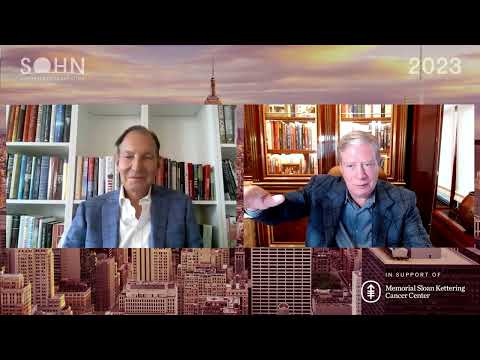
Sohn 2023 | Kiril Sokoloff in conversation with Stanley Druckenmiller
Introduction
The introduction covers the corporate sponsor Tegus and their offer to source a custom expert call for anyone in the audience. It also introduces Stan Druckenmiller, who is being interviewed by Carol Sokoloff.
Tegus Corporate Sponsorship
- Tegus has offered to source a custom expert call for anyone in the audience.
- The calls can be accessed at tegus.com.
Introduction of Stan Druckenmiller
- Stan Druckenmiller is introduced as the founder CEO and chairman of the Duquesne family office.
- He is known as one of the most successful and legendary investors of all time with an incredible investing track record across decades and through a variety of market environments.
Interview with Stan Druckenmiller
This section covers Carol Sokoloff's interview with Stan Druckenmiller, where they discuss his thoughts on macro predictions, U.S recession, credit contraction issues, real estate crisis in commercial real estate regional banks, and more.
Macro Predictions
- Carol Sokoloff asks about Stan's prediction that the U.S recession would arrive in late 2023 or early 2024.
- However, he recently brought forward his recession forecast due to anecdotal information from CEOs he talked to regarding problems in trucking, retail, credit contraction issues.
- He believes that the consensus of a soft landing is very unlikely and rates the probabilities of a hard landing as high after 11 years of monetary stimulus in U.S history.
Real Estate Crisis
- Edward Chancellor's book "The Price of Time" describes how every time interest rates have been below two percent going back 500 years it has generally been followed with difficult economic times.
- Stan Druckenmiller believes that the developing real estate crisis in commercial real estate regional banks, which have 33 percent of their allowance in that sector, and the bursting of the everything bubble are part of the current menu.
Monetary Policy
- Stan Druckenmiller believes that Jerome Powell's Fed continued to buy $120 billion dollars a bond a month while rates were increasing was surprising.
- He was not surprised by inflation reaching nine percent or specs going crazy, Bitcoin going crazy, Dogecoin going crazy, equities going crazy.
Conclusion
The conclusion covers Stan Druckenmiller's thoughts on economic forecasting and how it is not an exact science. He also talks about his observations on asset bubbles and how they tend to follow the worst economic outcomes.
Economic Forecasting
- Stan Druckenmiller says that he has been doing economic forecasts for 45 years and this is easily the most challenging period he has had to make confident forecasts.
- He qualifies anything he says as not being as much confidence as he would usually have since momentum coming out of COVID is uncertain.
Asset Bubbles
- Edward Chancellor's book "The Price of Time" describes how every time interest rates have been below two percent going back 500 years it has generally been followed with difficult economic times.
- Stan Druckenmiller observes that asset bubbles tend to follow the worst economic outcomes.
Economic Outcomes and Asset Bubbles
In this section, the speaker discusses the negative economic outcomes that tend to follow asset bubbles and how businesses should not fight against the Federal Reserve.
Asset Bubbles
- Too easily engineered asset bubbles lead to the worst economic outcomes.
- The speaker is staring at the biggest and broadest asset bubble he has ever seen or studied, which has been ongoing for 10-11 years.
Business and Federal Reserve
- Businesses should not fight against the Federal Reserve.
Soft Landing vs Hard Landing
In this section, the speaker talks about soft landings versus hard landings in economics.
Soft Landings
- Historically, housing tends to lead soft landings and is currently robust.
- Travel, restaurants, etc., are also fairly robust.
Proactive Fed Policy
- All soft landings since 1950 were preceded by proactive Fed policy.
- Uncertainty exists regarding whether there will be a soft landing or a hard landing due to timing difficulties.
Anecdotal Information
- The speaker's firm uses anecdotal information frequently.
- Trucking is extremely weak with bad anecdotes from retail.
- Banking problems are emerging with free money leading people to do stupid things for 11 years.
- Regional banks have loans in commercial real estate with high vacancy rates due to lifestyle changes caused by COVID.
- Timing suggests Q3-Q4 of 2021 through Q1 of 2024 for a hard landing but recent anecdotes suggest it may have started in Q2 of 2021.
Hard Landing Risks and Implications
In this section, the speaker discusses the risks and implications of a hard landing in economics.
Hard Landing Definition
- A hard landing encompasses a 20%+ decline in corporate profits with an emphasis on the plus.
- Unemployment will likely increase from 3.4% to above 5%, and bankruptcies will increase.
- Bankruptcies are astonishingly low given that we've been in one of the most disruptive economic periods since the 1880s.
Inflation or Deflation
- The speaker is unsure whether there will be inflation or deflation due to recent events.
- Two years ago, he was confident that inflation would occur.
Money Supply and Inflation
The speaker discusses the money supply and inflation, predicting that inflation will come down to 3-3.5% in the next 6-9 months. However, he warns that it is difficult to predict what the FED will do once this happens, and there is a risk of stagflation or an asset bubble burst.
Money Supply
- The money supply has rapidly shrunk, but it grew around 40% a few years ago so the stock of money is still high.
- There is still a lot of liquidity out there with excess deposits and savings.
- It's difficult to time when inflation will come down due to long and variable lags.
Inflation Predictions
- Inflation will probably come down into the 3-3.5% range in the next six to nine months.
- If the FED doesn't act like Arthur Burns when inflation goes down to 3-3.5%, there could be an inflationary environment or even stagflation in a few years.
- There is a possibility that they can't put Humpty Dumpty back together again if there's an asset bubble burst.
Risk Management for Hard Landing
The speaker talks about how as a risk manager, he needs to consider all possibilities for a hard landing scenario. He mentions how basic industry stocks held up well during previous hard landings, but reducing exposure to commodities may not always work.
Asset Classes During Hard Landing
- Basic industry stocks went flat during previous hard landings but soared once the FED started cutting rates.
- Commodities and commodity equities, especially oil, held up well during the early 2000s internet bubble burst.
- It's important to evaluate exposure to different sectors and consider historical events or market actions that may affect them.
Investment Opportunities in a Hard Landing
In this section, the speaker discusses potential investment opportunities during a hard landing scenario.
Copper
- Copper is in the tightest position the speaker has ever studied.
- The move towards electric vehicles and infrastructure spending could make copper a huge beneficiary.
- It's hard to believe copper won't be a huge beneficiary, but it's uncertain when to buy and how big of an exposure to take.
U.S. Housing Industry
- Housing has gone down dramatically due to interest rate increases.
- However, there is a structural shortage in single-family homes going into this.
- If things got bad enough, housing could be a big beneficiary on the way out.
Biotech and AI
- Biotech has been an underperformer in the last three to five years, but there are tremendous things going on in cancer and other areas.
- AI could be every bit as impactful as the internet going forward and could be a beautiful opportunity in a hard landing.
- Nvidia and Microsoft are companies that benefit from AI.
Gold and Silver
- The speaker currently owns gold and silver despite their historical poor performance during hard landings.
- Given that monetary and fiscal authorities are at the end of their rope, betting against history may pay off.
Independence of the Fed
In this section, the speaker discusses whether or not he thinks the independence of the Federal Reserve is in jeopardy due to recent economic events.
- The speaker believes that while there is risk to the Fed's independence, it will likely survive.
- There is a 5% to 10% chance that if things get really bad with a hard landing scenario, people may look back at the Fed's record over the last five decades and question its independence.
The Possibility of a Hard Landing and the Independence of Central Banks
In this section, the speaker discusses the possibility of a hard landing and how it could affect central banks' independence.
Hard Landing and Central Bank's Independence
- The speaker believes that if there is a hard landing, people may say that central banks over-adjusted and were wrong again. This could lead to attacks on their independence.
- Despite this, the speaker hopes and believes that central bank independence will survive. However, he acknowledges that it is not an unreasonable question to ask.
Government Stimulus in a Recession
In this section, the speaker talks about what the government can do in terms of stimulus during a recession.
End of Credit Cycle
- The speaker wonders if it is possible that we have seen the end of the credit cycle and there are no more balance sheets left to right.
Fiscal Challenges in Stimulating During Recessions
In this section, the speaker discusses fiscal challenges when trying to stimulate during recessions.
Limited Room for Monetary or Fiscal Front Movement
- The speaker notes that we come into this with fiscal challenges completely unlike any time before. There is not much room for movement on either monetary or fiscal fronts in a reasonable manner compared to other cycles because we wasted all our bullets during economic expansion periods.
- Balance sheets particularly governments were nowhere near in the situation they're in now so there's not much room for movement on either monetary or fiscal fronts as compared to other cycles where there was more room for movement.
Possibility of Printing Money
In this section, the speaker talks about the possibility of printing money.
Government Can Print Money
- The government can always print money and try to stimulate the economy. However, the speaker notes that Japan tried everything and it didn't work. The question is whether we are there yet. The answer is he hopes not.
Concerns About Fiscal Situation
In this section, the speaker expresses his concerns about the fiscal situation.
Point of No Return?
- The speaker would never categorically say that we have passed a point of no return. However, he was worried about our fiscal situation 12 years ago and went out to convince young people on a college tour of what lay ahead of us. He was worried about the 2025 to 3035 period because of demographics and what might happen with interest expense. Since then, things have been worse than he ever imagined so he is concerned but does not want to go quite as far as Edward Chancellor who said we had passed the point of no return.
Navigating Tricky Markets
In this section, the speaker talks about how to navigate tricky markets.
Concentrated Bets
- The speaker likes concentrated bets where there are fat pitches and then swings big when they see them. If there are no fat pitches, they stand there and let them go by. Two years ago at 15 basis points with money growing at 40 percent supply growing at 40 percent was a fat pitch with risk reward being maybe if you're dead wrong two-year yield goes from 15 basis points to 10 basis points but if you're right it could go up to 200 or even higher than that which happened in reality when it went up to 500 in a year. However, the speaker does not see a pitch like that out there right now.
- The speaker was very negative on the stock market but we have come a long way. He is afraid of the authorities and if he liked the stock market, he would be exposed but he is not exposed to it. His advice to a long-short hedge fund is to keep your gross low, be open-minded, and wait for opportunities that will present themselves during hard landings. There are going to be unbelievable opportunities and he does not want to miss those opportunities by blowing his money now and having some 20 or 30 percent loss where his head is all screwed up when those opportunities present themselves so he's happy.
Fed Funds and US Fiscal Situation
In this section, the speaker discusses the Fed funds and the US fiscal situation.
Fed Funds
- The speaker believes that investing in Fed funds is not a good option due to the possibility of being wrong and an inflationary outcome.
- The speaker clarifies that he does not have a massive short dollar position, but it is a position that will move the needle at his firm.
US Fiscal Situation
- The speaker talks about the third-largest deficit in history during Q1 2021, which exceeded only by the coveted quarter and TFC.
- He expresses concern about what happens in a recession or hard landing can be deficit, and how federal debt is running out of 600 billion annual rate even during 2018 when unemployment hit a 50-year low.
- The speaker mentions that entitlements plus net interest will cost 100% of taxes in 2040.
Entitlement Expenses
In this section, the speaker discusses entitlement expenses.
- The speaker expresses concern for years has been next ability of this entitled expense.
- By some estimates, the present value of undefined government liabilities is its highest $200 trillion.
- One CEO study shows that entitlements plus net interest will cost 100% of taxes in 2040.
- He emphasizes that we are absolutely going to cut entitlements in this country; it is a lie and fantasy to say we don't have to cut them.
Debt Ceiling Debate
In this section, the speaker talks about debt ceiling debate.
- The speaker hopes there won't be technical default as it would be stupid and market event problem.
- He compares all the talk about the debt ceiling to sitting on the Santa Monica Pier and worrying about it being damaged while a 200-foot tsunami is coming.
- The speaker expresses concern that Republicans have given the Biden Administration the debt ceiling to even talk about because it enables them to talk about responsibility.
- He emphasizes that all this focus on the debt ceiling is depressing, and it's not a hard choice to cut entitlements now or later.
The Fiscal Gap
In this section, the speaker talks about the concept of fiscal gap and how it relates to the United States' current economic situation.
The Fiscal Gap
- The fiscal gap is the amount of taxes that would need to be raised today to maintain promised entitlements for future seniors.
- In the United States, the fiscal gap is 7.7% of GDP.
- To fix this situation without touching entitlements, taxes would have to be raised by 40% tomorrow morning or spending cut by 35%.
- France's fiscal gap is only 2.4%, less than a third of that in the US.
The Curse of Reserve Currency
In this section, the speaker discusses reserve currency and its privileges and drawbacks.
Reserve Currency
- A reserve currency allows a country to run myopic policies that don't address long-term issues because markets don't check them.
- This privilege enables countries to behave recklessly until consequences come to bear.
- When Britain tried to do fiscal stimulus with mistrust, the market immediately shut them down and they went back to more responsible governance.
- The curse of reserve currency refers to how it allows countries to keep digging their own grave until they are buried under debt.
Misallocation of Resources
In this section, the speaker talks about his concerns regarding misallocation of resources due to free money policies.
Misallocation of Resources
- Free money policies led to a massive misallocation of resources.
- Pricing for borrowing risky borrowers was at ridiculously low rates that did not reflect risk.
- There will eventually be bankruptcies as a result, but it remains unclear whether governments will support everything or if there is a limit.
The Existential Question of Our Time
In this section, the speaker discusses the possibility of a hard landing and whether creative destruction and capitalism will be allowed to do its thing.
Creative Destruction vs. Monetary Stimulus
- The speaker believes that if we allow creative destruction and capitalism to do its thing, there may be near-term consequences but it could lead to a revival of what made America great for 200 years.
- On the other hand, if we continue with more monetary stimulus and debt like Japan has done, we may end up in a permanent malaise.
Volcker's Recession
- The speaker recalls how Volcker intentionally threw the US into a recession in 1982 by raising rates to 20%. This led to a big increase in unemployment but ultimately helped clean up our act.
- Even politically, Reagan won 49 states in 1984 after taking the pain of the recession.
Precarious Moment
- It's hard to imagine any politician having the guts to allow creative destruction going forward given our political history and divisiveness. If a Federal Reserve chairman tries it, their independence could be threatened. We're in a precarious moment.
Tough Choices Ahead
In this section, the speaker talks about tough choices ahead for investors.
Liquidate Labor & Capital?
- The speaker references Andrew Mellon's famous statement from the early '30s - "liquidate labor liquidate capital urge The Rock from the system" - and wonders if we have the courage to follow through on such tough choices even though Mellon was vilified for his statement.
- Depression would be a horrible price to pay, but America did okay after the '30s ended. Tough choices lie ahead.
Opportunities Ahead
- Even if the market is flat for the next 10 years, there will still be opportunities for investors. The speaker believes that applications made on top of model builders in AI could lead to 100 billion dollar companies emerging. AI could be as impactful productivity-wise as the PC was for all the technology we've had so far.
Stocks Being Higher in 10 Years?
- When looking at markets at 20 times earnings, high margins, fiscal challenges, and squeezing of private investment, it's hard for the speaker to envision stocks being higher in 10 years. However, he is bullish for the long term and hopes people don't buy and hold thinking they'll make nine percent a year in the next 10 years.
MBs as the Most Popular Leader in the Middle East
In this section, the speaker discusses how Mohammed bin Salman (MBs) is the most popular leader in the Middle East and how this could impact geopolitics.
MBs' Popularity and Geopolitical Significance
- MBs is considered to be the most popular leader in the Middle East.
- The speaker believes that isolating Saudi Arabia was a mistake by the US administration.
- MBs is trying to make himself a hegemony in the Middle East by building an autocratic block within it.
- The speaker thinks that discouragement towards the US is not so much towards America but rather towards Biden's administration.
- It's imperative for America to get back on good terms with Saudi Arabia since he will be in power for 40 or 50 years.
Raising Extraordinary Daughters and Transferring Wealth
In this section, the speaker talks about raising his daughters and transferring wealth without generating entitlement.
Raising Extraordinary Daughters
- The speaker attributes his success at raising three extraordinary daughters to luck and marrying someone who was intelligent with great values.
- He advises young people to spend quantity time with their children instead of quality time because all time spent with them is quality time.
- His wife gave up her job to raise their children, which helped them become grounded overachievers.
Transferring Wealth
- The speaker and his wife had different views on how to handle their wealth with their children.
- His wife was the boss in terms of household decisions, which helped them raise happy and successful children.
- The speaker believes that he has been fortunate to live the American dream and attributes his success to being good at compounding money.
Philanthropy and the American Dream
In this section, the speaker talks about his philanthropic work and how he has been fortunate to live the American dream.
Philanthropy
- The speaker is involved in many different philanthropic endeavors.
- He is particularly excited about the "place matters" space, which focuses on changing disadvantaged neighborhoods to increase economic mobility.
- Cancer research is another area of focus for him, specifically personalized medicine and immunotherapy.
- The speaker also funds basic research in neuroscience and neurology.
- Lastly, he mentions his interest in environmental issues but expresses disappointment with the current top-down approach.
Living the American Dream
- The speaker considers himself lucky to have lived and continue living the American dream.
- He believes that if he wasn't happy, it would be bizarre given his fortunate circumstances.