The Waggle Dance of the Honeybee
How Do Honeybees Communicate the Location of Food?
The Behavior of Honeybees
- Aristotle documented honeybee behavior, noting how colonies coordinate worker activities, suggesting intelligent behavior in what seems like random swarming.
- Foraging honeybees discover food sources individually, raising questions about their communication methods to share this information with others.
Experiments by Carl von Frisch
- Austrian biologist Carl von Frisch conducted experiments in the 1940s to explore honeybee communication; modern researchers at Georgia Tech replicated these studies.
- In a two-feeder experiment, bees were marked with different colored paints to track which feeder they visited and observe their dance patterns upon returning.
Dance Language of Bees
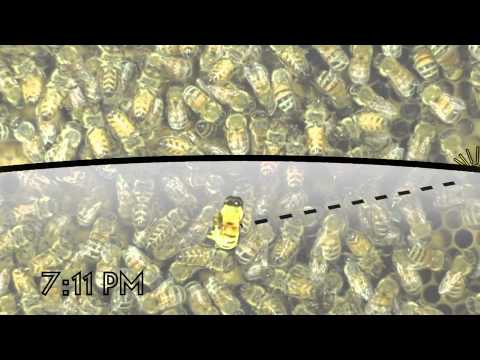
- Returning bees perform a figure-eight dance that varies based on the feeding source; the orientation of their dances correlates with the angle between feeders and hive.
- The angle of rotation in their dance provides clues about food location, revealing a complex grammar within honeybee communication.
Tools for Navigation
- Honeybees utilize ultraviolet and polarized light to determine the sun's position, even under cloudy conditions; this acts as a solar compass for navigation.
- Their internal clock allows them to adjust for the sun's movement throughout the day, enabling accurate navigation even after being inside a dark hive.
Communication Mechanism
- Bees use gravity as a reference point for direction (up/down), pairing it with solar positioning to create a simple language indicating where to find food.
- The angle of a bee's dance indicates direction relative to the sun; duration reflects distance—longer dances mean further distances while shorter ones indicate proximity.
Information Encoding in Dance
- The central waggle section of the dance conveys distance information: one second longer per kilometer away from food. Close food results in circular dances.
- Distance is also influenced by environmental factors like wind; thus, bees may adjust their dance based on energy expenditure during travel.
Future Research Directions