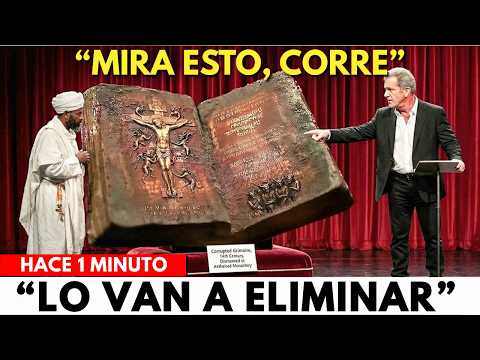
Se Publica una Página PROHIBIDA de la Biblia Después de 2000 Años | Mel Gibson
The Hidden Manuscript: A Revelation on Christianity
Mysterious Package and Its Contents
- A package received six months ago contained a note urging to "Read it before it disappears," alongside high-resolution photographs of an ancient manuscript in goat skin parchment, written in Ge'ez, the sacred liturgical language of the Ethiopian Church.
- The package also included a three-page typewritten English translation, suggesting the sender aimed to avoid leaving a digital trace. This prompted an investigation by the research team for a film project titled "The Resurrection of Christ."
Authenticity and Historical Significance
- After two weeks of verification, the findings revealed that the manuscript's contents posed a significant threat to the official narrative of Christianity, indicating efforts would be made to suppress this information.
- The speaker emphasizes that much of what is known about resurrection is incomplete due to historical omissions; entire chapters have been removed from accepted texts that fundamentally alter understanding.
Alternative Biblical Texts Preserved in Ethiopia
- Unlike Western versions concluding with an empty tomb, Ethiopian monks safeguarded an ancient Bible containing 81 books—15 more than Protestant and 8 more than Catholic Bibles—preserving texts not read or preached in Europe.
- These additional texts include significant writings like Enoch and Jubilees, which were revered by early believers but later dismissed as primitive myths by Western scholars.
Scientific Validation and Historical Context
- Carbon dating of manuscripts from Garima monastery indicates they were created between 330 and 650 CE, making them some of the oldest illustrated Christian manuscripts known today. While Europe faced chaos post-Roman Empire collapse, Ethiopian monks preserved original Christian codes.
- The Book of Enoch details humanity's transgressions before the flood and introduces concepts such as cosmic disruptions caused by beings called Watchers who descended from heaven with knowledge that accelerated human civilization's development beyond its natural course.
Knowledge Transfer from Watchers
- The Watchers are described as having taken human wives and produced hybrids (Nephilim), leading to societal violence; however, their most disturbing act was imparting forbidden knowledge across various fields including weaponry, cosmetics, astrology, meteorology, geology, and lunar cycles. This knowledge significantly advanced civilization unexpectedly.
- Their actions are framed not merely as disobedience but as unauthorized knowledge transfer—a hacking of civilization’s operating system—which explains why certain texts like Enoch were rejected by Roman authorities for being uncontrollable rather than false.
The Dangerous Knowledge of Enoch
The World Described by Enoch
- Enoch describes a world where forbidden knowledge is freely accessible, empowering individuals to learn skills like metallurgy and astronomy without needing permission from religious authorities.
- This world poses a threat to organized religion, which relies on controlling access to knowledge; thus, Enoch was deemed too dangerous and eliminated.
- Ethiopia preserved Enoch's teachings because it did not require the same control over knowledge as Rome, leading to the introduction of the Mashafa Kidan (Book of the Alliance).
The Significance of the Mashafa Kidan
- In Western tradition, the 40 days between Jesus' resurrection and ascension are overlooked; Luke summarizes this period in one line without detailing any teachings.
- Conversely, Ethiopian tradition views these 40 days as crucial, with Jesus revealing hidden truths about reality that were previously unshared during his ministry.
Revelations After Resurrection
- Jesus imparts profound insights that only he could share after conquering death, marking a shift from parables to clear communication.
- He introduces the concept of "the builder of shadows," explaining that material existence is an illusion maintained by forces misleading humanity into believing it is all there is.
Critique of Organized Religion
- Jesus warns against constructing physical temples made of stone; instead, he emphasizes building an eternal temple within one's heart.
- This serves as a direct critique against organized religion and its institutions that distract believers from true spiritual connection.
Predictions About Future Religious Practices
- Jesus predicts future misuse of his teachings for personal gain by those in power—foreseeing events like the Crusades and financial scandals within modern churches.
- He asserts that true believers should remain outsiders to human systems, maintaining awareness beyond institutional illusions.
Dualistic View of Human Nature
- Jesus presents a dualistic perspective on human souls: each person harbors two winds—the wind of life (divine spark connecting them directly to God) and the wind of error.
The Wind of Error and Spiritual Awakening
The Nature of the Wind of Error
- The "wind of error" is described as a parasitic entity that infiltrates through greed, false speech, and slanderous listening, ultimately calcifying the heart.
Spiritual Death in Modern Life
- This wind literally hardens the heart, transforming a living person into what Jesus refers to as a "walking tomb," indicating spiritual death despite biological life.
Disconnection from Genuine Experience
- Many individuals are spiritually dead while appearing active in daily life; they lack genuine connections beyond superficial interactions with technology.
The Antidote to Spiritual Death
- Jesus offers an antidote not found in rituals or sacraments but through direct knowledge (nosis), emphasizing personal experience of reality beyond mere shadows.
Inner Kingdom and Mindfulness
- Jesus teaches disciples to guard their thoughts vigilantly, asserting that the kingdom of heaven resides within them—not in external places like churches or rituals.
Silence Between Thoughts: A Path to Enlightenment
Discovering the Kingdom Within
- The kingdom exists in the silence between thoughts—a fleeting moment where the mind pauses. This concept aligns with various meditative practices across different traditions.
Historical Context of Meditation Teachings
- Jesus's teachings on meditation and mindfulness predate modern interpretations by centuries, highlighting a profound understanding long before contemporary applications emerged.
Suppression by Authority
- The Roman Empire suppressed these teachings because they fostered self-awareness and independence from institutional control over spirituality.
Scientific Validation of Ancient Texts
Cosmological Insights in Ancient Writings
- Ancient texts contain cosmological details dismissed as primitive poetry until modern science validated concepts like global wind patterns and subterranean water reservoirs.
Confirmation of Underground Water Sources
- Research revealed vast underground oceans beneath Earth's surface, aligning with ancient descriptions previously deemed mythological.
The Dark Facade of Evil
Understanding True Malevolence
- Jesus warns that darkness will disguise itself as Christ-like goodness; true evil may appear benevolent rather than monstrous, challenging perceptions of morality.
The Deceptive Nature of the Antichrist
Characteristics of the Antichrist
- The Antichrist will embody love and peace, quoting scriptures and building beautiful churches, creating a facade that resembles Jesus.
- This figure will manipulate the world by appearing as a benevolent leader while secretly engaging in deceitful practices, such as soliciting donations for personal gain.
Hidden Teachings of Jesus
- Jesus left behind not only warnings but also secret instructions involving breathing control and meditation techniques akin to Eastern practices.
- These teachings suggest that Jesus may have spent his "lost years" (ages 12 to 30) studying in India or Tibet, which aligns with certain Eastern philosophies.
The Mashafa Qidhan: Ancient Wisdom
Eastern Influences in Teachings
- The Mashafa Qidhan contains teachings on inner energy, power centers within the body, thought observation, and breath control—concepts familiar to those who study contemplative traditions from the East.
Suppression of Knowledge
- There exists a secret book warning against false churches and providing methods to unlock inner power that organized religion has suppressed for two millennia.
The Ark of the Covenant: A Historical Enigma
Location and Beliefs
- Many Ethiopians believe that the Ark of the Covenant is housed in Aksum at the Church of Our Lady Mary of Zion, guarded by a monk who cannot leave until death.
Historical Context
- The story traces back to Queen Sheba's visit to King Solomon; her son Menelik I allegedly stole the original Ark during his visit to Jerusalem.
The Power of the Ark
Descriptions and Effects
- Biblical accounts describe the Ark as an instrument capable of devastating power—burning armies and causing death upon unauthorized contact. Uza's attempt to stabilize it led to his immediate death.
Modern Interpretations
- Symptoms experienced by guardians at Aksum resemble those caused by exposure to ionizing radiation, suggesting that the Ark may contain ancient high-energy technology rather than just being a religious artifact.
Ethiopia's Unique History
Preservation Against Colonization
- Ethiopia has safeguarded its heritage for over 3,000 years against invaders due to its unique status as never having been colonized; this includes defending against Italy’s modern military during their invasion in 1896.
Alleged Supernatural Events
- Local lore suggests that during battles like Adwa, an energy released from the Ark altered outcomes significantly; even historical orders like the Knights Templar sought it out for its supposed powers.
Connection Between Lineage and Power
Salomonic Dynasty Claims
- Ethiopian emperors claimed descent from King Solomon through Menelik I, linking their rule directly back to biblical lineage—a significant aspect influencing their governance and cultural identity.
The Legacy of Ethiopian Royalty and the Mystery of Lalibela
Historical Context of Ethiopian Monarchy
- For nearly 3,000 years, a single royal lineage governed Ethiopia, culminating with Emperor Haile Selassie, the 225th ruler in this dynasty. His title as "Lion of Judah" signifies a legal claim to the bloodline of King David.
Connection Between Jesus and Ethiopia
- Jesus' mother belonged to the House of David, linking her genetically to Ethiopian emperors. This connection is not merely theological but rooted in familial ties.
Genetic Evidence Supporting Historical Claims
- Modern genetic studies published in Nature reveal ancient DNA from the Levant (modern-day Israel and Syria), confirming historical migrations from Jerusalem to Ethiopia over 3,000 years ago.
The Architectural Marvel of Lalibela
- In the 12th century, King Lalibela commissioned eleven churches carved directly from solid volcanic rock rather than built with bricks. These structures are complete cathedrals featuring intricate designs like windows and arches.
Complexity and Precision in Construction
- The churches exhibit negative sculpture techniques requiring advanced three-dimensional planning. Any mistake could ruin the entire project due to the irreversible nature of rock carving.
Comparison with Egyptian Pyramids
- Lalibela's construction complexity surpasses that of Egypt's pyramids; it involves subtractive methods rather than additive ones, indicating an extraordinary level of foresight and skill beyond typical engineering capabilities for that era.
Mystical Elements Surrounding Construction Techniques
- The precision required suggests a visionary who could conceptualize finished structures within raw rock—akin to Michelangelo’s approach but on a grander scale with massive churches instead of statues.
Unexplained Aspects of Construction Timeline
- Remarkably, these eleven churches were reportedly completed in just 24 years. Modern engineers estimate that such work would require thousands more workers over many decades without any evidence left behind for debris removal.
Local Legends About Divine Assistance
- Local lore claims angels assisted human workers at night, using tools that cut through rock effortlessly—a notion suggesting advanced or even lost technologies capable of manipulating materials differently than known today.
Potential Lost Technologies
- Some researchers propose that ancient Ethiopians may have possessed technology allowing them to soften stone using sound frequencies or chemicals—methods documented across various ancient cultures worldwide.
Personal Experience at Lalibela
- A visit to Lalibela evokes profound physical sensations attributed to its unique energy; visitors report feeling vibrations emanating from the rocks themselves—a testament to its spiritual significance.
Architectural Resilience Over Time
- The Church of St. George showcases remarkable engineering; despite centuries of heavy rainfall, it has never flooded due to its sophisticated drainage system designed by its builders over eight centuries ago.
Observations on Rock Finishing Techniques
- Touching the walls reveals an unusually smooth surface lacking typical chisel marks—suggesting alternative cutting methods possibly involving heat or other unknown techniques during construction.
Spiritual Significance Behind Construction Intentions
- King Lalibela aimed not only for architectural beauty but also sought refuge for faith amidst global turmoil—creating a spiritual stronghold akin to a new Jerusalem designed for preservation against external threats.
The Mysteries of the Libela
The Architecture and Its Significance
- The Libela is a sensory deprivation chamber made entirely of stone, built 800 years ago, connecting to teachings about darkness and the soul's journey towards light. The architecture itself serves as a theological lesson.
- Recent laser scans revealed unexpected anomalies beneath the surface, including sealed chambers under churches that may contain treasures or tools used in construction, suggesting complexity beyond that of Egyptian pyramids.
- The construction of the Libela involved material subtraction rather than addition, indicating advanced three-dimensional planning that implies a computational mindset far ahead of its time.
Historical Context and Purpose
- The king aimed to create a new Jerusalem in Africa as a spiritual fortress against Middle Eastern conflicts. This structure remained intact during World War bombings while Western manuscripts were destroyed.
- Carvings within the Libela include symbols like the Star of David and ancient sun symbols, showcasing a blend of traditions and sacred geometry aligned with celestial bodies.
Hidden Knowledge and Modern Relevance
- The builders may have inscribed a cosmic map into stone. Questions arise about why these texts are surfacing now after centuries of silence in mountain monasteries.
- These manuscripts survived various threats over time but are now proliferating online through unauthorized translations, reaching millions rapidly due to social media algorithms.
Prophetic Insights from Ancient Texts
- Radical interpretations suggest these texts contain an emergency mechanism for humanity activated during specific historical moments, describing modern society as hyper-connected yet illusory.
- Concepts such as "speaking without a mouth" reflect contemporary communication methods like texting or commenting online—indicating an eerie alignment with digital realities described two millennia ago.
A Call for Truth Amidst Illusion
- Ancient texts appear to serve as instructions for navigating today's digital age where reality is often obscured by illusions; they warn against losing sight of truth amidst falsehood.
- Current societal distrust in governments and organized religion highlights humanity's quest for unfiltered knowledge—a desire for direct understanding rather than mediated experiences.
- By excluding certain books from biblical canon, Western powers stripped away essential tools for self-understanding and defense against control mechanisms; Ethiopia preserved this complete version despite external pressures.
The Hidden Truth of Ethiopian Texts
The Source of Truth
- Dicen que Occidente tiene el agua, pero nosotros tenemos el pozo. Occidente ofrece una versión diluida de la verdad, mientras que Etiopía posee el agua sin filtrar y la verdad sin censura. Los monjes etíopes están permitiendo al mundo acceder a esta fuente original después de dos mil años de secreto.
The Urgency for Complete Truth
- No es un cambio de opinión, sino una necesidad urgente: la humanidad requiere la verdad completa para enfrentar lo que viene. Guardar secretos sería traicionar su misión histórica desde hace 1,700 años cuando se copió el primer manuscrito del mashafa qidan en un monasterio etíope.
A New Perspective on Christ's Resurrection
- La investigación sobre los textos etíopes ha transformado la narrativa de la resurrección de Cristo; no será una historia simple y cómoda, sino una representación más compleja y profunda del Jesús que enseña meditación y advierte contra las instituciones futuras.
The Unfiltered Message of Jesus
- El Jesús de los textos etíopes es un maestro revolucionario cuyas enseñanzas incluyen elementos nunca antes vistos en producciones cinematográficas. Su resurrección es presentada como un evento físico con huellas tangibles aún presentes hoy en día.
The Incomplete Bible and Its Implications
- Los textos revelan que tu Biblia está incompleta por diseño; alguien eligió qué leer y qué no, recortando el mensaje original de Jesús para hacerlo controlable por instituciones religiosas. Esto incluye 15 libros eliminados que contenían verdades poderosas e incompatibles con estructuras eclesiásticas tradicionales.
The Significance of the 40 Days
- En Hechos 1:3 se menciona que Jesús habló durante cuarenta días sobre el reino de Dios, pero no hay registro escrito de sus palabras; esto plantea dudas sobre las intenciones deliberadas detrás del canon bíblico oficial y su omisión intencionada de enseñanzas clave.
Oral Traditions and Their Erasure
- Las tradiciones orales existían en comunidades primitivas, pero fueron eliminadas porque eran incompatibles con el modelo jerárquico desarrollado por obispos del siglo IV; esto revela cómo se manipuló la enseñanza cristiana para mantener estructuras eclesiásticas dominantes.
Challenging Ecclesiastical Authority
- Si Jesús enseñó que el reino de Dios está dentro de cada persona, eso socavaría toda estructura eclesiástica; los obispos no incluirían tal texto en su Biblia oficial porque amenazaría su autoridad similar a pedirle a un banquero publicar cómo vivir sin bancos.
Ethiopian Monastic Tradition
- La Iglesia Etíope presenta un modelo diferente sin una jerarquía rígida o papa; sus monjes viven en comunidades autónomas donde la autoridad proviene del conocimiento personal y espiritual más que político, lo cual permite aceptar enseñanzas radicales sobre el acceso directo a Dios.
Understanding the Mashafa Kidan's Teachings
- El mashafa Kidan describe esos 40 días con seriedad inexplorada; muchos comentarios lo tratan como curiosidad marginal cuando realmente representa una tradición anterior a las narrativas occidentales dominantes y potencialmente más auténtica sobre las enseñanzas de Jesús.
Tone and Urgency in Jesus' Final Instructions
- El tono en los textos etíopes es urgente y directo; refleja a un general dando instrucciones finales antes del combate, enfatizando que los verdaderos creyentes deben ser ajenos a sistemas humanos e institucionales engañosos, incluyendo religiosos.
Insights on Contemplative Traditions and the Ark of the Covenant
Eastern Contemplative Techniques and Their Parallels
- The mashaf akidán's techniques were met with genuine astonishment by experts in Eastern contemplative traditions, highlighting similarities with practices like vipassana meditation in Theravada Buddhism.
- A yoga expert noted that the concept of two winds within humans closely resembles Prana and Apana from yogic tradition, indicating a shared understanding across cultures.
- The idea that profound spiritual truths are universal raises questions about Jesus' potential studies with Eastern masters during his "lost years," suggesting a deeper connection between Christianity and other faiths.
Historical Context of Jesus' Life
- The canonical gospels present an 18-year gap in Jesus' life, prompting inquiries into his activities and teachings during this period.
- Nikolas Notovich's 1894 book claimed to have found manuscripts detailing Jesus (referred to as Isa) studying in India, although initially dismissed by scholars.
Evidence Supporting the Existence of Manuscripts
- Subsequent confirmations by Swami Abgedananda and traveler Elizabeth Kaspari lend credibility to Notovich's claims about the manuscripts, warranting further investigation into their implications for understanding Jesus’ teachings.
Security Surrounding the Ark of the Covenant
- The Church of Our Lady Mary of Zion in Aksum is described as a heavily secured complex, challenging dismissals of local beliefs regarding the Ark’s presence.
- Access to the chapel housing the Ark is restricted to a designated guardian chosen for life, raising questions about why such security exists if it merely protects an empty box.
Testimonies and Historical Accounts
- Journalist Graham Hancock reported that a former guardian confirmed the Ark emits a low-frequency sound, suggesting it possesses an internal energy source rather than being just wood and gold.
- During Mussolini's invasion in 1935, Italian troops sought the Ark but failed to find it despite extensive searches; its disappearance adds intrigue to its historical significance.
Conclusion on Power Perceived in Religious Artifacts
- The biblical description portrays the Ark as an immensely powerful weapon; its guarded status implies significant belief among various leaders throughout history regarding its capabilities.
The Devastation of Tigray's Cultural Heritage
Impact of the War on Manuscripts
- The Tigray war severely damaged the region's cultural heritage, with Eritrean troops looting monasteries that had stood for 1500 years.
- Over 3000 ancient manuscripts were taken from Gualduba monastery, some dating back over a millennium, which had survived previous invasions and conflicts.
- The destruction led to significant loss of irreplaceable Christian manuscripts, highlighting the tragic context in which these artifacts were stolen during a modern civil war.
The Urgency of Preservation
- A manuscript was sent to the speaker during the conflict not for sale but for preservation, emphasizing its importance amidst widespread looting.
- The sender urged immediate action to share this manuscript’s story before it vanished forever due to ongoing warfare and black market activities.
The Significance of Ethiopian Scriptures
- The Ethiopian Bible contains 81 books compared to the standard 66 in Western Bibles, suggesting a deeper theological narrative that has been suppressed.
- These additional texts hold profound insights about Jesus' teachings and spiritual truths that challenge established religious institutions.
Historical Context and Claims
- Research reveals an Ethiopian tradition regarding Jesus’ lineage that contradicts Western narratives, potentially undermining Roman ecclesiastical authority.
- Ethiopia's Solomonic dynasty claims descent from King David, suggesting a continuous royal lineage that connects directly back to biblical history.
Implications of Lineage
- If claims about Jesus' family ties are legitimate, it implies direct blood relations between Jesus and powerful figures in Ethiopia throughout history.
- This connection is not merely theological; it presents a genetic link that could reshape understandings of historical narratives surrounding Christianity.
The Connection Between Ethiopia and Biblical Lineage
The Significance of Ancestry in Ethiopian Christianity
- The Book of Revelation mentions the Lion of the Tribe of Judah, a title held by Selasie, who recognized the importance of ancestry and lineage.
- A 2015 study from Cambridge University revealed that modern Ethiopian populations carry significant genetic components from the Levant, dating back approximately 3,000 years.
- This genetic link supports historical accounts of Menelik I's journey from Jerusalem to Ethiopia, emphasizing real migrations and connections rather than mere legends.
Distinctiveness of Ethiopian Christianity
- Ethiopian Christians maintained Jewish laws and customs such as dietary restrictions similar to kashrut, circumcision on the eighth day, and observing Saturday as a holy day.
- Unlike Western Christianity shaped by Roman reforms, Ethiopians view Jesus as fulfilling rather than abolishing the law, preserving their traditions for two millennia without external permission.
The Watchers and Their Consequences
Enoch's Account of the Watchers
- The Book of Enoch details not only the arrival of 200 watchers but also their offspring—the Nephilim—who grew to enormous sizes and caused ecological devastation.
- These beings consumed resources unsustainably until they turned on each other in a catastrophic cycle reminiscent of modern environmental crises.
Parallels with Modern Civilization
- The narrative reflects current issues where humanity depletes resources leading to societal collapse; God's response was a flood—a reset for civilization against Nephilim influences.
Spiritual Implications Post-Flood
Survival of Nephilim Spirits
- Enoch states that while Nephilim bodies perished in the flood, their spirits remained on Earth as malevolent entities causing suffering—later termed demons in Christian tradition.
Influence on Humanity
- These spirits may subtly influence humans through greed and moral decay rather than overt possession. This aligns with teachings about inner spiritual battles described in various texts.
Cosmic Warfare: Inner Struggles
Understanding Spiritual Warfare
- The struggle is depicted not as physical conflict but an internal battle between divine inspiration (the wind of life) versus destructive influences (the wind of error).
Knowledge as Defense
- Awareness and knowledge are presented as crucial defenses against these subtle manipulations. The Church historically excluded certain texts like Enoch due to their implications about unseen spiritual warfare.
The Hidden Truths of the Bible
The Church's Role in Biblical Interpretation
- The Church's removal of certain books from the Bible did not simplify it; instead, it disarmed humanity by withholding essential information needed to understand spiritual warfare.
- This act created a dependency on the Church as the sole intermediary for communication with God, effectively selling spiritual weapons that were inherently available to individuals.
The Business of Spiritual Control
- The Church's strategy mirrors that of drug traffickers: creating a problem (spiritual ignorance) and then offering a solution (religious guidance), all while claiming to save souls.
- Unlike drug dealers, who do not disguise their intentions, the Church presents itself as a savior while perpetuating this cycle.
Unveiling the 40 Days Post-Crucifixion
- The speaker emphasizes that the critical events following Christ’s resurrection—specifically, the 40 days—are often overlooked in traditional biblical narratives but contain vital instructions for spiritual combat.
- A film project aims to depict these 40 days authentically, utilizing modern cinematic techniques and focusing on truths preserved by Ethiopian monks for centuries.
Preservation of Ancient Texts
- An anonymous monk sent crucial texts that challenge mainstream Christian narratives, emphasizing their importance and urging preservation against erasure.
- Accessing ancient monasteries like Debre Damo symbolizes the difficulty in reaching profound truths that have been safeguarded from destruction.
Readiness for Truth
- A conversation with an elderly monk reveals that these ancient texts were never hidden; rather, humanity was unprepared to receive them until now.
- The monk likens historical truths to seeds needing proper conditions to germinate, suggesting that current societal readiness aligns with revealing these long-silenced messages.
Modern Parallels and Prophetic Insights
- The monk articulates concerns about modern technology disconnecting people from divine truth—a prescient observation reflecting contemporary issues like social media and virtual reality.
- His insights resonate deeply with today's digital landscape, highlighting how illusions can obscure reality and necessitate a return to foundational truths.
Exploring the Hidden Teachings of Jesus
The Need for Ancient Texts in Modern Times
- The speaker reflects on the idea that humanity may not have needed certain ancient texts until now, as people are increasingly connected yet feel more isolated and empty.
- There is a growing search for meaning beyond superficial distractions like social media, consumption, and pharmaceuticals. Instead, true fulfillment lies in silence and introspection.
Rediscovering Lost Wisdom
- The teachings sought by many are linked to what Jesus purportedly taught during an overlooked period after his resurrection, which has been obscured from mainstream narratives.
- Access to previously hidden texts such as the Book of Enoch and other writings preserved by Ethiopian monks is now available online, allowing individuals to explore these teachings directly.
Understanding Spiritual Foundations
- Key insights can be gained from reading texts like the Mashafa Qidán and the Ascension of Isaiah, which provide clarity on theological concepts that have been omitted from Western theology. This includes understanding the structure of heaven and correcting misconceptions about liturgical calendars.
A Call to Action
- The speaker expresses uncertainty about returning to Ethiopia but emphasizes the importance of sharing newfound knowledge that could transform humanity's understanding of God, Jesus, and existential themes such as death and resurrection. This knowledge is likened to seeds waiting for spring to grow into something profound.