Criterios para hallar la distancia entre dos rectas alabeadas o cruzadas
How to Find Distances Between Two Skew Lines
Introduction to Skew Lines
- The video introduces the concept of skew lines, specifically focusing on two lines labeled l1 and l2 that are parallel (alabiadas), meaning they will never intersect.
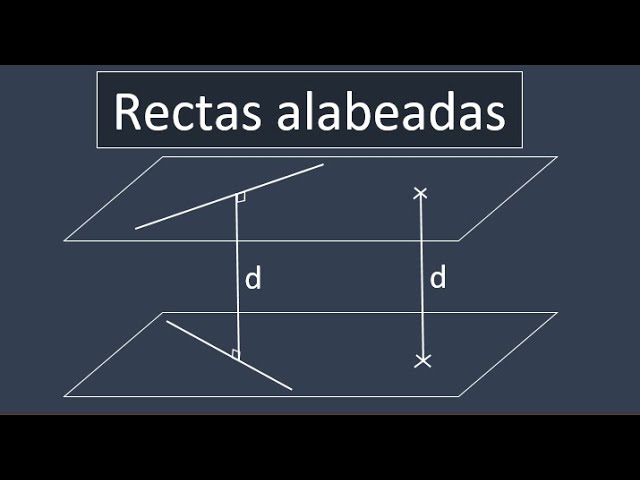
- The distance between these two skew lines is defined as a line that is both secant and perpendicular to them.
Understanding Distance Between Skew Lines
- It is emphasized that the distance calculated is unique; no other line can serve as the distance between l1 and l2.
- This distance represents the shortest possible length between the two lines, establishing it as a critical geometric property.
First Criterion for Finding Distance
- The first criterion involves projecting one of the skew lines onto a plane (denoted as P), treating it as a point.
- After projecting both lines onto this plane, their projections result in points from which distances can be measured.
- To find the distance from a point to a line, one must draw a perpendicular line from the point to the original line.
Second Criterion for Finding Distance
- The second criterion states that if there are two skew lines, there exist two unique parallel planes: one containing each of the skew lines.
- By drawing parallel lines through these planes, we can establish relationships between them based on their geometric properties.
Conclusion on Criteria for Distance Calculation
- It’s concluded that when dealing with skew lines contained within parallel planes, their distances will be equal to each other and also correspond to the distance between those planes.