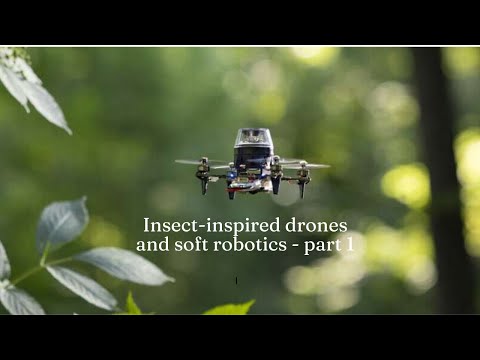
Insect-inspired drones and soft robotics - part 1
Introduction to Insect-Inspired Drones and Soft Robotics
Overview of Learning Outcomes
- The module focuses on bio-inspired engineering design, specifically examining flight mechanisms in insects and birds.
- Key learning objectives include understanding insect intelligence for autonomous flying robots and various flight mechanisms.
- Emphasis is placed on the crawling mechanisms of insects alongside their flying capabilities.
Structure of Insects
- Insects are composed of three main parts: head, thorax, and abdomen.
- The head contains sensory organs like eyes and antennae; the thorax houses legs responsible for locomotion.
- The abdomen contains species-specific organs; drones mimic these structures to enhance functionality.
Design Features of Robotic Insects
Mimicking Natural Behavior
- Drones designed to replicate insect behavior differ from conventional drones by imitating natural instincts that facilitate flight.
- Components such as thermal cameras, GPS devices, and video transmitters are integrated into drone designs.
Sensory Mechanisms
- Insect compound eyes provide high-resolution panoramic views; FPV cameras in drones aim to replicate this capability.
- Antennae serve critical functions in food detection and environmental sensing; researchers explore integrating nature-inspired sensors into drones.
Wing Mechanics in Flight
Flapping Mechanism
- Wing flapping is essential for locomotion; insects utilize specialized musculature for control during flight.
- Energy storage occurs through electrostatic deformation during wing flapping, allowing efficient movement over distances.
Research Developments
- Previous research focused solely on linear flapping without considering wing flexibility or kinematics; current studies aim to improve these aspects.
- Innovations involve flexible wing materials that can bend and twist, enhancing drone performance compared to rigid-winged designs.
Enhancements in Drone Flight Efficiency
Smart Wing Technologies
- Shape memory alloys are utilized in smart wings to optimize energy storage and release during flight cycles.
- Researchers report a 40% increase in dynamics and performance due to advancements in wing technology.
Mechanical Design Considerations
- Spring mechanisms allow for controlled bending while rotary mechanisms enable effective rotation during flight maneuvers.
Performance Metrics for Insect-Inspired Drones
Aerodynamic Analysis
- Aerodynamics depend on factors like leading edge shape and aerodynamic forces acting on wings during motion.
- The Reynolds number is crucial for understanding how viscous forces affect insect flight mechanics.
Experimental Setup
- High-speed cameras measure flapping frequency while force transducers assess lift generation during drone flights.
Advantages of Insect-Inspired Drones
Unique Capabilities
- These drones feature complex designs enabling operation in confined spaces with swarm capabilities.
- They excel at surveillance tasks, search-and-rescue operations, leveraging minimalistic design principles inherent to insects.
Challenges Faced by Designers
Complications with Miniaturization
- Designing small-scale insect drones presents challenges related to component size limitations affecting autonomy.
- Achieving full autonomy requires advanced computing power within compact frameworks which complicates design efforts.
Conclusion & Future Directions
Next Steps
- Upcoming discussions will cover various types of insect-inspired drones such as robo-bees and robo-spiders along with soft robotics applications.
Turn any video into a summary like this
YouTube links, meetings, lectures. With transcripts, search, and chat.