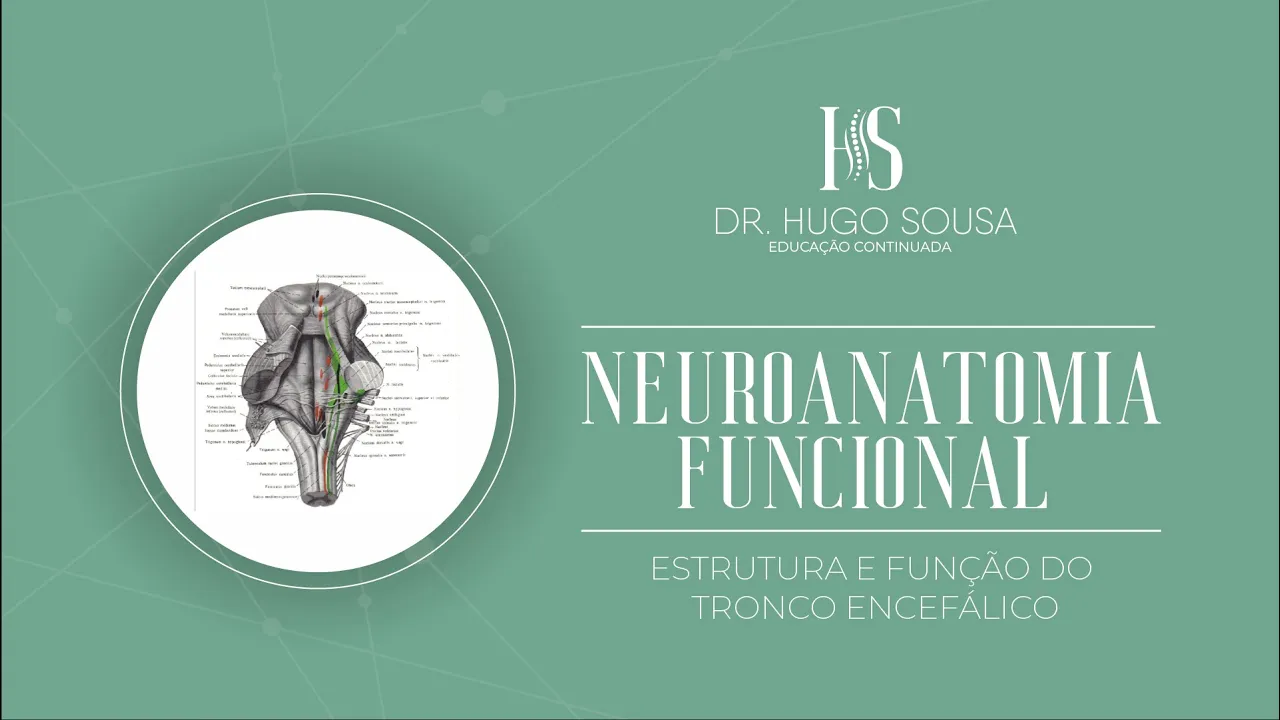
ESTRUTURA E FUNÇÃO DO TRONCO ENCEFÁLICO - PARTE 3
Understanding the Brainstem and Cerebellar Connections
Overview of Brainstem Complexity
- The brainstem is complex due to numerous crossing fibers within it, including reciprocal fibers connecting the brainstem to the cerebellum.
- Fibers project from the cerebral cortex to pontine nuclei, crossing the midline and forming transverse fibers in the pons.
Afferent and Efferent Fiber Functions
- Pontine fibers cross over to connect with contralateral cortical areas, serving as afferent pathways that relay information from the brain to the cerebellum for motor activity regulation.
- The reticular formation in the mesencephalon receives input from various regions, including spinal cord and cranial nerves, establishing connections crucial for motor coordination.
Vestibular System Integration
- Vestibular nuclei connect with semicircular canals in the inner ear, influencing postural regulation and balance through head position feedback.
- Information about head positioning travels via vestibular nerves to other vestibular nuclei before reaching the cerebellum for motor planning adjustments.
Olivary Nuclei Role
- The inferior olivary nuclei are a complex of nuclei involved in proprioceptive information processing from both cortical and spinal sources.
- These nuclei project crossed fibers that connect with cerebellar structures, facilitating communication between sensory input and motor output.
Cerebellar Output Pathways
- The cerebellum receives afferent signals from various brain regions while also sending efferent signals back out, establishing reciprocal connections essential for motor control.
- The red nucleus in the mesencephalon influences flexor muscle activity primarily in upper limbs but also has some effect on lower limbs.
Motor Regulation Circuitry
- Descending fibers from the red nucleus cross midline similar to corticospinal tracts, indicating a coordinated pathway for muscle control.
- Cerebral projections extend to reticular formation and vestibular nuclei before looping back to pontine nuclei and returning to cerebellum—forming a continuous circuit regulating muscle tone.
Summary of Motor Activity Influence
- All motor pathways originating from different brain structures converge at spinal levels affecting muscular activity; thus, highlighting how interconnected these systems are.
Formation Reticular: Key Functions and Connections
Overview of the Formation Reticular
- The formation reticular is interconnected with various brain structures, including the spinal cord and brainstem, playing a crucial role in sensory and motor functions.
- It forms part of the projection system of fibers that influence consciousness states, particularly through the ascending reticular activating system (ARAS).
Role in Sensory Regulation
- The formation reticular regulates sleep-wake cycles and alters states of consciousness, impacting our perception of pain during physical activities.
- During exercise, it reduces pain sensitivity by modulating signals from the spinal cord to decrease painful stimuli.
Therapeutic Implications
- Non-pharmacological therapies can stimulate the formation reticular to manage pain effectively by influencing neurotransmitter activity in specific neural pathways.
Motor Control Functions
- The formation reticular also plays a significant role in motor control, affecting both somatic and visceral motor neurons linked to autonomic nervous system functions.
Impact of Lesions on Functionality
- Damage to the formation reticular or brainstem can lead to severe consequences due to its integrative role in vital reflexes like cardiorespiratory control.
Understanding Sleep Mechanisms
Connection Between Formation Reticular and Sleep
- The formation reticular is essential for integrating sensory-motor information, which influences sleep patterns and phases.
Activation of Cerebral Cortex
- It activates different areas within the cerebral cortex based on incoming sensory information from various body parts via cranial nerves.
Modulation of Alertness
- As daily activities progress, there’s a natural decline in alertness due to fatigue within this region; this leads to increased sleepiness as activity levels drop.
Importance for Restorative Processes
- During deep sleep phases characterized by low muscle tone, restorative processes occur that are critical for memory consolidation and overall health.
Biological Rhythms Influence
Understanding Sleep and Wakefulness
The Role of Sleep Stages
- Discussion on the different stages of sleep, highlighting how certain brain areas become activated during lighter sleep phases.
- The reticular formation's involvement in dreaming and memory recall of dreams is emphasized, indicating its significance in sleep dynamics.
Transition from Sleep to Wakefulness
- The reticular formation plays a crucial role in transitioning from sleep to wakefulness, facilitating the shift from a state of drowsiness to full consciousness.
- External stimuli such as sounds (e.g., rooster crowing or alarm clocks) activate the reticular formation, which then re-engages the cortex for alertness.
Anatomy and Functionality of the Reticular Formation
- Description of the reticular formation's structure as a network of neurons interspersed with nerve fibers, located centrally within the brainstem.
- Its connections extend to various parts of the brain including cranial nerve nuclei and are integral for visual orientation and autonomic functions like respiration.
Autonomic Functions Regulated by Reticular Formation
- The reticular formation regulates involuntary actions such as breathing patterns and heart rate without conscious thought.
- It manages reflexive actions related to swallowing, vomiting, and blood pressure regulation through its influence on autonomic nervous system responses.
Integration with Other Brain Systems
- Connections between the reticular formation and limbic systems highlight its role in emotional processing and physiological responses tied to feelings.
- The hypothalamus is identified as a key player in maintaining homeostasis by regulating hunger, thirst, emotions, and autonomic functions linked to stress responses.
Vascular Supply to Brain Structures
- Overview of vascular supply mechanisms for brain structures via carotid arteries; essential for nourishing neural tissues within the brainstem.
Understanding the Cerebral and Vertebral Arterial Systems
Overview of the Cerebral Circulation
- The project discusses the formation of the cerebral arterial circle, known as the Circle of Willis, which is crucial for brain vascularization. It originates from two carotid arteries and includes anterior and posterior cerebral arteries.
- The vertebral artery system also plays a significant role in supplying blood to the brain. It branches from the subclavian artery and ascends through cervical vertebrae.
Anatomy of Vertebral Arteries
- As vertebral arteries ascend, they pass through transverse foramina in cervical vertebrae before entering the skull at the foramen magnum, where they converge.
- The union of right and left vertebral arteries forms the basilar artery, which is vital for supplying blood to both the cerebellum and brainstem.
Vascularization Contributions
- The basilar artery not only supplies blood to critical areas like the brainstem but also contributes to spinal cord vascularization.
- Key branches from this system include anterior spinal arteries and posterior spinal arteries that further enhance vascular supply to these regions.
Importance of Basilar Artery
- The inferior anterior cerebellar artery arises from the basilar artery, providing essential blood flow to parts of both the cerebellum and brainstem.
- Additionally, superior cerebellar arteries branch off from this area, contributing significantly to mesencephalic (midbrain) vascularization.
Clinical Implications
- Understanding these arterial systems is crucial because damage or blockage can lead to severe consequences such as strokes affecting various neurological functions due to their extensive roles in circulation.
- A stroke involving the basilar artery can have fatal outcomes due to its control over vital functions managed by structures within its territory.
Neurological Symptoms Related to Vascular Issues
- Lesions in specific areas supplied by these vessels can result in symptoms like diplopia (double vision), pupillary disturbances, or ptosis (drooping eyelids).
Understanding the Medulla Oblongata and Its Functions
Key Insights on Muscle Tone and Symptoms
- The discussion begins with the impact of muscle tone loss, leading to expression wrinkles resembling Botox effects.
- Weakness in the lateral tongue is linked to hypoglossal nuclei, causing speech and swallowing disturbances.
- Lesions affecting sensitivity can lead to contralateral loss of thermal and pain sensations due to crossed pathways in the medulla.
Sensory Pathways and Their Implications
- Lesions in the medial portion of the brainstem may result in hemiparesis (muscle weakness) or paralysis, particularly affecting contralateral sides.
- The base of the brainstem contains descending motor fibers; damage here results in contralateral sensory loss for vibratory and postural senses.
Understanding Lemniscal Pathways
- The medial lemniscus carries sensory information from gracile and cuneate fasciculi, indicating that these fibers cross over before reaching higher centers.
- Damage in lower regions like pons or mesencephalon can manifest as contralateral symptoms due to fiber crossing.
Summary of Brainstem Structure and Function
- A summary emphasizes key structural aspects of the brainstem's function, highlighting its integrative role within neuroanatomy.
Future Learning on Cranial Nerves
Turn any video into a summary like this
YouTube links, meetings, lectures. With transcripts, search, and chat.