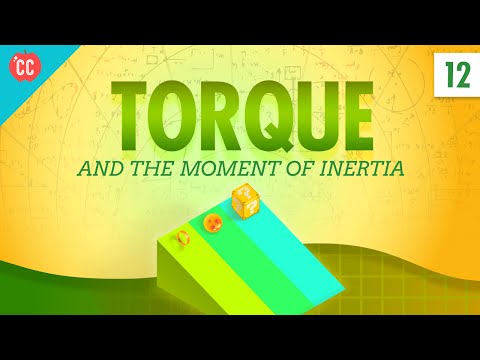
Torque: Crash Course Physics #12
What Happens When You Release a Box, Ring, and Marble on a Ramp?
Introduction to the Experiment
- The scenario involves three objects: a box, a ring, and a marble placed at the top of a ramp.
- The ramp allows for static friction but not kinetic friction, leading to different behaviors among the objects when released simultaneously.
Unexpected Outcomes
- Contrary to expectations based on dropping objects in a vacuum (where they hit the ground simultaneously), these three will not reach the bottom at the same time.
- The difference in their descent is attributed to how energy is distributed during rolling motion.
Understanding Rotational Motion
- To analyze which object wins the race down the ramp, concepts of rotational motion such as torque and moment of inertia must be explored.
- Torque is defined as applying force perpendicular to an axis of rotation, affecting angular velocity similar to how net forces affect linear velocity.
Calculating Torque
- Torque increases with greater applied force and distance from the axis of rotation (radius). A larger radius results in more torque; hence doorknobs are positioned far from hinges for easier operation.
- The angle between applied force and radius also influences torque; only perpendicular forces contribute effectively to rotation. Thus, torque (τ) can be mathematically expressed as τ = F_perpendicular × r.
Moment of Inertia Explained
- Moment of inertia reflects an object's resistance to changes in its rotational motion and depends on mass distribution relative to the axis of rotation. It can be defined mathematically by summing individual mass points multiplied by their squared distances from that axis.
- Unlike translational inertia that relies solely on mass, moment of inertia considers how far mass is located from the axis—greater distance leads to higher moment of inertia values.
Work Done by Torques
- Both torques and forces can perform work; work done by torque integrates over angles just like work done by force integrates over distances. More torque means more work done during rotation, impacting energy changes within systems.
- Kinetic energy varies between translational motion (entirely dependent on mass and velocity) and rotational motion (influenced by moment of inertia). For rotating objects: KE_rotational = 1/2 × I × ω² where I is moment of inertia and ω is angular velocity.
Angular Momentum and Energy in Motion
Understanding Angular Momentum
- Angular momentum is defined as an object's moment of inertia multiplied by its angular velocity, similar to how linear momentum is mass times velocity.
- A fundamental principle of physics states that angular momentum cannot be created or destroyed; it must always be conserved.
The Great Crash Course Physics Ramp Race
- In the context of a ramp race involving a box, marble, and ring, the focus is on how fast each object covers the distance down the ramp.
- At the top of the ramp, all objects possess gravitational potential energy, which converts into kinetic energy as they descend. For the box, this energy becomes translational kinetic energy only.
Results of the Ramp Race
- The box reaches the bottom first because it does not convert any potential energy into rotational kinetic energy like the marble and ring do.
- The mass of each object does not affect their performance; instead, it's about how their energies are distributed during motion.
Comparing Marble and Ring
- Between the marble and ring, the marble wins due to its lower moment of inertia; its mass is closer to its center compared to that of a ring.
- The final results show that:
- Box wins,
- Marble comes second,
- Ring finishes last due to higher moment of inertia affecting speed.
Key Takeaways from Today's Lesson
- Today’s discussion covered torque's relationship with angular acceleration and moment of inertia. We also learned about calculating moments of inertia and angular momentum while understanding how torques can perform work.