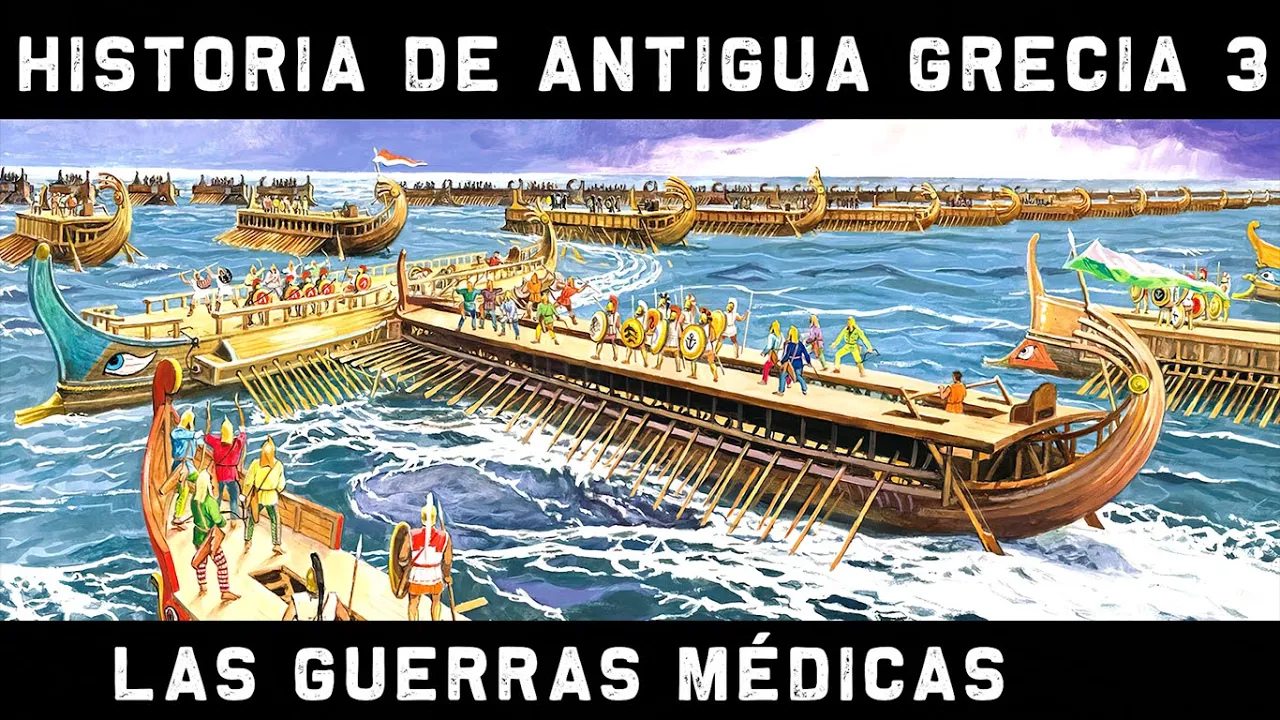
ANTIGUA GRECIA 3: La Época Clásica 1/2 - Las Guerras Médicas y la Democracia de Pericles (Historia)
Ancient Greece: The Classical Period 1/2
This section provides an introduction to the imminent war in Ancient Greece during the Classical period.
The Persian Advance and Rebellion in Miletus
- Persia had conquered Thrace and Ionian cities on the coast of Anatolia.
- The Ionians, under the orders of Aristagoras of Miletus, decided to mobilize against Persia.
- Miletus resisted the Persian advance but eventually fell.
- Athens and Eretria came to aid Miletus, while Sparta refused to help.
The Beginning of the War
- Darius I wanted to teach a lesson to the Athenians.
- Persian troops commanded by Mardonius arrived in Thrace, Macedonia, and Thassos.
- Miltiades set up an outpost near Hellespont but had to retreat to Athens.
Preparation for War
- Argos and Thebes surrendered to the Persians.
- Themistocles, the newly elected archon of Athens, developed a fleet and fortified Piraeus port.
- Miltiades was appointed as general by the assembly.
Division Among Greeks
- Some Athenians wanted to surrender to Persia due to their support for Hippias.
- Spartans delayed their involvement due to festivities honoring Apollo.
The Battle of Marathon
This section focuses on the events leading up to and during the Battle of Marathon.
Persian Fleet's Arrival
- In 490 BC, after taking Eretria, the first Persian fleet reached Attica's coast.
- They expected an uprising from supporters of Hippias that never happened due to a storm disrupting their plans.
Greek Victory at Marathon
- Another Persian fleet landed at Marathon.
- Miltiades sent all troops to attack the Persians, surprising them and forcing them to retreat to their boats.
- Greeks had the advantage of fighting on their home turf and a strong sense of patriotism.
Contrasting Armaments
- Greeks had a phalanx formation with bronze shields, long spears, and short-range swords.
- Persians had wicker shields and shorter spears.
The Message to Athens
- Pheidippides was sent as a messenger from the battlefield to Athens.
- He delivered the message of victory but died upon arrival.
Aftermath of the Battle
This section covers the aftermath of the Battle of Marathon and its impact on Greece.
Persian Retreat
- The Persians withdrew but set their sights on unprotected Athens.
The Legend of Marathon
- Pheidippides' run from Marathon to Athens gave rise to the marathon race tradition.
Alternative Version
- Another version suggests that Pheidippides went to Sparta for help, but they declined assistance.
- Athenians decided to evacuate Athens upon seeing the Persian fleet approaching.
Spartan Arrival
- When Spartans arrived three days later, they found only a beach full of corpses.
Miltiades' Fate
This section focuses on Miltiades' fate after his heroism at Marathon.
Miltiades' Hero Status
- Miltiades was considered a hero after the Battle of Marathon.
Failed Expedition and Consequences
- The assembly granted him a fleet to retrieve Cyclades islands, but his attack on Paros ended in failure.
- He desecrated a temple and suffered gangrene in his leg.
Imprisonment and Death
- Athenians condemned Miltiades to prison and a fine of 50 talents.
- He died shortly after his imprisonment.
The Rise of Themistocles
This section focuses on the rise of Themistocles and the preparations for future conflicts.
Importance of Strategos
- The office of Strategos became important in Athens.
Building a Fleet
- Themistocles convinced the assembly to build a large fleet using silver mines in Laurium.
Rivalry with Aristides
- Aristides preferred dividing profits among citizens, but reports of Persia building a new fleet led to his ostracism.
Panhellenic League Formation
- In 481 BC, many Greek polis met in Corinth and founded the Panhellenic League to prepare for the next Persian invasion.
- Sparta was chosen as the leader of this army.
Sicilian Wars
This section briefly mentions the beginning of the Sicilian Wars.
Gelon's Ambitions
- Tyrant Gelon of Syracuse aimed to take control of Sicily and expel Carthaginians.
Greek Dominance in Sicily
- Greeks fought against Etruscans and Carthaginians for years but eventually lost control to Rome.
The Second Persian War
This section introduces Xerxes I's expedition during the Second Persian War.
Xerxes' Expedition
- In 480 BC, Xerxes sent an expedition from Sardis with 100,000 men.
- They crossed Hellespont by building a bridge with wooden rafts.
The Battle of Thermopylae
This section discusses the Battle of Thermopylae, led by Spartan King Leonidas I, where 300 Spartans and other troops from various city-states faced a massive Persian army.
The Battle at Thermopylae
- The Panhellenic League, led by Spartan King Leonidas I, chose the pass of Thermopylae as the best place to face the Persians due to its narrowness and difficulty for Persian carts, horsemen, and archers to attack.
- Contrary to what is depicted in movies, there were more than just 300 Spartans present at the battle. There were also troops from other city-states, making it a force of around 7,000 Greeks against 100,000 Persians.
- The fighting was intense and many Persian soldiers fell one after another. However, with the help of a traitor named Ephialtes, the Persians found a road leading to the Greek rearguard and attacked them. This resulted in the defeat of the Greeks at that position.
Fierce Resistance and Memorial
- Despite their defeat at the rearguard, around 300 Spartans along with 700 Thespians fiercely fought against the Persian Immortals led by Hidarnes. A memorial was built on the battlefield to honor these fallen soldiers.
- Simultaneously, Athenians slowed down the Persian fleet in the Battle of Artemisium under Artemisia I's leadership. However, Athens eventually had to retreat as Boeotia fell followed by Attica. Most Athenians fled to the island of Salamis, where they witnessed Athens being set on fire by the Persians.
The Battle of Salamis and Retreat
- The Greek fleet took refuge in the Bay of Eleusis, a narrow and rocky area. Although the Persian fleet was larger and heavier, the Greeks used their maneuverability advantage to push Persian ships against rocks, resulting in a Greek victory at the Battle of Salamis.
- Artemisia's ship, who had warned about the danger of this battle to the Persians, was caught and had to ram and sink a Persian ship to escape. This action led the Greeks to believe that she was on their side and allowed her to flee.
- The Athenians seized many Persian ships, forcing them to retreat back to Asia Minor. Meanwhile, another part of the Persian army under Mardonius stayed in Thessaly with some Theban allies. In 479 BC, these soldiers again took Athens but were eventually defeated by Spartan general Pausanias at the Battle of Plataea. -
The Rise of Athens
This section covers Athens' rise after the war until the Peloponnesian War.
Pentecontaetia - 50 Years of Relative Peace
- After the war ended, there were 50 years of relative peace known as Pentecontaetia. During this time, Athens became a powerful force in the Mediterranean and adopted democracy as its new political system. However, Persia still posed a threat in the Aegean, and the Greeks were determined to resist them.
The Delian League and Athenian Hegemony
- The Panhellenic League had collapsed, but in 477 BC, the other Greek city-states formed the Delian League. This confederation, led by Athens, aimed to restore colonies in the east that had been under Persian control. Aristides was responsible for drafting their constitutions.
- Member states of the Delian League had to contribute financially (phoros) to fund a large fleet. Athens used its wealth to build Long Walls for protection and establish dominance over Greece, which caused tension with Sparta and its allies.
Cimon's Leadership and Conflicts
- In 471 BC, Themistocles was exiled from Athens and ended up in the court of Persian King Artaxerxes I due to his pro-Spartan stance. Cimon, son of Miltiades, came into power as a more pro-Spartan leader who sought closer ties with Persia as well.
- Cimon achieved military victories against pirates on Skyros Island and defeated Persians at the Battle of Eurymedon River, reclaiming Greek control over the Aegean Sea. However, conflicts arose within the Delian League as some member states wanted to leave due to no longer perceiving a Persian threat. Athens punished these defections harshly. -
Spartan War with Messene
This section discusses Sparta's war with Messene and the beginning of problems for the Archon.
Spartan War with Messene
- In 464 BC, an earthquake devastated Laconia, leading to the destruction of many Spartan cities. This event sparked a war between Sparta and Messene.
The transcript continues beyond this point, but it is not included in the provided text.
Cimon, Ephialtes, and Pericles: Architects of Greek Democracy
This section discusses the political reforms and leaders that shaped Greek democracy, including Cimon, Ephialtes, and Pericles.
Cimon's Exile and Successors
- Cimon was exiled in 461 BC. After him came the great architects of Greek democracy, Ephialtes and Pericles.
Reforms by Ephialtes and Pericles
- Ephialtes was elected archon and initiated reforms to transfer powers from the Areopagus to the Bulé and Heliaia, creating a more democratic state.
- Pericles continued these reforms with the goal of achieving political equality for all male citizens. However, women and slaves were still excluded from citizenship rights.
Political Structure
- The judges were chosen annually by lottery, while there were 10 strategos elected by the ten tribes of Athens. The strategos held important military positions.
- The Ekklesia (popular assembly) allowed more people to participate in decision-making processes, preventing aristocratic families from monopolizing power. Laws, decrees, and political issues were decided in this assembly.
- The Bulé served as a Senate-like body with 500 members chosen by lot. It gave approval to various decisions made by other institutions.
Public Works and Cultural Achievements
- Pericles organized numerous public works projects that improved citizens' lives and beautified the city of Athens. Notable examples include the construction of the new Acropolis with iconic structures like the Parthenon, Propylaea, Temple of Athena Nike, and Erechtheion with its caryatids.
- Pericles also implemented social assistance programs to alleviate poverty and reduce social conflicts.
Women and Education
- Women were still excluded from voting and holding public office, but some well-educated women like Sappho of Lesbos challenged societal norms through their writings. Athenian education was private, with children being taught at home by hired teachers. The main disciplines included grammar, music, and gymnastics.
- Slaves called pedagogues assisted in bringing children to school and helping them with their homework.
Prominent Figures of the Time
- Many famous Greek thinkers lived during this period, including philosophers like Socrates, Plato's teacher; sophist Gorgias; Anaxagoras; Empedocles; historians Herodotus and Thucydides; sculptor Phidias; poets Sophocles and Euripides; playwright Aristophanes; architect Hippodamus of Miletus; and physician Hippocrates.
1st Peloponnesian War
- Athens under Pericles' leadership transformed the Delian League into a major economic and commercial power. This led to tensions with Sparta and the Peloponnesian League, resulting in the 1st Peloponnesian War characterized by sporadic battles interspersed with periods of peace.
- Causes for the war included disputes over construction projects such as the Long Walls and Megara's shift from the Peloponnesian League to the Delian League due to rivalry with Corinth. Athens initially faced losses but managed to gain control over various regions.
Conclusion
- Despite his achievements, Pericles faced personal challenges such as divorce, loss of sons, and controversy surrounding his relationship with Aspasia. Athens became a powerful naval empire during his time in power.
The Battle of Coronea and the Boeotian League
This section discusses the aftermath of the Battle of Coronea, where Beocia revolted and gained independence. It also mentions the creation of an antidemocratic Boeotian League.
Beocia Revolt and Independence
- Beocia revolted and gained independence after the Battle of Coronea.
- This encouraged other regions like Euboea and Megara to do the same.
Antidemocratic Boeotian League
- An antidemocratic Boeotian League was created after the Battle of Coronea.
- The league consisted of various regions, including Beocia, Euboea, and Megara.
Leonidas' Strategy at Thermopylae
This section focuses on Leonidas' strategy at Thermopylae, specifically choosing a narrow place for battle to make it difficult for Persian horsemen and archers to attack.
Choosing a Narrow Place for Battle
- Leonidas deliberately chose a very narrow place at Thermopylae.
- This made it challenging for Persian horsemen and archers to attack effectively.
The Last Stand of Leonidas' Troops
This section describes the last stand of Leonidas' troops at Thermopylae against the Persians Immortals led by Hidarnes.
Fierce Battle with Persians Immortals
- In the last battle at Thermopylae, 300 Spartans, 700 Thespians, and possibly 400 Thebans stayed behind.
- They fiercely fought against the Persians Immortals led by Hidarnes.
- A memorial was built in honor of these soldiers at the place of battle.
The Battle of Artemisium and the Retreat from Athens
This section discusses the Battle of Artemisium, where the Athenians slowed down the Persian fleet. It also mentions the retreat from Athens as Beocia and Attica fell to the Persians.
Battle of Artemisium
- The Athenians engaged in the Battle of Artemisium against the Persian fleet.
- The Persian fleet was led by Artemisia I of Caria, queen of Halicarnassus.
- Although it did not work out for the Athenians, they managed to slow down the Persian fleet.
Retreat from Athens
- As Beocia and Attica fell to the Persians, Themistocles decided to evacuate Athens.
- Most Athenians fled to an island called Salamina off the coast.
- From there, they witnessed their city being set on fire by the Persians.
The Battle of Salamis
This section describes the Battle of Salamis, where Greek ships pushed Persian ships against rocks with help from waves, resulting in a Greek victory.
Greek Victory at Salamis
- The Greek fleet took refuge in a narrow area full of rocks in the Bay of Eleusis.
- The larger and less maneuverable Persian ships were pushed against rocks by waves.
- Many Persian ships were seized by Athenians, forcing them to flee back to Asia Minor.
Aftermath and Consequences
This section discusses how some Greeks mistook Artemisia's actions during battle as being on their side. It also mentions that Spartans reached general Pausanias and forced the Persians to retreat at the Battle of Plataea.
Mistaken Identity and Retreat
- Artemisia's ship was caught during the battle, and she had to ram and sink a Persian ship to escape.
- The Greeks mistook this action as being on their side and left to flee.
- The Athenians seized many Persian ships, forcing them to flee back to Asia Minor.
- In 479 BC, the Spartans reached general Pausanias, and together with the Panhellenic League, they forced the Persians to retreat at the Battle of Plataea.
The Rise of Athens
This section highlights the rise of Athens after the war. It mentions Athens becoming a powerful force in the Mediterranean and adopting democracy as its new way of doing politics.
Rise of Athens
- After the war, there were 50 years of relative peace known as pentecontaetia.
- Athens became the most powerful force in the Mediterranean during this time.
- Democracy was adopted as a new political system in Athens.
The Delian League
This section discusses the creation of the Delian League by other Greek regions under Athenian leadership. It also mentions how Athens used funds from member states for building a fleet and constructing protective walls.
Creation of Delian League
- In 477 BC, other Greek regions created the Delian League under Athenian leadership.
- The league aimed to restore colonies in eastern regions previously controlled by Persia.
- Aristides was commissioned to draw up their constitutions.
Funding for Fleet and Walls
- Member states had to provide contributions called phoros for funding a large fleet.
- The money collected was kept in Apollo's Temple on Delos Island.
- Athens used the funds to build protective walls around the city and the port of Piraeus.
Tensions with Sparta and Cimon's Leadership
This section discusses tensions between Athens and Sparta due to Athens' growing power. It also mentions Cimon's leadership approach, which aimed to strengthen ties with Sparta and Persia.
Tensions with Sparta
- Athens' rise as a hegemon in Greece created tensions with Sparta.
- The rivalry between the two city-states increased during this time.
Cimon's Leadership Approach
- In 471 BC, Themistocles was exiled, and Cimon came to power.
- Cimon adopted a more pro-Sparta and pro-Persia approach.
- He drove pirates out of Skyros and found alleged remains of King Theseus, gaining popularity.
The Third Medical War
This section briefly mentions the Third Medical War in 467 BC. It also highlights Themistocles' role in revealing incriminating information about Persia to the Greeks.
The Third Medical War
- In 467 BC, there was a smaller conflict known as the Third Medical War.
- Themistocles played a role in revealing incriminating information about Persia to the Greeks.
Problems within Delian League
This section discusses problems that arose within the Delian League after defeating Persia. It mentions defection by some member states like Naxos or Tesos, leading to harsh punishment by Athens.
Defection and Punishment
- Some member states of the Delian League wanted to leave due to no Persian threat.
- Naxos and Tesos were punished harshly by Athens for their defection.
Problems in Sparta and Conclusion
This section briefly mentions problems faced by Sparta, including an earthquake that destroyed many Spartan cities. It concludes the summary of the transcript.
Problems in Sparta
- In 464 BC, an earthquake caused significant destruction in Laconia, affecting many Spartan cities.
- This event marked the beginning of a war between Sparta and Messene.
This concludes the summary of the transcript.
Cimon's Exile and the Rise of Ephialtes and Pericles
This section discusses the exile of Cimon in 461 BC and the subsequent rise of Ephialtes and Pericles as influential figures in Greek democracy.
The Exile of Cimon
- Cimon was exiled in 461 BC.
- After his exile, Ephialtes and Pericles emerged as prominent leaders.
Military Actions
- Milcíades decided to send all troops, led by Temístocles, against the Persians while they were still disembarking.
- The Persian forces did not have time to react effectively.
Aspasia and Women's Role
- Aspasia, wife of Pericles, played a significant role as his advisor.
- However, she was not well-liked by the people due to societal norms that limited women's rights.
- Women were still unable to vote or hold public office during this time.
Factors Leading to Greek Victory
- The Greeks had several advantages over the Persians.
- They had a psychological advantage through their patriotism and fight for freedom.
- Education was widespread among Athenians, with almost eradicated illiteracy rates.
- Athenian education was private rather than public, with students going to teachers' homes for lessons.
Defying Norms: Heteras and Sappho
This section explores how some women challenged societal norms during ancient Greece. It also mentions famous thinkers who lived during this period.
Heteras - Educated Women
- Some women called "heteras" defied social norms by receiving education.
- Safo de Lesbos, a poetess known for her writings about women's lives during that era, derived from the term "lesbian."
Greek Victory and Education
- The Greeks achieved victory due to various factors.
- Apart from playing on their home ground, they had the advantage of widespread literacy.
- Atenians were educated in grammar, music, and physical education.
Contrasting Armaments
- Greek soldiers fought in phalanx formation with bronze shields, long spears, and short swords.
- Persian soldiers were mainly recruited from conquered territories and grouped by nationality.
- Persian soldiers used wicker shields and shorter spears.
Festivals, Symposia, and the Marathon
This section discusses festivals and social gatherings in ancient Greece. It also mentions the famous "marathon" origin story.
Greek Festivals
- Greece had numerous festivals like Panateneas featuring processions and sports events.
- Symposia were common social gatherings where friends dined together and drank after work.
The Marathon Origin Story
- During a war with Persia, a Greek soldier named Filípides was sent as a messenger to Athens to announce their victory.
- Filípides ran non-stop but died upon delivering the message. This inspired the modern marathon race.
Prominent Thinkers of Ancient Greece
This section highlights famous thinkers who lived during this period of ancient Greece.
Notable Philosophers, Artists, Poets
- Sócrates (teacher of Plato), Gorgias (a sophist), Anaxágoras, Empédocles were prominent philosophers.
- Heródoto and Tucídides were historians. Fidias was a renowned sculptor.
- Sófocles (author of Antígona and Edipo Rey) and Eurípides were notable poets.
- Aristófanes (author of Las Nubes or Lisístrata) was a famous playwright.
Atenas' Resilience and Persian Retreat
- Atenas successfully defended itself, leading the Persians to retreat.
- The war came to an end as the Persians realized they couldn't overcome the Athenian defenses.
Pericles' Rule and Political Changes
This section focuses on Pericles' rule and political changes during his time in power.
Pericles' Divorce and New Relationship
- Pericles divorced his wife and had children who died. He then entered into a relationship with Aspasia from Mileto.
- Aspasia was not well-received by Athenians due to her foreign origin.
Citizenship Restrictions
- Pericles implemented a policy that denied citizenship to children born to non-Athenian parents.
- This aimed to limit ties between different aristocracies but caused less panhellenic sentiment and more division among people.
Importance of Strategos
- The position of strategos became crucial, leading Athens to reconsider the selection process.
- Instead of choosing strategoi by lottery, they started selecting them based on merit.
Rise of Athens as a Naval Power
This section discusses how Athens became a powerful naval empire through the League of Delos.
Economic Power of Athens
- Under Temístocles' influence, Athens transformed the League of Delos into an economic powerhouse.
- They built a formidable navy using silver mines in Laurion.
- Arístides, Temístocles' political rival, preferred distributing profits among citizens rather than investing in naval power.
Rivalry with Sparta
- Sparta and the Peloponnesian League viewed Athens' rise with suspicion.
- The main concern shifted from the Persians to internal conflicts.
- Reports indicated that the Persians were building a new fleet in their ports.
Spanish La Guerra del Peloponeso
En esta sección se habla sobre la Guerra del Peloponeso, una guerra no declarada entre Esparta y Atenas con batallas esporádicas y largos intervalos de paz.
La Guerra del Peloponeso
- La Guerra del Peloponeso fue una guerra no declarada entre Esparta y Atenas.
- Se caracterizó por tener batallas esporádicas y largos periodos de paz.
- Esta guerra no debe confundirse con la famosa Guerra del Peloponeso.