Beta Decay & Neutrino Hypothesis !! (VIOLATION of Conservation Laws)
Introduction to Beta Decay
This section introduces beta decay as a spontaneous radioactive decay process in which a neutron or a proton inside a nucleus gets converted to the other kind of particle, resulting in the emission of an electron or a positron. The reason for this type of reaction happening is explained by the imbalance of neutrons and protons in unstable nuclei.
Why does beta decay occur?
- Most stable nuclei have a balance of neutrons and protons.
- When there is an excess number of neutrons or protons, the particle in excess gets converted to the other kind of particle.
- Example: Boron-12 undergoes beta decay to form Carbon-12, where a neutron converts into a proton and an electron is emitted.
Energy configuration in nuclei
- Neutrons and protons are fermions, so no more than two of the same kind can occupy a given energy level.
- In Boron-12, with five protons and seven neutrons, there are two excess neutrons occupying higher energy levels compared to protons.
- Conversion of neutron to proton decreases overall energy configuration, leading to more stability.
Neutrino Hypothesis
This section discusses the historical development related to beta decay and the prediction of neutrinos as fundamental elementary particles based on experimental observations.
Experimental aspects leading to neutrino hypothesis
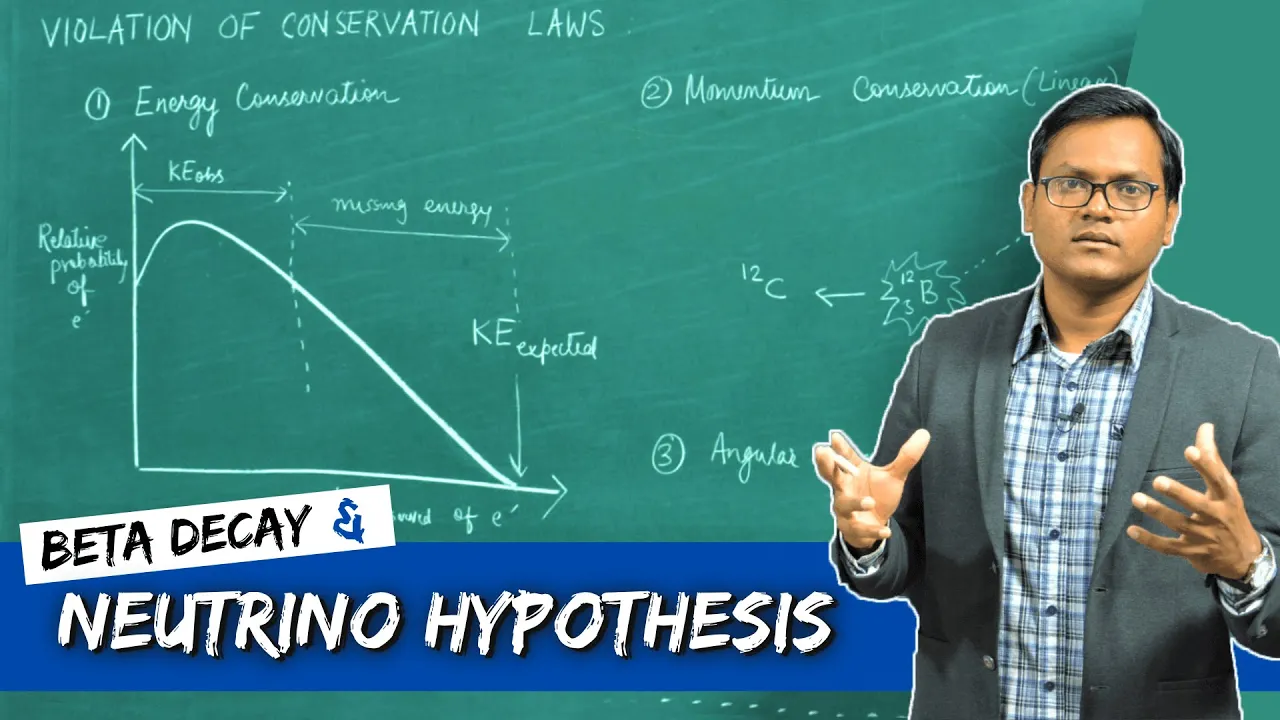
- Kinetic energy distribution of emitted electrons in beta decay was found to be continuous rather than fixed.
- Theoretical calculations predicted fixed kinetic energy based on disintegration energy associated with nuclear reactions.
- Experimental observations showed electrons having varying kinetic energies within a continuous range.
Missing energy puzzle
- Experimental data showed that some energy was missing when comparing observed electron energies with theoretical predictions.
- Niels Bohr suggested that beta decay might violate the conservation laws of energy and momentum.
Beta Decay Kinetic Energy
This section focuses on the kinetic energy of particles emitted in beta decay reactions and the discrepancy between theoretical predictions and experimental observations.
Expected kinetic energy
- Beta decay reactions are expected to emit particles with fixed kinetic energy, which can be theoretically calculated.
- The expected kinetic energy for electrons in beta decay is determined based on theoretical calculations.
Experimental observations
- Experimental observations showed a continuous distribution of electron energies in beta decay.
- The observed electron energies did not match the predicted fixed values, leading to a discrepancy.
Conclusion
Beta decay is a spontaneous radioactive decay process where neutrons or protons inside a nucleus convert into the other kind of particle, resulting in the emission of an electron or positron. The imbalance of neutrons and protons in unstable nuclei leads to this type of reaction. The neutrino hypothesis was developed based on experimental observations of continuous distributions of electron energies in beta decay, which deviated from theoretical predictions. This discrepancy raised questions about the conservation laws of energy and momentum.
The Confusion of Beta Decay
This section discusses the confusion surrounding beta decay, specifically regarding the direction of emitted particles and the conservation of linear momentum and spin angular momentum.
Conservation of Linear Momentum and Direction of Emitted Particles
- Conservation of linear momentum suggests that the recoiling particle and emitted electron should move in opposite directions.
- However, in beta decay, the electron is not emitted exactly opposite to the recoil of the daughter nuclei, leading to confusion.
- This discrepancy raised concerns about whether beta decay violates the conservation of momentum principle.
Conservation of Spin Angular Momentum
- In beta decay, a neutron becomes a proton and emits an electron.
- All particles involved (neutron, proton, electron) have a spin of 1/2.
- This violates the conservation of spin angular momentum because one spin 1/2 particle cannot lead to the creation of two spin 1/2 particles.
Violation of Conservation Principles
- Experimental data associated with beta decay suggested violations of energy conservation, linear momentum conservation, and angular momentum conservation principles.
- However, charge conservation was maintained since electrons are negatively charged while protons are positively charged.
Introduction to Neutrino Hypothesis
This section introduces Wolfgang Pauli's suggestion for explaining the violations observed in beta decay by introducing a new particle called neutrino.
Neutrino as an Explanation
- Wolfgang Pauli proposed in 1931 that another particle is emitted during nuclear reactions like beta decay to explain these violations.
- The new particle should be uncharged and have a tiny mass to conserve energy.
- Its existence would prevent violations of linear momentum conservation as well.
Properties Predicted for Neutrino
- Based on conservation principles, this third particle should also have a spin of 1/2 to conserve angular momentum.
- It would be a fermion and satisfy Fermi-Dirac statistics.
- Wolfgang Pauli initially suggested the particle, later explored by Enrico Fermi, and named it neutrino (meaning "little neutral one").
Experimental Discovery of Neutrino
This section discusses the experimental discovery of neutrinos in the 1960s, validating Fermi's theory about their existence.
Validation of Neutrino Hypothesis
- The neutrino hypothesis explained the violations observed in beta decay.
- However, it took almost 30 years for this particle to be experimentally discovered in the 1960s.
- The discovery confirmed Fermi's prediction of a new fundamental particle.
Neutrino Types
- Neutrinos associated with electron emission are known as electron neutrinos or simply neutrinos.
- There are also antimatter versions called anti-electron neutrinos or anti-neutrinos.
Properties of Neutrinos
- Neutrinos are uncharged particles represented by the symbol ν (nu).
- They have a tiny mass and spin 1/2.
Conclusion
The transcript discusses the confusion surrounding beta decay and how it led to violations of conservation principles. To explain these violations, Wolfgang Pauli proposed the existence of a new particle called neutrino. The properties predicted for neutrinos were later validated through experimental discoveries in the 1960s.
New Section
This section discusses the distinction between neutrinos and antineutrinos in beta decay processes.
Neutrino Hypothesis
- In negative beta decay, an excess number of neutrons inside the nucleus can convert a neutron to a proton, emitting an electron and an electron neutrino.
- In positive beta decay or positron emission, when there is an excess of protons inside the nucleus, a proton can convert to a neutron, emitting a positron and a neutrino.
- Electron capture is another type of nuclear decay process where a nearby electron from the nearest electron orbit can be absorbed by the nucleus. The proton absorbs an electron, becomes a neutron, and emits a neutrino.
Mirror Reactions and Inverse Beta Decay
- Positive beta decay (positron emission) and electron capture are mirror reactions. In positive beta decay, a positron is emitted, while in electron capture, an electron is absorbed.
- These mirror reactions are also known as inverse beta decay processes. For example, in negative beta decay (neutron to proton conversion), an anti-neutrino is emitted. The mirror reaction involves the absorption of a neutrino by a neutron to create a proton and an electron.
- Experimentally detecting neutrinos often involves inverse beta decay processes where neutrinos interact with neutrons or protons to confirm their existence.
New Section
This section concludes the discussion on different types of beta decay processes and the role of neutrinos.
Summary
- Negative beta decay involves neutron to proton conversion with emission of an electron and an electron neutrino.
- Positive beta decay (positron emission) involves proton to neutron conversion with emission of a positron and a neutrino.
- Electron capture occurs when a proton absorbs an electron, converting into a neutron and emitting a neutrino.
- Mirror reactions involve the emission or absorption of particles in positive beta decay and electron capture processes.
- Inverse beta decay processes involve the absorption of neutrinos to create certain beta decay reactions.
- Neutrinos play a crucial role in confirming their existence through experimental setups involving inverse beta decay processes.
The transcript is already in English, so there is no need to translate it.
Turn any video into a summary like this
YouTube links, meetings, lectures. With transcripts, search, and chat.