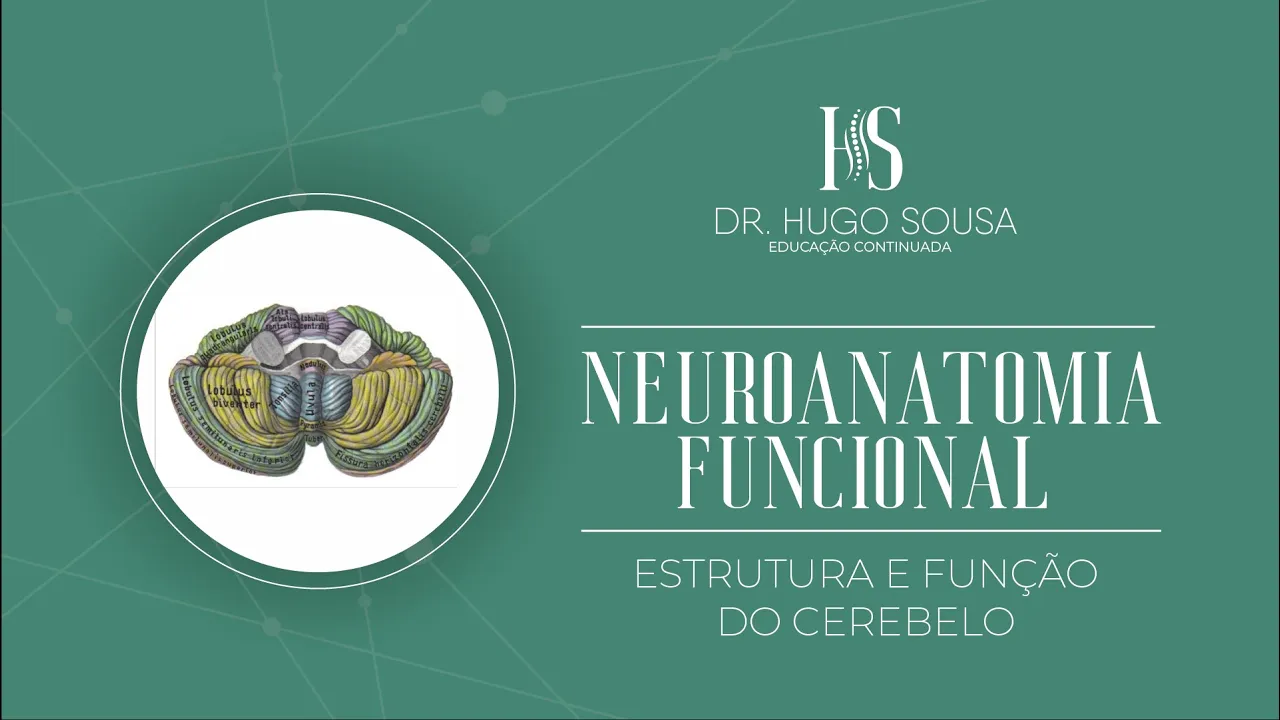
ESTRUTURA E FUNÇÃO DO CEREBELO PARTE 2
Cerebellar Cortex Structure and Function
Overview of Cerebellar Layers
- The cerebellum lacks a distinct architecture, consisting of three main layers: the molecular layer, Purkinje cell layer, and granular layer.
- The molecular layer is characterized by its "putiform" appearance and contains transverse fibers related to this area, along with star-shaped cells (stellate cells) and basket cells.
- Parallel fibers from granule cells project into the molecular layer, establishing connections with Purkinje cells. These projections are crucial for cerebellar function.
Purkinje Cells and Their Role
- The second layer consists primarily of Purkinje cells, which play a vital role in transmitting information from the cerebellar cortex to the deep cerebellar nuclei.
- Purkinje cells connect the cortical layers to the cerebellar nuclei, serving as key conduits for information flow within the brain.
Granular Layer Insights
- The granular layer features two types of neurons: Golgi cells and granule cells. Granule cells project their axons into the molecular layer where they form synapses with Purkinje cells.
- This structure emphasizes that there are three distinct layers in the cerebellar cortex: molecular, Purkinje cell, and granular layers.
Fiber Types in Cerebellum
- The presence of white matter indicates various fiber types within the cerebellum; these include intrinsic fibers (within the cerebellum) and extrinsic fibers (from other brain regions).
Cerebellar Connections and Functions
Overview of Cerebellar Structure and Importance
- The central nervous system connects to the cerebellum, highlighting its significance. Fibers pass through the cerebellar peduncle to project towards the medullary center.
Types of Afferent Fibers in the Cerebellum
- The image illustrates intense connections within the cerebellum, focusing on mossy fibers (the majority) and climbing fibers (less numerous).
- Climbing fibers originate from the inferior olivary nucleus, projecting information to the cerebellum, which is crucial for motor coordination.
Impact of Olivary Nucleus Lesions
- Damage to bulbar olives can lead to motor coordination issues or cerebellar disturbances due to their projection towards the cerebellum.
Excitatory Role of Climbing Fibers
- Climbing fibers connect with Purkinje cells in a complex manner, establishing excitatory interactions that are essential for motor function.
- These climbing fibers utilize glutamate as a neurotransmitter, providing excitatory signals to Purkinje cells.
Mossy Fibers and Their Connections
- Mossy fibers also establish connections with deep nuclei in addition to Purkinje cells, playing a significant role in transmitting sensory information.
- They bring diffuse afferent information from various parts of the central nervous system including spinal cord and brainstem structures.
Interaction Between Granular Cells and Purkinje Cells
- Granular cells form extensive connections with Purkinje cells, exerting excitatory effects that are vital for proper cerebellar function.
Inhibitory Mechanisms Within Cerebellar Circuits
- Inhibitory interneurons modulate excitatory activity between Purkinje cells and deep nuclei, balancing overall cerebellar output.
Flocculonodular Lobe Functionality
- The flocculonodular lobe lacks deep nuclei but interacts reciprocally with vestibular nuclei for balance control.
Vestibular Influence on Motor Coordination
- Vestibular nuclei influence reticular formation and spinal cord projections aiding in movement coordination and muscle tone regulation.
Cerebellar Function and Its Impact on Motor Control
Overview of Reticulospinal Pathways
- The reticulospinal system plays a crucial role in adjusting the axial muscles of the body, connecting vestibular nuclei to the anterior column of the spinal cord where lower motor neurons reside.
Role of Purkinje Cells
- Purkinje cells exert inhibitory effects on cerebellar nuclei, which are responsible for exciting other structures. This modulation is essential for maintaining balance and coordination.
Cerebellar Modulation Mechanism
- The cerebellum's function involves neuromodulation; without inhibitory activity from Purkinje cells, there would be excessive excitation leading to disorganized motor functions.
Consequences of Cerebellar Lesions
- Damage to the cerebellum results in movement disorders due to its critical role in modulating motor activity. Observations include disturbances in balance and coordination.
Inhibitory Nature of Cerebellar Output
- Information from the cerebellar cortex to deep nuclei is primarily inhibitory, highlighting the importance of Purkinje cell activity in regulating excitatory signals within motor pathways.
Clinical Case Study: Balance Disorders
Patient Presentation
- A 45-year-old male presented with balance issues starting in 2017, accompanied by severe bilateral pulsating headaches and vertigo.
Importance of Physical Examination
- The physical examination revealed significant findings related to ataxia (lack of coordination), emphasizing how neuroanatomical knowledge aids clinical assessments.
Observations During Examination
- Notable symptoms included postural instability and ataxia affecting both axial and appendicular movements, particularly evident during gait analysis.
Characteristics of Ataxic Gait
- Ataxic gait resembles that seen in intoxicated individuals, characterized by wide-based walking patterns indicating impaired coordination due to cerebellar dysfunction.
Speech Alterations Linked to Cerebellar Dysfunction
- Dysarthria (slurred speech) was observed as a result of cerebellar neuron impairment, affecting speech rhythm and clarity during verbal communication tasks.
Movement Control and Coordination
Understanding Movement Control
- The ability to control movements in advance is crucial for executing tasks at an appropriate speed. This involves the concept of "co-sinesthesia," which refers to the capacity to perform alternating movements effectively.
- An example of this is performing alternating hand movements, such as supination (palm up) and pronation (palm down). The challenge lies in executing these movements quickly and accurately.
- Individuals with "double acinesia" struggle with these tasks, exhibiting hesitance and requiring excessive thought to coordinate their actions. This condition relates closely to ataxia, where movement becomes unsteady.
Challenges in Movement Execution
- A key issue faced by individuals with movement disorders is dismetria, which affects their ability to gauge the correct distance or measure needed for precise movements. They may fail to align their body position correctly relative to a target object.
Turn any video into a summary like this
YouTube links, meetings, lectures — with transcripts, search, and chat.