I5 Curva de la conducción
Explanation of Pump Curve and Operating Point
In this section, the speaker delves into explaining the pump curve and the operating point of a pump system.
Understanding Pump Impulsion Calculation
- The calculation of impulsion involves applying the head at point A and point B to determine the energy provided by the impulsion.
- The energy provided by impulsion must equal the head differences between points A and B, accounting for both suction and discharge sides.
- The difference in elevations between points A and B, along with the head losses during flow from A to B, influences impulsion calculation.
Curva de la Conducción: System Expression
- The system's water elevation system is dominated by what is known as "Curva de la Conducción," which includes geometric levels and head losses between points A and B.
- The final expression for impulsion height involves geometric level, numerical values, and a coefficient dependent on flow rate squared.
Calculation Considerations for Water Elevation Systems
This section focuses on calculating parameters such as geometric levels, head losses, and coefficients in water elevation systems.
Calculating Losses and Coefficients
- Geometric levels (e.g., 48 meters), disregarding certain losses, are crucial in determining total head losses in suction and discharge sides.
- Utilizing Manning's coefficient aids in expressing losses based on flow rate and pipe diameter.
Representation of Pump Curve in System Design
Exploring how to represent pump curves graphically within a system design context.
Graphical Representation of Pump Curves
- By manipulating numbers based on calculations, a family of curves representing different pipe diameters emerges.
- The resulting pump curve equation reflects variations in flow rate concerning pipe diameter.
Understanding Pump Operation Characteristics
Delving into operational characteristics related to pumps within a water elevation system.
Operational Insights
- Factors like flow rate influence the steepness of pump characteristic curves.
New Section
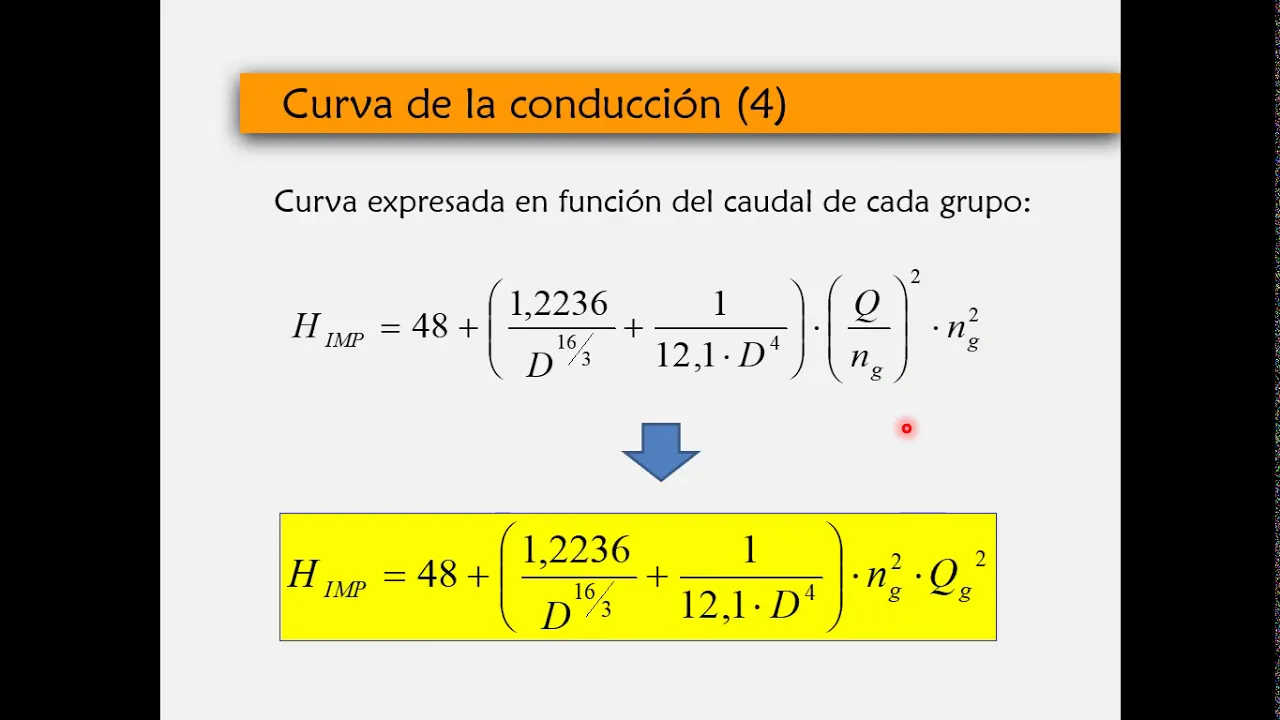
In this section, the speaker discusses how to express the curve of conduction in different scenarios, focusing on groups in parallel and series.
Expressing Conduction Curve for Parallel Groups
- The flow passing through each pump in parallel is the total flow divided by the number of groups.
- By changing variables, maintaining pressure expressions, and adjusting total flow based on group numbers squared, a new variable is introduced.
- The expression for conduction curve shifts to focus on group flow rather than total flow driven by pumps.
Conduction Curve for Series Pumps
- Operating with a new variable representing group flow squared multiplied by the number of groups squared.
- The expression now revolves around group flow instead of total flow, allowing comparison with pump characteristic curves.
New Section
This part delves into solving the conduction curve for pumps in series by altering variables to height per stage and group flow.
Solving Conduction Curve for Series Pumps
- Multiplying and dividing by the number of stages to transform expressions into terms related to stage height (tap height).
- Expressing the conduction curve using tap height and group flow allows comparison with pump characteristic curves.
New Section
Exploring a simplified scenario with one group and one stage to analyze diameter variations affecting flow rates and heights.
Analyzing Diameter Variations
- Each diameter corresponds to a specific thickness leading to interior diameters influencing calculations.
- Plotting data points for various diameters against flows reveals varying head heights based on diameter changes.
New Section
Visual representation of how different diameters impact head losses in conduits as flows change.
Impact of Diameters on Head Losses
- Graphical representation showcasing how different diameters affect head losses at varying flows.