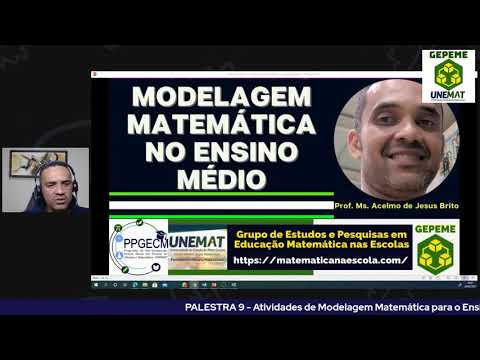
PALESTRA - Atividades de Modelagem Matemática para o Ensino Médio
Introduction to Mathematical Modeling in High School Education
The Role of Teachers in Learning
- The foundation of all achievements is attributed to teachers, who are seen as sources of wisdom and guidance.
- Every significant discovery or invention begins with a good teacher, emphasizing the importance of educators in various fields.
Live Discussion on Mathematical Modeling
- The session welcomes participants to discuss mathematical modeling in high school education, introducing Professor Anselmo de Jesus Brito and Professor Selma de Jesus Brito.
- This live transmission is part of a training initiative for a graduate program focused on teaching sciences and mathematics.
Importance of Real-World Applications
- Professor Anselmo expresses excitement about sharing experiences related to integrating real-world scenarios into math lessons.
- He acknowledges his lack of expertise but emphasizes the value of discussions that enhance understanding and teaching practices.
Exploring Mathematical Modeling
Personal Experiences and Perspectives
- Professor Anselmo shares his background in basic education, highlighting his experience across different educational levels from elementary to higher education.
- He aims to adapt mathematical modeling approaches for various educational stages, including middle school.
Methodological Insights
- Emphasizing a conversational approach, he invites questions regarding his experiences with mathematical modeling as an interface between real-world problems and mathematics.
- He notes that modeling can be adapted based on objectives and methodologies used in teaching.
Theoretical Foundations of Mathematical Modeling
Bridging Theory and Practice
- Professor Anselmo discusses his transition from focusing on applied science contexts to incorporating pedagogical methodologies within mathematical modeling.
- His reflections stem from collaborative discussions with peers that have enriched his understanding and practice.
Influential Figures in Mathematics Education
- He references Maria Salete's contributions to the field, indicating her influence on his approach towards integrating real-life applications into mathematics education.
Defining Mathematical Modeling
- According to Professor Anselmo, mathematical modeling serves as an interface connecting real-world situations with mathematical concepts.
- He stresses that while mathematics plays a supportive role, the primary focus should remain on addressing real-world problems rather than solely on mathematical techniques.
Mathematical Modeling in Education
Phases of Mathematical Modeling
- The discussion begins with a pragmatic approach to mathematical modeling, referencing Maria Salete's methodology which includes three main phases: interaction, mathematization, and model interpretation.
- Interaction is characterized as the initial phase where students familiarize themselves with the problem and engage with theoretical references. This stage encourages recognition and provocation regarding the problem at hand.
- Mathematization involves formalizing the problem through hypothesis formulation and model construction. It emphasizes that models are approximations of reality rather than exact representations.
- The final phase focuses on interpreting solutions derived from the model, evaluating its effectiveness in representing real-world phenomena. A good model should provide reliable insights into the phenomenon being studied.
Competencies in Mathematical Education
- The discussion highlights specific competencies outlined in educational standards (BNCC), particularly emphasizing the ability to utilize mathematical strategies across various fields such as arithmetic, algebra, geometry, and statistics for effective problem-solving.
- There is an emphasis on constructing consistent arguments based on analyzed results and proposed solutions within diverse contexts.
Practical Application of Mathematical Modeling
- The speaker shares personal experiences related to implementing mathematical modeling in high school education, aiming to align teaching practices with theoretical frameworks discussed earlier.
- An example is provided focusing on a specific skill (M13 mate 302), which involves constructing models using polynomial functions to solve problems across different contexts—both with or without technology support.
Experimentation Approach
- The proposed experiment aims to address water resource management issues by engaging students through various resources like internet articles and videos discussing water scarcity—a pressing topic in many regions today.
- Initial discussions focus on promoting awareness about water conservation challenges faced locally, highlighting how even minor leaks can contribute significantly to waste—a social issue that requires attention.
Stages of Experiment Implementation
- In this experimental approach, students will follow defined phases according to Bebegold’s model: starting from interaction leading into data collection during experimentation—emphasizing primary data recording for accurate modeling outcomes.
- The importance of fostering interest through discussions around water resources sets a foundation for deeper engagement as students transition into more technical aspects of data analysis and modeling processes.
Mathematical Modeling and Water Management
Understanding Mathematical Models
- The mathematical model phase involves analyzing results to determine the limitations and validity of the model concerning real-world phenomena. This includes understanding how well the model represents various circumstances.
- It is crucial to evaluate both the model's effectiveness and its applicability in different contexts, ensuring that it accurately reflects the phenomenon being studied.
Perspectives on Water Usage
- The discussion highlights two distinct perspectives for approaching water management: wastefulness versus reuse. Both can be explored using the same underlying narrative or framework.
- Each perspective allows for a unique exploration of themes relevant to students' experiences, making it easier for them to engage with the material personally.
Experimentation with Water Leakage
- Students are encouraged to monitor or simulate a leaking faucet as part of their experiments, which can lead to diverse data collection based on individual circumstances. Each student's approach will yield different results, contributing to varied models and evaluations.
- The experiment emphasizes personalized learning by allowing each student or group to tackle specific problems related to water leakage, fostering deeper engagement with practical applications of mathematics.
Data Collection Methodology
- A graduated container is used in experiments where students measure accumulated water over time after simulating a leak at home during pandemic conditions, promoting hands-on learning experiences.
- Students record measurements at regular intervals (e.g., every hour) to gather data on volume accumulation, which aids in constructing a more accurate mathematical model reflecting real-life scenarios rather than estimations based on assumptions.
Importance of Accurate Modeling
- Emphasizing accuracy in modeling helps reduce discrepancies between theoretical predictions and actual outcomes; this leads to better understanding and representation of water usage patterns over time. Students learn that precise data collection is essential for effective modeling practices.
- The instructor shares personal experiences from their educational journey, highlighting challenges faced while studying mathematics and emphasizing the importance of understanding functions within practical contexts rather than abstractly without clear application purposes.
Understanding Data Visualization in Excel
Introduction to Data Handling
- The discussion begins with the idea of approaching data from different perspectives, emphasizing that one does not need to be an expert in spreadsheets to manage basic tasks.
- A column for time and volume is introduced, where specific measurements are recorded over time (e.g., 200 ml after one hour, 452 ml after two hours).
Creating Graphs in Excel
- The speaker explains how to create a scatter plot graph in Excel, which uses coordinates from the data columns as ordered pairs.
- Instructions are provided on selecting the appropriate graph type and connecting points on the scatter plot for clarity.
Adding Trend Lines
- The importance of adding a trend line to visualize data behavior is discussed; this involves recognizing linear patterns within the dataset.
- Steps are outlined for adding a trend line and displaying its equation along with the R-squared value, which indicates how well the model fits the data.
Model Evaluation
- The concept of R-squared is explained: values closer to 1 indicate a better fit of the model to observed data points.
- It’s noted that while models can help infer relationships within certain intervals, they must consider external factors affecting outcomes.
Practical Applications and Considerations
- Discussion shifts towards practical implications such as measuring water usage or leaks, highlighting real-world applications of modeling techniques.
- Emphasis is placed on customizing models based on individual experiments; results may vary depending on specific conditions or variables involved.
Defining Function Domains
- The conversation addresses defining domains and ranges when working with functions; negative values for time are deemed impractical since time cannot start at negative values.
- It’s crucial that initial conditions (like starting volume being zero at time zero) are accurately represented in any mathematical model created.
Modeling Water Usage and Construction
Introduction to the Model
- The speaker discusses a linear model for predicting water usage, emphasizing that it must intersect at the origin (0,0), indicating zero water quantity at time zero.
- The model's accuracy is evaluated; despite some loss in adjustment, it shows minimal deviation from reality with values close to 99.99% accuracy.
Validity of the Model
- The importance of validating the model against real-world phenomena is highlighted, particularly regarding initial conditions where no water was present.
- The linear equation serves as a foundational model representing physical phenomena like water leakage and air conditioning capture.
Application of the Model
- The model can be used to calculate water volume over time, aiding in understanding waste versus reuse within a 24-hour period.
- Discussion on evaluating conditions under which the model may fail or misrepresent reality, prompting considerations for practical applications.
Educational Context and Community Engagement
- A monograph intended for high school application was disrupted by the pandemic; however, ideas were generated around modeling popular housing construction.
- Emphasizes leveraging local knowledge from community members (e.g., a retired mason), integrating their expertise into educational projects.
Curriculum Integration
- Specific skills outlined in Brazil's National Common Curricular Base (BNCC), focusing on calculations related to perimeter, area, volume, and real-life problem-solving.
- Plans to utilize local government projects (like affordable housing developments in Porto Estrela) as case studies for students' learning experiences.
Project Development Phases
- Engaging students through field visits to observe construction sites and municipal planning offices enhances practical understanding of theoretical concepts.
- Initial phases involve theoretical grounding through research and geometric figure analysis relevant to construction plans provided by local authorities.
Evaluation of Results
- Students analyze architectural designs using geometric principles while considering structural elements like walls without delving into finishing details.
- Final evaluations focus on comparing project outcomes with realistic expectations; however, due to external circumstances, validation remains incomplete.
House Design and Construction Insights
Project Overview
- The project involves a detailed design of a house, focusing on the front, left side, right side, and back. Proposals include foundational elements and interior walls.
- The external walls are highlighted in the design, with geometric figures identified in the facade. Windows are noted as being "vazadas" (hollowed out).
Geometric Figures Identification
- Various geometric figures within the project are named for reference: figure 1 through figure 5. This naming convention aids in discussing specific elements of the design.
- Observations from site visits confirm that walls were constructed using 8-hole bricks arranged vertically.
Wall Construction Details
- The construction details emphasize how different figures contribute to the overall area of the facade. Specific areas for doors and windows are also accounted for.
- Specifications reveal that bricks measure 19 cm by 19 cm, totaling an area of approximately 361 cm² per brick.
Brick Installation Considerations
- Each brick is set with mortar approximately 1 cm thick between them, which affects total wall area calculations.
- The installation method results in a slight increase in occupied area due to mortar thickness.
Calculating Material Requirements
- A formula is introduced to determine how many bricks fit into a given wall area while considering mortar space.
- The discussion includes calculating volume requirements for mortar needed during brick installation.
Volume Calculation Methodology
- A parallelogram model is used to represent each brick's dimensions when stacked; this helps visualize mortar distribution.
- Collaboration with peers led to insights about accounting for additional mass entering inside each brick during installation.
Final Equations and Models
- Two key equations emerge: one calculates the number of bricks required for wall construction, while another estimates necessary mortar volume per brick.
- These equations form a foundational part of understanding material needs for effective construction practices.
Discussion on Cognitive Processes and Decision-Making
Overview of Material and References
- The speaker discusses the materials brought from Porto Estrela, indicating that they contain all necessary calculations related to a specific situation. They invite interested parties to reach out for further discussion.
- A conversation with Johnny is mentioned, where additional elements were integrated into their model based on insights shared by Orivaldo.
Cognitive Process Stages
- Maria Salete's interview highlights the cognitive process stages: motivation leads to interest, which can generate knowledge if there is a necessity. Without necessity, even motivated individuals may struggle to pursue knowledge effectively.
- The speaker reflects on personal experiences as part of their socialization process, emphasizing how these experiences shape understanding.
Housing Decisions and Economic Considerations
- Professor Anselmo raises a thought-provoking question about whether it is more beneficial to build one's own house or rent in the current economic climate. This touches upon broader social discussions regarding home ownership versus renting.
- The speaker suggests that logical reasoning should guide decisions about housing investments, advocating for mathematical analysis in evaluating options.
Real-Life Problem Solving
- A personal anecdote illustrates the complexities involved in purchasing a home, comparing two construction companies with different pricing strategies for land and construction costs.
- The decision-making process was visualized through graphing functions representing each company's pricing structure, highlighting the importance of financial implications in real estate decisions.
Educational Perspectives on Mathematics
- The speaker emphasizes modeling as an essential teaching strategy but acknowledges its challenges due to students' expectations for straightforward answers rather than engaging with complex problem-solving processes.
- There’s a call for demystifying decision-making processes in education; students often seek validation from instructors before making choices based on their analyses.
Technology Integration in Learning
- Discussion shifts towards integrating technology like Excel into educational models. This approach makes mathematical concepts more accessible and relatable to everyday problems.
- The potential of tools like GeoGebra is highlighted as valuable resources for modeling various situations mathematically, enhancing student engagement with real-world applications.
The Role of Technology in Citizenship Education
Importance of Technological Resources
- The school environment is crucial for citizenship formation, with the military serving as a place for students to gain experiences.
- Essential technological resources include widely used software like Windows, Word, PowerPoint, and Excel, which are vital for citizenship education.
- Proficiency in tools such as text editors and spreadsheets is necessary for functioning in a globalized and technologically advanced society.
Practical Application of Technology
- Students should engage with various technological resources to enhance their educational experience; this includes both free and paid software options.
- The integration of technology into the learning process is essential for developing informed citizens who can navigate modern challenges.
Experiential Learning Beyond Information Gathering
- Educators encourage students to go beyond simply collecting information; they should also focus on producing knowledge that can be mathematically represented.
- This approach fosters deeper understanding and critical thinking skills among students.
Caution with Technological Use
- There is a need for caution regarding technology's economic, political, and social implications; educators must choose tools that contribute positively to societal development.
Closing Remarks and Engagement Opportunities
- Participants are invited to submit work related to their experiences in remote teaching or other relevant topics by July.
- The speaker emphasizes the importance of ongoing learning through participation in discussions and activities within the course framework.
- Acknowledgment of audience engagement during the session encourages further contact for sharing insights or seeking advice on presented topics.