Vía de la pentosa fosfato | Bioquímica
The Pentose Phosphate Pathway: An Overview
Introduction to the Pentose Phosphate Pathway
- The pentose phosphate pathway (PPP), also known as the hexose monophosphate shunt, is crucial for cellular function. It does not consume or produce ATP.
- Enzymes involved in this biochemical route are located in the cytosol and generate ribose 5-phosphate, essential for nucleotide biosynthesis.
Importance of Ribose 5-Phosphate and NADPH
- Ribose 5-phosphate is vital for synthesizing nucleotides that form DNA and RNA; it also contributes to ATP formation.
- The pathway produces NADPH, a reducing agent important for fatty acid synthesis, steroid hormone production, and amino acid synthesis. Additionally, it plays a role in regenerating reduced glutathione (GSH).
Role of NADPH in Cellular Antioxidant Defense
- NADPH helps regenerate reduced glutathione from its oxidized form, which is critical for detoxifying oxidative agents like hydrogen peroxide. This process maintains GSH's antioxidant capacity.
Metabolic Intermediates and Amphibolic Nature
- The PPP is considered amphibolic because it can integrate intermediates from other metabolic pathways and direct them towards various routes based on cellular needs.
Phases of the Pentose Phosphate Pathway
Oxidative Phase
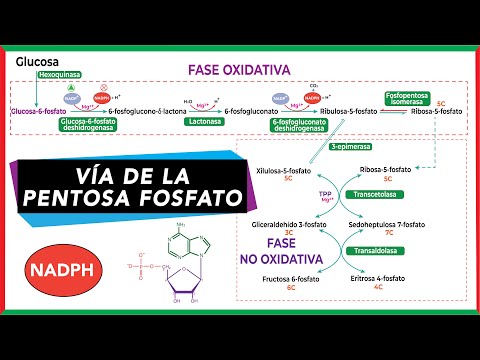
- Glucose 6-phosphate converts to gluconolactone through glucose 6-phosphate dehydrogenase (G6PD), generating NADPH; this step is rate-limiting and highly regulated by magnesium ions and NADP⁺ levels.
- Deficiencies in G6PD can lead to serious health consequences due to impaired redox balance within cells. Following this step, gluconolactone transforms into 6-phosphogluconate via lactonase, which also requires magnesium as a cofactor.
Transition to Ribulose 5-Phosphate
- The conversion of 6-phosphogluconate into ribulose 5-phosphate occurs with another generation of NADPH through the enzyme phosphogluconate dehydrogenase; one carbon atom is released as CO₂ during this transformation.
Non-Oxidative Phase
Conversion Processes
- Ribulose 5-phosphate can be converted back into ribose 5-phosphate via ribose 5-phosphate isomerase or further processed into xylulose 5-phosphate through epimerization reactions requiring iron as a cofactor.
Carbon Transfer Reactions
- Transketolase facilitates carbon transfer between sugars resulting in glyceraldehyde 3-phosphate (G3P) and sedoheptulose 7-phosphate while maintaining a total carbon count of ten throughout these transformations; thiamine pyrophosphate (TPP) acts as an essential cofactor here alongside magnesium ions.
Final Steps
Overview of the Pentose Phosphate Pathway
Key Phases of the Pathway
- The non-oxidative phase generates intermediates for glycolysis or gluconeogenesis, specifically converting fructose 6-phosphate to pyruvate through a series of glycolytic reactions.
- Fructose 6-phosphate can enter the oxidative phase, continuing to generate NADPH, which is crucial depending on cellular requirements for synthesis pathways.
- Glyceraldehyde 3-phosphate (G3P) can also enter either glycolysis or gluconeogenesis; it highlights the versatility of these metabolic routes.
Reversible Reactions and Their Importance
- Through reversible reactions catalyzed by transaldolase and transketolase, ribose 5-phosphate can be formed, essential for nucleotide synthesis.
- The oxidative phase is irreversible and converts glucose 6-phosphate into ribulose 5-phosphate and NADPH. The non-oxidative phase allows conversion back to ribose 5-phosphate and xylulose 5-phosphate.
Contextual Dependency in Metabolic Demand
- The proportion of components generated, such as NADPH and ribose 5-phosphate, depends on cellular context and demands.
Turn any video into a summary like this
YouTube links, meetings, lectures. With transcripts, search, and chat.