The incredible inventions of intuitive AI | Maurice Conti
Introduction
The speaker addresses a diverse audience of creatives, designers, engineers, entrepreneurs, artists, and individuals with big imaginations. They introduce the concept of significant changes in the way we work over the next 20 years.
The Dawn of a New Age
- The speaker suggests that more changes will occur in the next 20 years than in the past 2,000 years.
- They believe that humanity is entering a new age in history.
Historical Eras of Work
- Four major historical eras are defined by the way we work: Hunter-Gatherer Age (millions of years), Agricultural Age (thousands of years), Industrial Age (centuries), and Information Age (decades).
- We are now on the cusp of a new era called the Augmented Age.
The Augmented Age
In this section, the speaker explains how our natural human capabilities will be augmented by computational systems, robotic systems, and a digital nervous system.
Cognitive Augmentation
- The speaker asks how many people consider themselves augmented cyborgs.
- They argue that humans are already augmented due to access to information through devices like smartphones.
- However, current tools are still passive and require explicit instructions from users.
Generative Design Tools
- The speaker envisions having conversations with computers for design purposes.
- They introduce generative design tools that use algorithms to explore solution spaces and come up with designs beyond human imagination.
- These tools can generate solutions based on given goals and constraints.
Real-world Applications
This section highlights real-world applications of generative design tools.
Airbus Collaboration
- The speaker mentions collaborating with Airbus on designing a concept plane for the future.
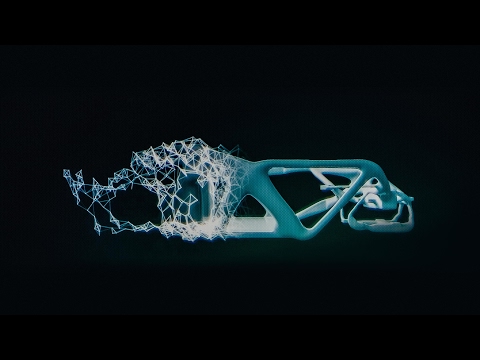
- They showcase a 3D-printed cabin partition designed by a computer, which is stronger and lighter than the original design.
- This generative design AI will be implemented in an Airbus A320.
Limitations of Current Tools
- While computers can generate solutions to well-defined problems, they lack intuition and learning capabilities.
- The speaker compares current tools to Maggie, a dog who learns from repeated experiences.
Conclusion
The speaker concludes by emphasizing the potential of augmented human capabilities through computational systems and generative design tools.
Augmented Human Potential
- The speaker highlights how humans can leverage computational systems and generative design tools to enhance their problem-solving abilities.
- They express excitement about the future possibilities of these technologies.
Timestamps are provided for each section based on the available transcript.
New Section
This section discusses the progress made in AI over the years, from playing simple games like Tic-Tac-Toe to beating humans at complex games like chess and Jeopardy. It also highlights the development of intuition in AI systems.
Progress in AI Gaming
- In 1952, a computer was built that could play Tic-Tac-Toe.
- In 1997, Deep Blue defeated Kasparov at chess.
- In 2011, Watson beat human opponents at Jeopardy using reasoning instead of predefined recipes.
- Recently, AlphaGo defeated the world's best human player at Go, a game with more possible moves than there are atoms in the universe.
Development of Intuition
- AlphaGo had to develop intuition to win at Go.
- At times, even its programmers didn't understand why AlphaGo made certain moves.
New Section
This section explores how technology can amplify our cognitive abilities and help us solve complex problems such as climate change. It also discusses the potential for computers to provide feedback on creative endeavors.
Amplifying Cognitive Abilities
- Technology can enhance our cognitive abilities and help us imagine and design things beyond our reach as un-augmented humans.
- Computers equipped with deep-learning systems are developing intuition similar to human intuition.
- Soon, computers will be able to provide feedback on designs or creative works and assist in problem-solving tasks like climate change mitigation.
New Section
This section focuses on how technology can augment humans in both the physical and virtual realms. It introduces the concept of human-robot collaboration and showcases examples of robots assisting humans in construction tasks.
Human-Robot Collaboration
- Humans and robots can augment each other's capabilities through collaboration.
- Robots can excel at precision and repetitiveness, while humans contribute awareness, perception, and decision-making skills.
- Examples include a robot named Bishop assisting with repetitive construction tasks and a project called HIVE where humans, robots, and AI worked together to solve a complex design problem.
New Section
This section presents an ambitious project involving generative design and robotic printing to create the world's first autonomously manufactured bridge.
Autonomously Manufactured Bridge
- Collaboration between artist Joris Laarman's team at MX3D and researchers aims to create a bridge using generative design and robotic printing.
- The project demonstrates how human, robot, and AI augmentation is essential for achieving such complex endeavors.
New Section
In this section, the speaker discusses the need for a nervous system for the things we create and use.
The Importance of a Nervous System
- Our ability to imagine and design new things is augmented by computers.
- Robotic systems help us build things that were previously impossible to make.
- However, our ability to sense and control these things is limited.
- The human nervous system informs us about what's happening around us.
- The nervous system of the things we make is rudimentary at best.
- Cars, buildings, and toys lack the ability to communicate important information.
Designing Better Experiences
- If designers had knowledge of how their creations are being used in the real world, they could improve user experiences.
- A missing component is a nervous system connecting us to all the things we design, make, and use.
Connecting with Designs
- Imagine having information flowing from the things you create in the real world.
- By establishing a connection between designers and their creations after they are sold or launched, we can shift from making people want our stuff to making stuff that people want.
Digital Nervous Systems
- Efforts are underway to develop digital nervous systems that connect us to our designs.
- Collaboration with organizations like Bandito Brothers involves creating a nervous system for cars through sensors and AI technology.
Augmented Design Capabilities
- By combining human creativity with generative-design AI, digital nervous systems, and fabrication robots, we can achieve designs that surpass human capabilities.
- This represents a future where humans are augmented cognitively, physically, and perceptually.
New Section
In this section, the speaker envisions a future where technology, nature, and humanity collaborate to shape a new world.
Shaping the Future
- The future will involve moving from fabricated things to farmed things.
- Construction will be replaced by growth.
- Isolation will give way to connectivity.
- Extraction will be replaced by aggregation.
- Autonomy will be valued over obedience.
Augmented Capabilities
- Thanks to augmented capabilities, our world is set to undergo dramatic changes.
- These changes include increased variety, connectedness, dynamism, complexity, adaptability, and beauty.
A New Partnership
- The shape of things to come will be shaped by the partnership between technology, nature, and humanity.
The transcript provided does not contain timestamps for every line. Therefore, some sections may not have associated timestamps.
Turn any video into a summary like this
YouTube links, meetings, lectures. With transcripts, search, and chat.