Life Is Supposed To Be Difficult (The Way To Mental Mastery)
Introduction
The speaker talks about the discomfort that humans experience and how it is necessary to reach a level of mind that is comfortable with discomfort in order to achieve true comfort.
Comfort is an Impermanent State
- Humans love to call comfort home, but the longer we box ourselves into this mental house, the more uncomfortable it gets.
- True comfort can only be achieved by reaching a level of mind that is comfortable with discomfort.
- Most people's automatic reaction when faced with an uncomfortable situation is to flee rather than fight.
Discomfort Creates Tension
- When we flee from discomfort, our mind wants to move towards the mental comfort of a past experience. This projection out of the present moment creates tension that can stay around much longer than we'd like.
- This tension leads to feeling lost, overwhelmed or uncertain about the future and makes it difficult to gain clarity on what to pursue next.
- Clarity can only be gained by leaning into discomfort and moving forward in life in a way that aligns with our goals.
Narrow Perspective Leads to Negative Perception
- Most people have a narrow perspective, especially when focused on a problem which leads to negative perception of the situation and inaccurate decision making.
- Broadening your perspective by approaching life with an open mind allows you to accept situations as they are and reap joy from progress.
Philosophy vs Practice
The speaker discusses how philosophy must meet practice for it to be effective.
Grounding Philosophy in Reality
- Theory has to meet practice for philosophy to be effective.
- Philosophers can intellectualize all day, but can they run a business?
- Practical results are necessary to back up claims made by philosophers.
Aligning Actions with Words
- Actions must align with words.
- Observing societal patterns is a good practice to adopt into your life.
The Importance of Aligning Actions with Beliefs
In this section, the speaker discusses how important it is to align actions with beliefs and shares his philosophy on creating one's own philosophy.
Creating Your Own Philosophy
- It's important to create your own philosophy and live by it.
- Don't take prescriptions or hard set advice from others until you test it and see how it fits in your life.
- Internalize the knowledge or philosophy that you are picking up along the way.
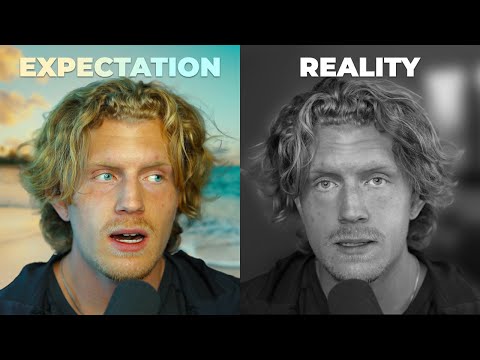
Expectation vs Reality
In this section, the speaker talks about expectations and how they can narrow our minds towards a predictable future.
Expectations
- Expectations are beliefs conditioned into our mind as we go about life from a young age.
- Expectations narrow our mind towards a predictable future, closing off potentially other potential futures.
- Following preset expectations projected by society can lead to pain and suffering.
Choices
- Choices are the bricks that build your future self and life.
- Face reality of your own situation and open your mind to potential opportunities available.
Creating Your Own Goals
In this section, the speaker discusses how individuals can create their own goals and find aligned mentors to help them achieve those goals.
Niche Down Towards a Goal
- Individuals should create their own goals rather than adopting the expectations of others they see online.
- It is important to search for aligned mentors, education, and advice that will help individuals reach their specific goals in their unique situations.
- Hard set prescriptive actionable advice may not always apply to an individual's situation. They must extract the essence or truth of what is being said and apply it to their own context.
Concept vs Experience
In this section, the speaker explains how concepts are layers over experience and how understanding comes from experience.
Reality is Experience
- Reality is experience, and concepts are layers over experience.
- The concept of God is an example of a concept pointing towards an experience that religious people attach to causing unnecessary tension when people disagree on that concept because experience is personal.
Knowing vs Understanding
- Concepts allow you to know while experiences allow you to understand.
- Knowledge is a layer on top of reality used as a symbol representative of an experience while understanding is inherent in human consciousness as internal versus external awareness.
What Is vs What Isn't
In this section, the speaker emphasizes making a distinction between what is and what isn't as a way to close the gap between expectation and reality.
The Present Moment Is What Is
- Making a distinction between what is and what isn't helps close the gap between expectation and reality.
- The present moment or direct experience is the only thing that is, and anything aside from that is what isn't.
The Importance of Experience Over Concepts and Expectations
In this section, the speaker emphasizes the importance of personal experience over concepts and expectations. He explains that while concepts and expectations can be useful as guides, they should not be treated as reality. Instead, individuals should focus on experiencing life in order to extract personal lessons.
Personal Lessons from Experience
- Personal lessons cannot be taught except by personal experience.
- Concepts and expectations are useful but should only be treated as guides.
- Negative perceptions of concepts and expectations can cause stress, overwhelm, anxiety, and feeling lost.
- Beliefs, expectations, and concepts are not reality.
Increasing Your Level of Mind
- Meditation is a good practice to get out of your head and into reality.
- Solving problems increases your level of mind or how you interact with reality.
- Problems create a gap between expectation and reality that requires a higher perspective to solve.
- The broader your perspective becomes, the more you increase your level of mind.
Solving Problems for Personal Evolution
- Perspective or level of mind houses beliefs, ideas, skills, experience, potentialities for the future.
- Solving problems increases your level of mind which allows you to view problems from a better lens.
- Life is about solving problems; it's what the universe is all about throughout evolution.
- Once you master survival by solving surface-level problems like health or finances then you can move on to joining collective minds or communities helping others.
Expectation and Reality
This section discusses the relationship between expectation, reality, and experience. It explains how experience gained from navigating problems can be transferred into business.
Gaining Experience
- Navigating problems helps you gain experience.
- Experience gained from problem-solving can be transferred into business.
- Teaching others helps you gain more experience.
Living at Your Edge
- To reach new levels of mind, you have to encounter problems and live at your edge.
- Pursuing goals that are closer to your current level of skill allows you to solve problems and gain experience.
- Closing the gap between expectation and reality requires solving subsequent problems step-by-step.
Steps for Increasing Your Level of Mind
- Pursue a challenging goal that is not impossible for your current state of mind.
- Create clarity on the path to achieving your goal by breaking it down into actionable steps.
- Perceive accompanying problems from a better lens if the goal is too high or far away.
- Act on your goal every single day by organizing your time around it.
Pursuing Goals and Finding Peace of Mind
In this section, the speaker discusses how pursuing goals can lead to peace of mind. He explains that progress is necessary to solve relationship problems and that peace of mind is a byproduct of pursuing goals.
Steps to Achieving Goals
- Telek and atelic activities are different states of being where there's doing nothing and then there's doing. The way you reap fulfillment from it is by focusing still on the present moment while holding the goal in the back of your mind.
- Everything in life evolves, so once you actualize one goal, you're going to have to set another. Stay conscious of present moment difficulty.
- You will hit a critical point or perception threshold when difficult becomes enjoyable after pushing through discomfort. Train your pain tolerance by taking on an increasing level of challenge.
Perception Threshold
- Perceived difficulty increases as your mind starts to narrow in on little things going on in your head. Once you accept reality for what it is, perceived difficulty decreases, and you can start finding more enjoyment in the actual difficulty.
- Thoughts and emotions flood your mind when faced with challenges like writer's block or hesitation to post content. The only way out is through.
Conclusion
- Training your pain tolerance takes time but hitting the perception threshold leads to enjoyment in achieving goals.
Overcoming Difficulty with Writing
In this video, the speaker discusses how to overcome difficulty with writing and shares tips on how to adopt a higher perspective when facing challenges.
Adopting a Higher Perspective
- When facing difficulties with writing, it's important to adopt a higher perspective.
- This allows you to see the problem for what it is and not get bogged down by negative thoughts.
- Not having ideas for your writing should not be an excuse for not performing the last rep that leads to the most gains.
- Push through and don't let fear hold you back from posting your first piece of content.
Deep Satisfaction as a Result
- Overcoming difficulty with writing can lead to deep satisfaction.
- Check out 202 Hour Writer (link in description) for theory backed by practice on how to face this difficulty head-on.
- Other resources are available in the description as well.
- Like, subscribe, and comment if you enjoyed the video.
Turn any video into a summary like this
YouTube links, meetings, lectures. With transcripts, search, and chat.