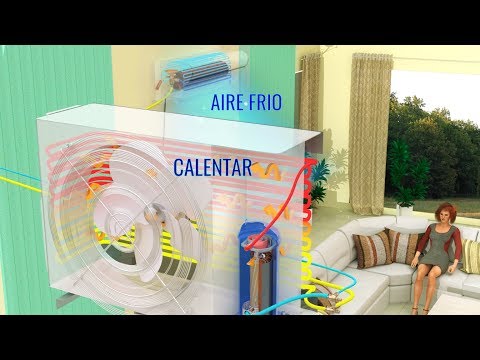
¿Cómo funciona tu aire acondicionado?
How Do Air Conditioners Work?
Introduction to Air Conditioning
- Air conditioners provide thermal comfort during hot summers by maintaining optimal ambient temperature and removing air particles and humidity.
- The video is supported by Danfoss, which offers free lessons on refrigeration systems through their e-learning platform.
Basic Components of an Air Conditioner
- An air conditioner consists of two coils connected by refrigerant: the evaporator (inside the room) and the condenser (outside).
- The fundamental principle is to keep the evaporator colder than the ambient temperature while keeping the condenser hotter, allowing heat absorption from inside to be expelled outside.
Functioning Mechanism
- Two additional components are essential: a compressor and an expansion valve. The compressor increases refrigerant pressure, raising its temperature.
- Hot gas from the compressor passes through the condenser where it releases heat with help from a fan, condensing into liquid refrigerant.
Refrigeration Cycle Process
- The expansion valve restricts refrigerant flow, reducing its pressure. This allows part of the liquid refrigerant to evaporate, cooling down as it absorbs energy.
- Cold refrigerant circulates over the evaporator coil, absorbing heat from indoor air and lowering room temperature.
Understanding Cooling Capacity
- "Tons" in air conditioning refers to how much heat an evaporator can absorb; it indicates cooling capacity.
- In practical designs, compressors are near condensers while expansion valves are close to evaporators for efficiency.
Addressing Practical Challenges
- Low temperatures at evaporator coils can cause condensation; thus, drainage pipes are necessary for excess water removal.
- Modern units use scroll compressors that operate quietly and maintain consistent temperatures regardless of load due to variable speed motor technology.
Ensuring Efficient Operation
- Compressors must handle only vapor; any liquid content can impair performance. Evaporators should convert all liquid into vapor before entering compressors.
Understanding TXV Operation in Refrigeration Systems
The Role of the TXV in Temperature Control
- The refrigerant exiting the evaporator remains at a low temperature, preventing overheating as it enters the compressor. This is crucial for maintaining system efficiency.
- The low temperature detected by the bulb causes an upward movement of the needle, resulting in a narrower restriction. This adjustment leads to a significant drop in temperature, allowing the evaporator to receive much colder fluid.
- The TXV ensures that all liquid refrigerant is converted into vapor before entering the compressor, automatically maintaining optimal conditions for efficient operation.
- A common misconception is clarified: TXVs do not control ambient temperature; instead, they ensure that only pure vapor reaches the compressor.