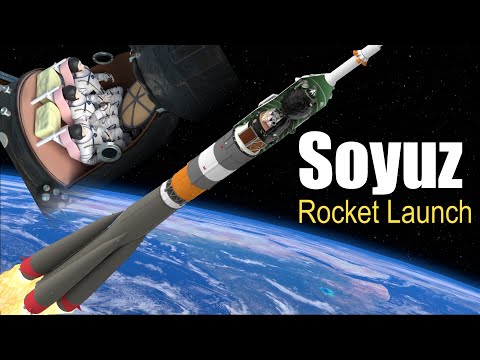
How does the Soyuz Launch work? (and Reentry)
How Does the Soyuz Rocket Launch?
Introduction to the Soyuz Spacecraft
- The Soyuz is a Russian spacecraft designed to carry a crew of three, launched aboard the Soyuz rocket.
- Jared introduces himself and mentions his background in creating 3D animations, including previous work on how the Soyuz spacecraft operates and its docking with the International Space Station.
Launch Site and Historical Context
- The launch occurs at Baikonur Cosmodrome in Kazakhstan, while mission control is located in Moscow, Russia.
- Historical context: The Baikonur Cosmodrome was established during the Soviet Union era in the 1950s, explaining why Russia launches from Kazakhstan.
Physics of Rocket Launching
- Optimal launch locations are near the Equator due to Earth's rotational speed providing a speed boost; Kazakhstan offers a better position than Russia for this purpose.
Rocket Assembly Process
- The Soyuz rocket stands about 50 meters tall with the spacecraft inside a protective covering called the launch shroud.
- Initial assembly takes place in Building 254 where extensive testing ensures functionality before moving to Building 112 for horizontal assembly.
Rollout and Preparation for Launch
- The rollout process occurs two or three days prior to launch, transporting the assembled rocket on a slow-moving train to the launch pad.
- Protective coverings on each engine are removed shortly before liftoff; support structures secure the rocket as it transitions to vertical positioning.
Comparison with NASA's Approach
- Contrasting methods: NASA builds rockets vertically and uses large crawlers for transport, while Soyuz employs horizontal assembly followed by vertical positioning at launch.
Rocket Specifications and Stages
- The Soyuz rocket utilizes kerosene and liquid oxygen across three stages: four side boosters plus a central block (first stage), just central block (second stage), and smaller upper block (third stage).
Safety Features of Launch System
- A launch escape tower is included for emergency situations; it can detach parts of the spacecraft if needed during liftoff.
Pre-launch Activities
- Five hours before liftoff, fuel tanks are filled; crew members arrive wearing Sokol spacesuits equipped with portable cooling units until they board.
Crew Boarding Procedure
- Crew members take final photos before entering through a hatch leading into different modules of the spacecraft.
Soyuz Spacecraft Launch and Re-entry Process
Pre-launch Preparations
- The commander in the center seat has a stick to reach all controls, while a zero-G indicator (often a toy) serves as a visual reminder of weightlessness.
- All crew members must be fluent in Russian, as all operations inside the Soyuz spacecraft are conducted in this language.
- Two hours before launch, multiple checks ensure the rocket and spacecraft's readiness; music is played to help relax the crew.
Launch Sequence
- Personnel evacuate from the launch pad 15 minutes prior to liftoff. The first umbilical tower releases at 35 seconds before launch, followed by the second at 15 seconds.
- The automated Soyuz launch requires crew readiness for emergencies; it begins pitching over about 20 seconds after liftoff.
- At just under nine minutes into flight, main engine cutoff (MECO) occurs, separating the Soyuz spacecraft from its boosters.
Post-launch Operations
- Antennas and solar panels deploy after MECO, generating power for the spacecraft as it reaches an altitude of approximately 240 kilometers at speeds of 27,000 km/h.
- The next phase involves rendezvous and docking with the International Space Station (ISS), where crews typically spend six months.
Return Journey
- After saying goodbyes on ISS, astronauts enter Soyuz for undocking. They detach from ISS and prepare for re-entry about three and a half hours later.
- A deorbit burn slows down Soyuz for atmospheric re-entry; this process mirrors Hohmann Transfer but focuses on lowering orbit instead of raising it.
Re-entry Procedures
- Thirty minutes post-deorbit burn, modules separate by turning 90 degrees to avoid collision during descent; only the descent module survives re-entry.
- As atmosphere thickens during re-entry, small thrusters steer the module while heat shields protect against extreme temperatures.
Landing Mechanics
- A radio blackout occurs during descent due to heat interference. Unlike NASA's splashdown method, Soyuz lands on solid ground but can float if landing in water.
Landing Procedures and Recovery
Descent Module Touchdown
- The landing process generates significant dust, indicating the force of touchdown.
- Upon landing, parachutes are disconnected to prevent the capsule from being dragged by wind.
- Astronauts and cosmonauts require assistance to exit the descent module after landing.
- A recovery crew is typically stationed nearby, prepared to welcome the returning space travelers.
Turn any video into a summary like this
YouTube links, meetings, lectures — with transcripts, search, and chat.