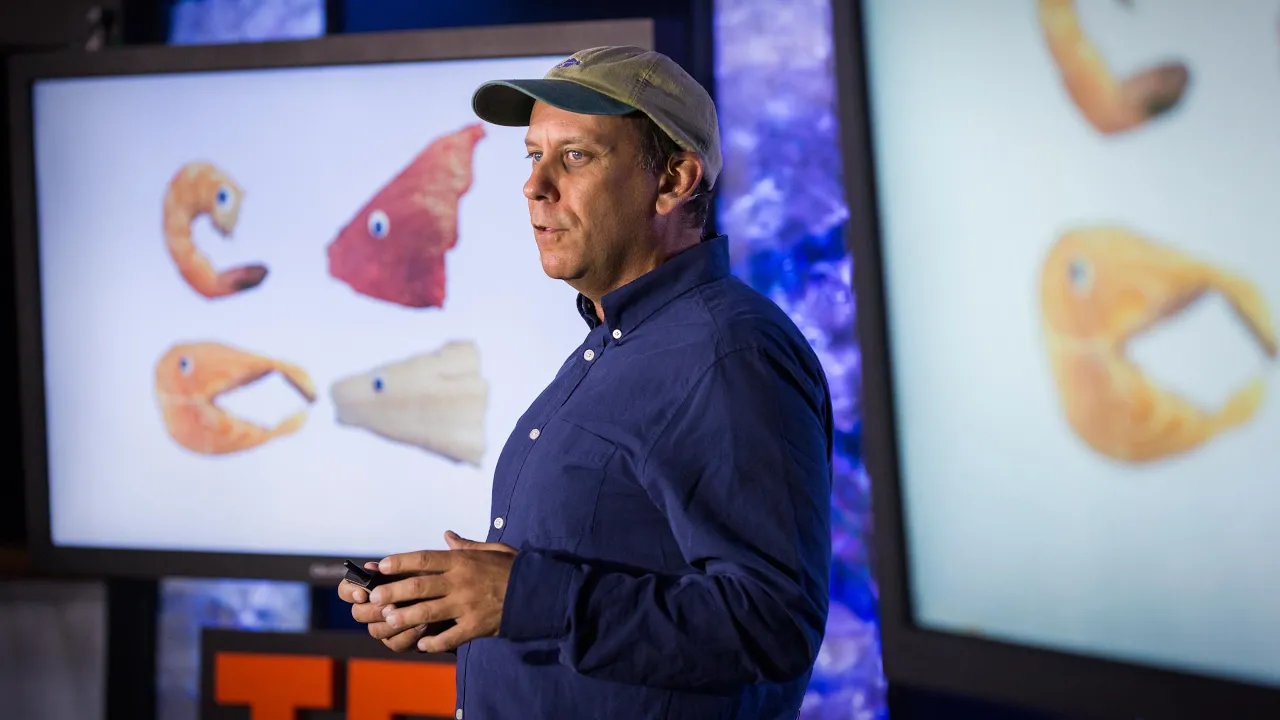
The four fish we're overeating -- and what to eat instead | Paul Greenberg
The Shrinking of the Sea's Bounty
The speaker reflects on his childhood fishing experiences and how the variety of sea creatures he encountered has significantly decreased over time, leading to a limited selection in today's seafood markets.
The Human Tendency to Simplify Nature
- People tend to reduce the natural world to a few key elements, as seen historically with mammals like pigs, cows, sheep, and goats.
- This simplification trend extends to birds and seafood, where menus have transitioned from offering diverse options to focusing on a select few species.
Impact of Fishing Practices
- Post-World War II technological advancements led to a surge in fishing capacity, resulting in the extraction of 80-90 million metric tons of fish annually.
- Fish farming has grown substantially, surpassing wild fish production. The combination equals the weight of two Chinas harvested from oceans each year.
Environmental Consequences of Shrimp Farming
The speaker delves into the environmental repercussions of shrimp consumption and farming practices.
Destructive Shrimp Farming
- Shrimp farming involves significant bycatch and high carbon emissions due to dragging methods.
- Shrimp farms located in mangrove forests contribute to habitat destruction and loss of coastal protection.
"Grinding Nemo" Phenomenon
- Coastal mangrove forests face extensive degradation due to shrimp farming activities.
- Bycatch from shrimp draggers is ground up for shrimp feed, perpetuating an unsustainable ecosystem cycle.
Challenges in Tuna Management
The discussion shifts towards tuna consumption and challenges associated with managing this global fish species.
Global Tuna Consumption
- Tuna ranks as one of the most consumed seafood globally after shrimp.
- International efforts like ICCAT aim to regulate tuna fishing but face ongoing management issues.
Unsuitability for Aquaculture
The Impact of Aquaculture on Seafood Consumption
The speaker discusses the impact of aquaculture on seafood consumption, focusing on salmon and other fish varieties.
Salmon Overconsumption
- Salmon is a highly consumed seafood in America and the West.
- Dams in states like Connecticut hinder wild salmon from reaching their spawning grounds.
Aquaculture Practices
- Aquaculture has become popular due to dams blocking wild salmon migration.
- Initially, it took six pounds of wild fish to produce one pound of farmed salmon; now, it's below two to one.
Environmental Impact
- Despite improved efficiency, aquaculture production levels are unsustainable.
- Large quantities of wild creatures are harvested annually for feed production.
Evolution of Fast Food Fish Choices
The speaker explores the evolution of fast-food fish choices and its environmental implications.
Fast-Food Fish Evolution
- The Filet-O-Fish sandwich transitioned from halibut to Alaska pollock due to cost considerations.
- Atlantic cod depletion led to the current use of Alaska pollock in the Filet-O-Fish sandwich.
Sustainable Alternatives
- Tilapia emerged as a sustainable option but lacks desired omega-3 content for Western markets.
Exploring Alternative Seafood Sources
The speaker delves into alternative seafood sources and their potential benefits.
Clupeids as Food Source
- Proposes direct consumption of clupeids instead of using them for aquafeed due to efficiency and omega-3 content.
Bivalves as Sustainable Option
- Mussels offer high EPA and DHA content with minimal carbon footprint compared to beef production.
What Can We Learn from Mussels and Seaweed?
The speaker discusses the importance of mussels and seaweed in filtering water, addressing issues like algal blooms and dead zones while highlighting their nutritional value.
Mussels: Nature's Water Filters
- A single mussel can filter dozens of gallons daily, crucial for combating nitrification and phosphate overuse causing algal blooms.
- Mussels' water filtration concept extends to feeding seaweed to cows as a sustainable practice in water-limited areas.
Seaweed: A Nutrient-Rich Alternative
- Exploring seaweed as a high omega-3 and protein source, potentially aiding in sustainable food production.
Creating Aquacultured Fish for Sustainable Protein
The speaker delves into the potential of aquacultured fish as a solution for sustainable marine protein production.
Aquacultured Fish Criteria
- Describes the ideal aquacultured fish characteristics: vegetarian, fast-growing, adaptable to climate change, with an oily fish profile rich in EPA, DHA, omega-3 fatty acids.
Turn any video into a summary like this
YouTube links, meetings, lectures. With transcripts, search, and chat.