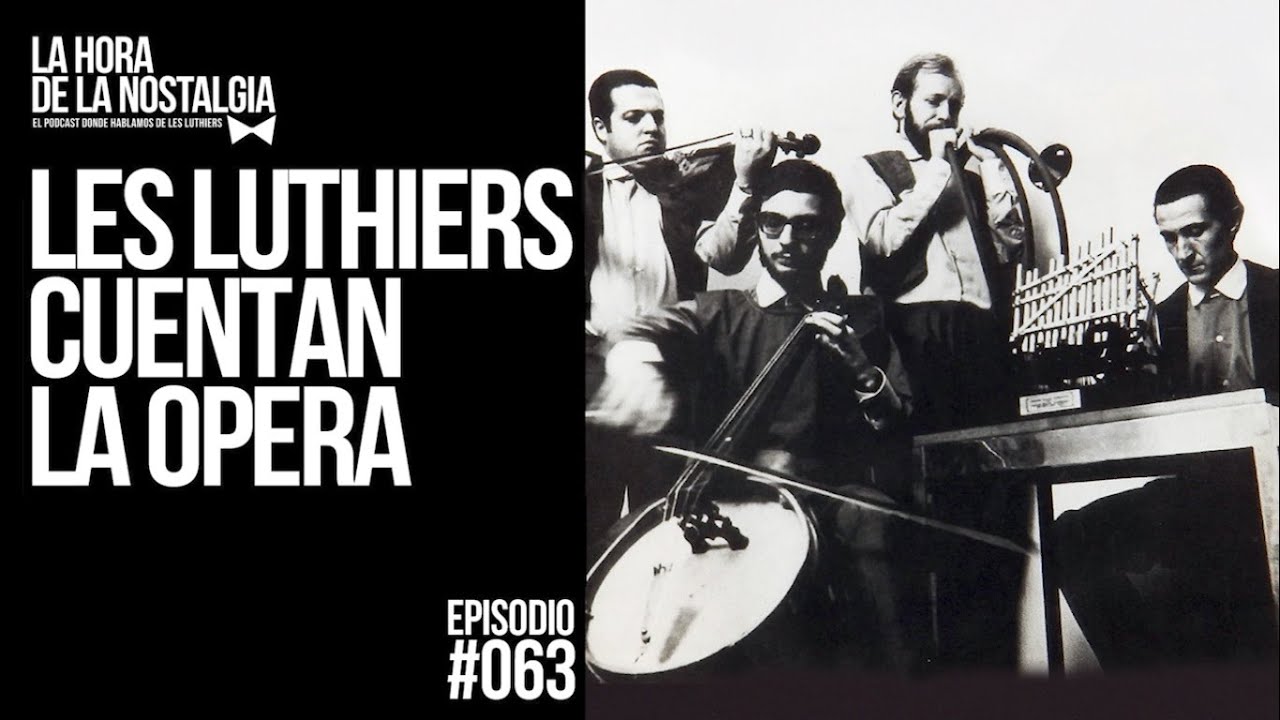
Les Luthiers Cuentan la Ópera - Episodio 063 de "LHDLN", el Podcast donde hablamos de Les Luthiers
New Section
The podcast "La Hora de la Nostalgia" is introduced with the hosts presenting themselves and setting the stage for discussing a historical show called "Le Luthier."
Introducing the Podcast Hosts
- Rosendo introduces himself as the host of the podcast.
- Other hosts, including Body Fazio, Arquímedes, Mati Strade, and a columnist, also introduce themselves.
Historical Context of Le Luthier
The discussion delves into the background of the first show by Le Luthier, exploring events leading up to its creation.
Preparing for the Show
- On September 4th, 1967, tensions arose within the group before a performance at Instituto de Itela.
- Gerardo decided to leave with his works and instruments after a heated argument within the group.
New Insights on Historical Events
- Leandro de Becky's book sheds light on Daniel's anger towards Jorge during their separation from Musichisti.
- Gerardo's letter to his family in September '67 hints at preparations for their new show under the name Le Luthier.
Show Preparation and Evolution
The conversation shifts towards how Le Luthier quickly prepared for their upcoming show after parting ways with Musichisti.
Rapid Show Development
- Due to urgent show requirements at Ditela, Le Luthier hastened to create a repertoire to replace Imilo's work.
- Within a busy semester, they were simultaneously working on music for another play titled "Angelito el Secuestrado."
Expanding Cast and Collaborations
The discussion focuses on expanding the cast for their shows and collaborations with other artists.
Inclusion of New Members
- Víctor Laplace, Elizabeth Henry, Mario Candel, Armando Trigger joined Le Luthier along with four original members.
New Section
In this section, the speaker reflects on their experiences over 40 years and the joy they found in being part of certain events.
Reflection on Joyful Experiences
- The speaker expresses that in their 40 years, they have not encountered experiences as joyful as being part of certain events.
- Being invited to these events remains a privilege that is cherished by the speaker.
New Section
The speaker recalls a moment involving a dermatophone and musical instruments during a performance.
Recollection of Musical Instruments
- The speaker vividly remembers encountering a dermatophone, which was like a split mate (a traditional South American cup for drinking mate).
- Playing this instrument was significant to the speaker, representing the utmost they could achieve musically.
New Section
The speaker reminisces about making empanadas and feeling immense happiness during those moments.
Nostalgia for Making Empanadas
- Making empanadas brought great joy to the speaker, who describes feeling like the happiest person in the world.
- These memories evoke strong emotions and highlight the significance of these experiences in shaping cultural expression.
New Section
The speaker discusses their involvement in an opera production following historical operas.
Involvement in Opera Production
- The opera premiered on November 14th, 1967 at Instituto Di Tella in Buenos Aires, Argentina.
- It was performed 20 times with its final show on December 23rd of the same year at the same venue.
New Section
Details about the scriptwriters and composers involved in the opera production are shared by the speaker.
Insight into Scriptwriters and Composers
- The script was written by Marcos Mustock, with music composed by Gerardo and Jorge.
- Specific songs within the opera are attributed to different lyricists and composers involved in creating this theatrical piece.
New Section
In this section, Juan expresses his views on the use of voice-over in a theatrical production and discusses the complexity and confusion caused by excessive names and characters.
Juan's Perspective on Voice-Over
- Juan finds voice-over to be an outdated resource that he struggles to comprehend due to its complexity.
- He mentions that the abundance of names and characters in the show leads to confusion, with little humor derived from it.
Complexity of Characters
- The show introduces numerous characters who have minimal stage presence, primarily appearing to justify the songs they perform.
- References to Amati and Stradivarius are noted as significant, potentially hinting at a deeper mystery within the narrative.
Exploring Musical Elements
This segment delves into musical compositions within the performance, highlighting similarities between different songs and their evolution across various shows.
Musical Composition Analysis
- A comparison is drawn between two versions of a song from different shows, emphasizing differences in lyrics while maintaining musical consistency.
- Marcos' inclusion of specific instrument quartets adds depth to the composition, setting a unique tone for each rendition.
Significance of Introductions in Music
The discussion centers around introductory elements in music performances and their role in setting the tone for the show.
Importance of Introductions
- The introductory chorus "Somos Lelotie" is praised for its beauty and historical significance within the narrative.
- Reflection on past musical traditions reveals how introductions served as a form of musical greeting or presentation for new concepts or groups.
Evolution of Performance Names
This part explores how performance names evolve over time based on audience reception and identity establishment.
Evolution of Performance Names
- Groups often modify their names as a means of identification or rebranding based on audience feedback or internal considerations.
New Section
In this section, the speaker discusses the evolution of the text and its humor, comparing earlier versions to later revisions for enhanced entertainment value.
Evolution of Text Humor
- The speaker finds earlier texts not very bright but notes that subsequent corrections made them much more enjoyable.
- There is a mention of a line about "chevrolegüero" and its unclear reference.
- The introduction of rhymes in the text is highlighted as a positive change for enhancing entertainment.
New Section
This part delves into the improvements seen in later performances of the show compared to initial versions.
Show Improvement
- Despite some confusion in understanding the lyrics initially, significant enhancements are noted in later shows.
- The performance is acknowledged to have improved considerably in subsequent spectacles.
New Section
Discussion on the informal presentation of instruments at the beginning of the show and its significance.
Informal Instrument Presentation
- The show starts with an informal display of instruments by the performers.
- Contrary to expectations, minimal informal instrument playing occurs throughout the rest of the performance due to its thematic focus.
New Section
Introduction to characters and themes within the performance, including historical references.
Character Introductions
- Víctor Laplace's first appearance singing a song about King Francis I sets the stage for subsequent character developments.
- Historical references such as battles between King Francis I and Charles V are intertwined with character narratives.
New Section
Analysis of comedic elements within songs and performances.
Comedic Elements
- Observations on subtle humor present in songs like "King Francis I" hint at playful undertones amidst serious themes.
- The incorporation of humor through music adds depth to character portrayals and storytelling.
New Section
Performance highlights focusing on combat scenes and energetic delivery.
Energetic Combat Scenes
- Energetic combat scenes are depicted through lively performances by actors during battle sequences.
- Themes of valor, luck, and patriotism are emphasized through dynamic musical renditions during combat acts.
New Section
Interpretation of war-related lyrics within performances.
War Depictions
- Lyrics portraying war against Germany, Italy, and England evoke patriotic sentiments among performers and audience members alike.
- Interpretations vary regarding references to fighting from behind (retaguardia) during battles within historical contexts discussed in performances.
New Section
In this section, the speaker discusses a performance that was highly encrypted for a specific audience, leading to a humorous situation where young individuals made jokes about an unfamiliar topic. The contrast in audience reception and understanding between different groups is highlighted.
Performance Encryption and Audience Perception
- The performance was very encrypted for a select audience who enjoyed opera. -
- Young people made jokes about a topic unfamiliar to them, causing amusement among the audience. -
- Lack of familiarity with the subject matter led to differing reactions between audiences. -
New Section
This segment delves into a comparison between Cleopatra and contemporary figures, emphasizing perceptions of beauty and cultural preferences across different eras.
Cleopatra vs. Modern Beauty Standards
- Humorous comparison made between Cleopatra and modern figure Sol Pérez regarding attractiveness. -
- Discussion on how Cleopatra was admired by certain audiences while others preferred figures like Sol Pérez. -
New Section
Here, the focus shifts to a song attempting to replace Tales' theorem with Archimedes' calypso, followed by reflections on its impact compared to previous performances.
Song Comparison and Impact Analysis
- Introduction of a song replacing Tales' theorem with Archimedes' calypso discussed in the performance context. -
- Evaluation of the song's quality compared to previous pieces like Tales' theorem in terms of entertainment value. -
New Section
This part explores the concept of "baricentro" introduced after discussing Archimedes, leading to an explanation related to gastronomy and mass centers.
Understanding "Baricentro" Concept
- Definition and significance of "baricentro" explained within the context of gastronomy and mass centers. -
- Elaboration on technical aspects related to "baricentro" as it pertains to triangular geometry and mass distribution. -
New Section
The discussion transitions into confusion surrounding the term "baricentro," prompting further exploration through references in subsequent parts of the performance.
Clarifying "Baricentro" Misunderstanding
- Continued perplexity regarding the use of "baricentro" post-Archimedes discussion leads to speculation on its intended meaning within the narrative flow. -
New Section
In this section, the speaker discusses various aspects related to success and envy.
Success and Envy
- The speaker mentions the success achieved with a clear volume three shoe, highlighting numerous successes.
- People tend to forget past achievements quickly, indicating a tendency to focus on current successes.
- Envy is highlighted as others would have loved to experience the happiness that comes with success.
Alucinaciones
This part features a segment titled "Alucinaciones."
Alucinaciones
- The segment titled "Alucinaciones" is presented.
Chacarera del Ácido Disléjico y Zamba de la Ausencia
The discussion transitions from one musical piece to another, exploring different themes within the performance.
Chacarera del Ácido Disléjico and Zamba de la Ausencia
- Transitioning from the chacarera del ácido disléjico to the onda telúrica featuring the zamba de la ausencia.
- Victor Laplace appears in a mysterious role within the performance, adding depth to the characters portrayed.
Te Fuiste y No Volviste - Liturgia Telúrica
This section focuses on the theme of departure and absence in a musical context.
Te Fuiste y No Volviste - Liturgia Telúrica
- The performance includes emotional elements such as te fuiste y no volviste, portraying a tortured soul's journey.
- A sense of eternal farewell is depicted through powerful lyrics and music.
Interpretation of Arquímedes' Principle by Víctor Laplace
Víctor Laplace delivers an intense interpretation of Arquímedes' principle within the narrative.
Interpretation of Arquímedes' Principle
- Víctor Laplace embodies Arquímedes' struggles dramatically, showcasing his abandonment by the indifferent universe.
New Section
In this section, the discussion revolves around the relationship with the alienated world and the recording of a show involving a body submerging in liquid equilibrium.
Relationship with Alienated World
- Marcos later rescues the idea of relating to the alienated world during the recording of "Los Cuatro Vientos."
- Victor Laplace's performance summary in the show is discussed, suggesting more incorporation of calypso music.
Body Submerging in Liquid Equilibrium
- The concept of buoyancy is explained as a result of pressure exerted by a liquid on a submerged body.
- Different outcomes are highlighted, such as bodies floating or sinking in liquid.
Exploring Show Endings
This part delves into the conclusion of performances, including character fates and plot resolutions.
Conclusion of Performances
- The show concludes with various character endings, including sacrifices and mysterious disappearances.
- Archimedes' declining fame due to his secretive research is mentioned, adding an element of intrigue to the narrative.
Closure and Revelations
The segment focuses on final revelations and closures within the show's storyline.
Final Revelations
- Rafael's true identity as Antonina's lost son adds a twist to the plot.
- Contrasting musical closures between versions are discussed for their impact on audience perception.
Comparing Programs
A comparison between two programs is made regarding their design similarities and historical significance.
Program Comparison
- Similarities in design between "Milo" and "Luthie Cuentan la Ópera" are highlighted due to time constraints.
- Critiques about formalities and lack of originality in program design are shared among reviewers.
Evaluating Performances
Reviewers provide ratings based on personal preferences and critical analysis of different aspects of performances.
Performance Ratings
- Reviewers express mixed feelings about performances, highlighting both strengths like historical significance and weaknesses such as lackluster humor.
Music and King Francisco de Francia
The discussion revolves around music and the mention of King Francisco de Francia.
Music and Historical Reference
- Mention of King Francisco de Francia in relation to music.
Evaluation of Performances
Evaluating performances based on luck, bravery, and humor.
Performance Evaluation Criteria
- Luck, bravery, and humor as criteria for evaluating performances.
Reflection on Show Evolution
Reflecting on the evolution of a show over time.
Show Evolution Insights
- Initial perceptions evolving into finding aspects more likable.
Comparative Analysis of Shows
Comparing different shows based on enjoyment levels.
Enjoyment Comparison
- Comparing show ratings with personal enjoyment levels.
Historical Context of Shows
Placing shows in historical context for evaluation.
Historical Significance
- Considering historical context when evaluating show performances.
Evolution of Shows Over Time
Discussing the evolution of shows across different eras.
Show Development Timeline
- Evolution from early shows to more elaborate productions over time.
Humoristic Introductions in Shows
Exploring humorous elements in show introductions.
Humoristic Elements
- Growth in humorous introductions within shows over time.
Promotion and Support Information
Providing information on supporting the podcast through various platforms.
Podcast Support Details
- Ways to support the podcast through different platforms like Patreon and merchandise purchase.
Closure and Call to Action
Concluding remarks and call to action for audience engagement.
Conclusion and Engagement Request
- Encouraging audience subscription, engagement, and support for future episodes.
Behind-the-Scenes Anecdotes
Sharing behind-the-scenes anecdotes from a photoshoot experience.
Photoshoot Anecdote Insights
Music and Jazz Performance
In this section, a jazz performance incorporating elements from previous works is discussed and celebrated.
Jazz Performance Details
- The performance required a significant amount of tuba, creating an impactful moment.
- A piece of jazz was played during the event, composed by Tropiro using elements from previously discarded works.
Opera and Character Costumes
This part delves into the opera and character costumes featured in the podcast.
Opera and Costume Discussion
- The translation of the jazz piece to Spanish is "the repellent green old man woman."
- The speaker humorously mentions leaving to perform in an opera while dressed as a mummy, adding a light-hearted touch to the conversation.
Humorous Interaction
This segment captures a humorous interaction regarding character costumes and playful banter.
Playful Banter Highlights
- A playful scenario is described where someone wishes to take a photo with others while dressed as a mummy, sparking laughter among the participants.