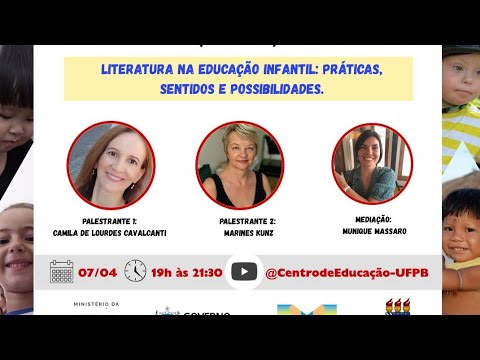
Literatura na Educação Infantil: Práticas, sentidos e possibilidades
Introduction to the Live Session
Host Introduction
- Renata da Costa Lima introduces herself as a white woman with long curly brown hair, wearing a goddess-colored lipstick and a black blouse. She mentions the presence of interpreters for Libras, Ledson and Smenia.
- Renata is a preschool teacher at UFPB's application school and an educational advisor for Prolei in Paraíba. She welcomes everyone to the second live session of the "Reading and Writing in Early Childhood Education" program.
Overview of Today's Theme
- The focus of today's discussion will be on literature in early childhood education, exploring practices, meanings, and possibilities. Renata introduces a video created by children from preschool 4 at UFPB's application school in 2025. This video features a story collectively constructed by the children under the supervision of Ana Torres, an intern from UFPB's music degree program.
Children’s Story Presentation
Story Synopsis
- The story titled "The Children and the Forest" begins with animals noticing deforestation caused by humans. The lion alerts other animals about this issue, leading them to seek help from "super kids." Each animal suggests ways to protect their forest home. The narrative emphasizes teamwork among children and animals to save nature. The moral conveyed is not to harm nature or cut down trees.
Reflection on Educational Practices
Insights into Teaching Methodology
- Renata expresses pride in the children's creativity showcased in the video, which was developed during her supervision alongside Ana Torres' internship. They aligned their thematic approach based on ongoing activities with students over seven lessons that included imaginative play related to sounds disappearing from the forest and collecting natural elements for musical activities.
Connection Between Literature and Learning
- She discusses how these collective storytelling experiences relate directly to literature themes being explored today; emphasizing daily interactions with children's literature through reading sessions led by teachers or spontaneous handling by children during free time enhances their literary repertoire significantly. This engagement fosters creativity leading them to produce stories like theirs successfully within class settings.
Introducing Monique Massaro
Transitioning Hosts
- Renata introduces Monique Massaro as tonight's mediator who has expertise in special inclusive education; she holds advanced degrees from Universidade Estadual Paulista focusing on this area while serving as an inclusion advisor for Prolei programs aimed at enhancing educational access for all students regardless of ability levels.
- Monique acknowledges her excitement about participating in such an important event for educators and children alike before concluding her introduction segment warmly welcoming attendees once again.
Introduction to Literature in Early Childhood Education
Speaker Introduction
- Camila de Lourdes Calcante Paiva is introduced as a speaker who will share her experiences regarding literature's role in guiding pedagogical practices in early childhood education.
- Camila holds degrees in pedagogy and speech therapy, along with specializations in educational material production and reading mediator training. She is also a master's graduate in education from UFPB.
Importance of Literature
- Camila emphasizes that literature serves as a crucial tool for children, helping them master increasingly complex language forms and artistic representation. It provides support while challenging them to reach higher levels of understanding.
- According to Colômbra (2016), engaging with literature fosters imagination, expands vocabulary, stimulates oral skills, and potentially cultivates future readers among children.
Practical Applications
- Camila shares images from her teaching practice, illustrating activities such as reading circles with children and producing educational materials during her time at the application school. She highlights the importance of consistent exposure to texts from the beginning of early education.
- Morais (2023) asserts that diverse textual genres should be present in early childhood classrooms daily to enrich children's learning experiences through varied reading practices.
Engaging Children in Reading
- Brandão and Rosa (2011) discuss how both adults and children interact within early childhood settings; they note that young children often need guidance on participating effectively in story circles. Over time, they learn to engage more fully with these activities through structured practice.
- The speaker describes how story circles are conducted both inside and outside the classroom, allowing for dynamic engagement with stories using puppets or other interactive methods to enhance participation among young learners.
Planning Pedagogical Practices
- Effective storytelling requires intentional planning by educators; weekly meetings ensure all teachers use the same literary resources for cohesive pedagogical strategies throughout their lessons. This collaborative approach enhances children's learning experiences across different contexts within the school environment.
- The integration of physical books into literacy activities remains vital; educators utilize various resources provided by programs like Lei to enrich their teaching materials and foster an engaging learning atmosphere for students through hands-on experiences with literature.
Project Identity Overview
Introduction to the Project
- The project "Identidade" at C Prefeito Antônio Joaquim de Moraes focuses on self-discovery, body awareness, emotions, nutrition, and musicality. It is ongoing throughout 2026.
Key Components of the Project
- Initial phases include exploring self-discovery and understanding emotions. The project aims to engage children in these topics through interactive activities.
Literature Integration
- The project incorporates literature such as "Meu Corpo," which encourages children to explore their bodies and differences among peers through storytelling and questions about identity.
Engagement Strategies
Encouraging Critical Thinking
- Educators plan discussions that provoke children's thoughts about their bodies and identities by asking open-ended questions rather than providing direct answers. This approach values children's hypotheses during reading sessions.
Listening to Children’s Perspectives
- Active listening is emphasized during reading sessions; educators aim to understand children's interpretations of stories to guide necessary interventions effectively. This fosters a supportive learning environment where children feel heard.
Respecting Differences
Addressing Social Issues
- The project also addresses respect for differences amid discussions on violence against women, emphasizing the importance of caring relationships between boys and girls as well as among all children. This includes lessons on non-violence and empathy.
Literary Tools Used
Exploring Body Functions Through Books
- Various books are utilized in the program, including one that discusses finger usage without focusing on writing, prompting discussions about its significance in daily life beyond just literacy skills. Another book engages children with animal movements while promoting physical activity through storytelling participation.
Cultural Awareness
Diversity in Professions and Cultures
- A book titled "A União faz a coxa" introduces children to various professions and cultural attire, fostering an understanding of diversity among genders and cultures within their community context. Activities encourage discussion around these themes with young learners.
Creative Expression Through Art
Visual Representation of Learning
- Children create visual representations of their learnings by cutting out images representing different people from diverse backgrounds, contributing to a collective art piece that reflects community diversity while reinforcing identity concepts learned throughout the project.
Physical Education Integration
Movement Activities
- Incorporating yoga into the curriculum helps children understand body movement's importance while promoting physical health awareness alongside emotional well-being through creative expression via art projects related to animals' movements discussed earlier in the program.
Educational Projects and Literary Engagement in the Classroom
Creative Expression through Art and Literature
- The project involved students creating a collage using their photos, drawings, and names, showcasing their self-image alongside various individuals' images.
- In May 2025, a project titled "Sabores" was conducted where children engaged with literary texts to create different genres such as recipes and menus.
- The project utilized books like "A Galinha Ruiva" and "O Caso do Bolinho," allowing children to retell stories creatively after reading sessions.
- A book called "Quem Abre o Bocão" was introduced, featuring rhymes that captivated the children's attention; they enjoyed identifying words that rhymed during readings.
- The interactive nature of storytelling included games like “Dedo Mendinho,” which incorporated playful elements into learning.
Engaging Learning Activities
- Children participated in reciting playful verses related to the stories read, enhancing their engagement with literature through rhythm and rhyme.
- Various other books were explored including "João e Maria," where students illustrated scenes from the story while practicing addition through counting characters.
- Students created shopping lists based on a field trip to a market, integrating practical math skills with literacy by identifying items phonetically.
- The class produced a panel displaying their work from the project, including illustrations and written pieces inspired by the stories they read together.
- They also brought fresh vegetables from the market for hands-on learning experiences about food and nutrition.
Philosophy of Education
- Emphasizing that education should foster creativity rather than mere repetition of past practices; it aims to develop innovative thinkers among students.
- Reflecting on personal educational experiences highlights the importance of evolving teaching methods beyond traditional approaches encountered in school settings.
- Access to diverse literature today allows educators to enrich children's vocabulary and imagination through storytelling, opening new worlds for exploration.
- A video presentation showcased students recounting "O Caso do Bolinho," demonstrating their ability to organize narratives collaboratively while engaging in creative expression.
Literature in Early Childhood Education
Introduction to the Story
- The session begins with a discussion about showing a video, led by Camila and Tatiana Belin.
- A storytelling segment is introduced, featuring a narrative about a grandmother making a delicious cake for her grandchildren.
Story Development
- The story progresses as the character expresses impatience while waiting for the cake, leading to various actions around the house.
- The character encounters different animals along the way, including a fox, emphasizing themes of adventure and interaction.
Musical Elements
- A song is introduced within the story that highlights the playful nature of the cake character, reinforcing engagement through music.
- The dialogue reflects on who has eaten cake and includes repetitive phrases that enhance memorability and participation.
Importance of Literature in Education
- Discussion shifts towards how literature can be explored through interactive methods such as puppetry, dramatization, and re-telling stories.
- Participants express nostalgia for childhood stories like "the little cake," highlighting their impact on personal development.
Transition to New Speaker
- Camila thanks participants for sharing insights before introducing Professor Marinês Cuns to discuss literature's role in early education.
The Role of Literature in Early Childhood
Introduction of Professor Marinês Cuns
- Professor Marinês Cuns is introduced; she holds advanced degrees in Linguistics and Letters and has extensive experience in Brazilian literature.
Significance of April 2nd
- April 2nd marks Hans Christian Andersen's birthday and is recognized as International Children's Book Day since 1967.
- This day aims to promote reading's importance during childhood through global initiatives involving various countries each year.
Theme Exploration: "Plant Stories"
- This year's theme focuses on "Plant Stories" from Cyprus, encouraging children to envision better worlds through literature.
The Magic of Words and Literature
The Journey of Growth Through Seasons
- The narrative begins with a child discovering the wisdom in books, leading to an understanding of necessary actions as seasons change.
- Spring brings new life; the child realizes that becoming a "seeder" of magical stories can transform the world through imagination and creativity.
- The child shares stories like branches of peace and hope, cultivating a garden filled with miracles for everyone to enjoy.
- This garden symbolizes hope and wonder, emphasizing the importance of literature in fostering connections among people amidst violence in society.
Understanding Literature's Role
- Literature is portrayed as a means to sow love and peace, essential in today's violent world. It promotes human connection through storytelling.
- A question arises: What is literature? It is neither truth nor falsehood but rather reflects life's possibilities and our imaginations.
- Stories often depict worlds that may not exist but resonate with readers' experiences, allowing them to explore various realities through imagination.
The Nature of Literary Interpretation
- Engaging with literature involves accepting its imaginative elements—ogres, talking animals—creating a pact between reader and story.
- Aristotle's comparison highlights that while history recounts events, literature explores what could have happened, offering philosophical insights into human experience.
Language in Children's Literature
- Children's literature employs both verbal and visual languages; understanding these interactions enriches reading experiences for young audiences.
- Educating children on visual language is crucial; details such as character placement or color choices convey deeper meanings within illustrations.
Exploring Diverse Perspectives Through Reading
- Literature presents possible worlds shaped by human imagination. Each book offers unique interpretations that broaden readers' perspectives on reality.
- Tzvetan Todorov emphasizes that reading allows us to encounter diverse interpretations of the world from different cultures, enhancing our understanding.
This structured summary captures key themes from the transcript while providing timestamps for easy reference.
Understanding the Impact of Literature
The Role of Books in Shaping Worldview
- Literature presents a cosmovision, or worldview, influencing our interpretations of reality. It is crucial to choose books wisely as not all interpretations are free from biases or prejudices.
Emotional Resonance in Literary Works
- Todorov states that literary works create a "tremor of senses," shaking our interpretative abilities and evoking deep emotional responses long after engagement with the text. This highlights literature's power to provoke thought and reflection on life.
- Engaging with art—be it literature, painting, or music—can awaken emotions previously unknown to us, allowing for self-discovery and deeper understanding of our feelings.
Access to Literature as a Right
- Professor Antônio Cândido argues that access to literature is a fundamental right, emphasizing its importance in education and personal development for children and students. This aligns with promoting literacy as an essential practice.
Structure and Meaning in Literary Texts
- According to Cândido, every literary text has a structure that conveys meaning; understanding this structure allows readers to gain knowledge and transform themselves through the reading experience. Readers should analyze how elements like imagery and word choice contribute to overall meaning.
- Recognizing the organization within texts helps readers reflect on their own emotions while engaging with literature, facilitating personal growth through this exploration of structure.
Literature as Empathy Builder
- Cândido emphasizes that literature educates us about alterity, or understanding others' perspectives; it fosters empathy by allowing readers to connect emotionally with characters from different backgrounds or historical contexts (e.g., experiences during WWII). This connection enhances our ability to learn from others' experiences without direct involvement.
- The structured nature of literary expression serves as an organizational tool for thoughts and emotions, similar to therapeutic practices where verbalization aids in processing feelings effectively over time. This can be particularly beneficial for children learning about temporal organization through storytelling experiences.
Narratives and Their Impact on Understanding
The Nature of Narratives
- A narrative is defined as a sequence of events linked by cause and effect, where one situation leads to another.
- Storytelling for children helps them organize time and facts, aiding in their cognitive development and emotional processing.
The Role of Form in Literature
- According to Antônio Cândido, the way a story is presented (its form) significantly influences its impact on readers compared to straightforward news reporting.
- Art's humanizing role emerges when readers derive meaning from what they read, transforming emotions into structured thoughts.
Engaging with Poetry
- The poem "O Eco" by Cecília Meirelles illustrates playful language through a child's interaction with an echo, highlighting semantic games.
- The experience of playing with echoes resonates with childhood curiosity and linguistic exploration.
Exploring "A Vida de Sapo"
- José Paulo Pais's poem "A Vida de Sapo" engages students through sound play; activities include singing different frog calls as part of learning.
- The repetitive structure mimics the life cycle of a frog, emphasizing rhythm and rhyme that reflect the animal's sounds.
Language Experience in Education
- Jorge La Rossa emphasizes that education should intertwine experience and meaning; literature appreciation stems from experiential learning.
- Children must engage with language actively—through storytelling, recitation, and discussion—to develop their understanding and subjective reality.
Understanding the Role of Language in Early Childhood Education
The Importance of Language in Shaping Perspectives
- Language influences how we perceive ourselves, others, and the world around us. La Rossa emphasizes that our words shape our self-concept and interactions with others.
- Our experiences are crucial for understanding literature; it must be lived to resonate with children. Literature should become an experiential part of their lives.
The Reader's Role in Literature
- Often, young readers are overlooked in educational settings, particularly in how they interpret texts independently. Teachers frequently dictate what children should understand from a text.
- It is essential to encourage children to express their interpretations rather than imposing a singular understanding dictated by the teacher's choice of text or theme. This approach fosters individual comprehension and engagement with literature.
Choosing Quality Literature Over Themes
- Teachers often select books based on thematic relevance rather than literary quality, which can negatively impact children's perception of literature as merely a tool for learning specific topics instead of appreciating its intrinsic value.
- Excluding certain themes (e.g., death, divorce) due to perceived unpreparedness can limit children's exposure to important discussions; these themes can be approached symbolically through literature without being explicit or realistic.
Encouraging Individual Interpretations
- Instead of asking what a text means universally, educators should inquire about each child's personal understanding and respect their unique perspectives shaped by their backgrounds and emotions at that moment. This promotes democratic engagement with literature where all interpretations are valid.
- Each child brings their own experiences into reading, filling gaps within the text based on personal knowledge and feelings; thus, teachers should focus on what students understood rather than seeking a single message from the text.
The Dynamic Nature of Literary Interpretation
- According to Wolf Kanga’s theory on aesthetic reception, texts hold potential effects that only materialize when readers engage with them personally during the reading process; this interaction is vital for meaning-making in literature education.
- A collection of books lacks significance until readers interact with them; thus, even young children contribute meaningfully through their interpretations during shared readings led by teachers who facilitate this engagement effectively.
Understanding the Role of Literature in Education
The Impact of Literary Interpretation
- The speaker reflects on how students can provide interpretations of texts that even experienced educators may not have considered, highlighting the continuous learning process inherent in teaching literature.
- Each reader's experience with a text is unique, shaped by their personal background and understanding, which emphasizes the subjective nature of literary interpretation.
Literature as an Aesthetic Experience
- Engaging with literature contributes to personal development, especially for children from challenging backgrounds who may lack exposure to language and literacy experiences.
- Offering art and literature to children serves as a means to inspire dreams and aspirations, particularly for those facing harsh realities such as violence or poverty.
Planting Dreams Through Stories
- An anecdote illustrates how a child clings to a book that represents her dreams for a better life, demonstrating the profound impact stories can have on young minds.
- The act of reading provides hope and nurtures the soul by allowing individuals to envision positive outcomes in their lives.
The Importance of Access to Literature
- Accessing literature is framed as a fundamental human right essential for holistic development—comparable to basic needs like food and shelter.
- Paulo Lins' assertion that "literature saves" underscores its transformative power in helping individuals escape violent environments.
Fostering Critical Thinking Through Reading
- The objective of reading is not merely functional; it is about creating meaningful experiences where children can express their thoughts and feelings about what they read.
- Encouraging discussions around different interpretations fosters critical thinking and allows readers to learn from one another’s perspectives.
Promoting Empathy and Self-Awareness
- Shared reading experiences cultivate respect for diverse opinions among peers, promoting empathy—a crucial skill often lacking in contemporary society.
- Expressing oneself through discussion aids self-understanding; articulating thoughts often leads individuals to clarify their own understanding.
Understanding Literary Engagement in Education
The Role of Discussion in Reading Comprehension
- Discussing what children read allows them to express their understanding, as highlighted by Argentine theorist Cecília Bajur, who states that talking about reading is akin to re-reading and learning from peers.
Literature's Impact on Perspective
- Literary texts challenge our worldviews and invite us to consider how we would react in fictional situations, emphasizing empathy and the exploration of different perspectives.
Artistic Construction of Texts
- Literature is an artistic construction that conveys complex meanings. Oscar Wilde’s assertion that a book represents a human experience underscores the depth embedded within literary works.
Reader Interpretation and Ethical Reflection
- Readers bring their own experiences to texts, which can lead to critical reflections. A child's ethical questioning regarding a character's actions illustrates how literature can provoke deeper moral considerations.
Importance of Documenting Student Insights
- Educators are encouraged to document children's thoughts during reading sessions. This practice helps track their development in narrative skills and language use over time.
Emergent Literacy Development
- Emergent literacy involves recognizing the purpose of books and understanding basic reading mechanics, such as directionality and author identification, even before full literacy is achieved.
Fostering Freedom in Learning
- It is essential for educators to avoid underestimating children or imposing meanings on texts. Instead, they should nurture each child's unique potential for growth and creativity through literature.
Literature and Inclusivity in Education
The Role of Literature in Child Development
- Emphasizes the importance of allowing children to express themselves freely, even when their understanding differs from that of adults. Encourages educators to foster an environment where literature serves as a guide rather than a strict learning tool.
- Advocates for a liberating approach to literature, urging respect for diverse worldviews and promoting the development of readers who appreciate different perspectives, including those of their peers.
Acknowledgment and Appreciation
- Expresses gratitude towards educators for their impactful work in schools, highlighting the positive feedback received about the presentation and its clarity.
- Notes various comments praising the speaker's insights on literature's significance in children's lives, emphasizing how it can evoke emotions and enhance understanding.
Importance of Inclusive Literature Practices
- Introduces a discussion on inclusive education within early childhood settings, stressing that all children—including those with disabilities—should have access to literature as a fundamental human right.
- Highlights the need for tailored strategies and resources to accommodate diverse interests and abilities among children in educational institutions.
Strategies for Engaging Diverse Learners
- Discusses challenges faced by some children in traditional classroom settings, such as difficulties with self-regulation. Suggests adapting literary practices to ensure participation from all students.
- Introduces the concept of Universal Design for Learning (UDL), advocating for multiple approaches to engage children with varying needs during literary activities.
Practical Approaches to Reading Sessions
- Stresses that there is no one-size-fits-all method for engaging children with literature due to individual differences. Encourages flexibility in teaching methods based on each child's unique needs.
- Suggests alternative ways to introduce books beyond immediate reading sessions, such as exploring illustrations or discussing key vocabulary before diving into full readings.
- Recommends using shared reading experiences not just as preparatory steps but also as opportunities for artistic engagement with texts, ensuring every child can connect meaningfully with literature.
Reading Strategies for Children with Diverse Needs
Importance of Dialogic Reading
- Emphasizes the significance of dialogic reading, which can be conducted both collectively and individually to help children engage with literature.
- Highlights the autonomy of children in selecting books from a designated area, promoting independent exploration and repeated readings.
Addressing Diverse Learning Needs
- Discusses challenges faced by children with intellectual disabilities or autism spectrum disorders, particularly in understanding oral language and deriving meaning from texts.
- Defines dialogic reading as an interactive approach where adults read aloud while incorporating dialogue and feedback about the text and illustrations.
Techniques for Enhancing Comprehension
- Suggests various questioning techniques during dialogic reading to enhance comprehension, such as completing sentences or recalling story facts.
- Recommends open-ended questions that encourage personal connections to the story, aiding in deeper understanding despite potential difficulties in inference-making.
Feedback Mechanisms During Reading
- Outlines strategies for providing feedback during reading sessions, including prompting children to articulate their understanding of the text.
- Encourages evaluating children's responses for coherence and expanding on their answers to foster better comprehension.
Alternative Communication Methods
- Addresses communication strategies for non-verbal children or those with complex communication needs, suggesting alternative methods like pictograms or gestures.
- Stresses the importance of providing visual aids that facilitate participation in dialogic reading experiences.
Accessibility Through Multiple Formats
- Introduces the concept of multi-format books that combine literary content with diverse strategies to make reading more accessible.
- Advocates for using physical books alongside simplified texts to ensure all children can engage meaningfully without underestimating their capabilities.
Developing Reading Skills for Children
Importance of Tailored Reading Approaches
- Emphasizes the necessity to advance children's reading skills, ensuring they do not remain stagnant at their current developmental level.
- Advocates for using Braille books with tactile images and pictographic symbols to enhance comprehension and engagement for children with visual impairments.
Multi-Sensory Resources
- Introduces a free digital library platform as a resource, acknowledging it may not meet all needs but serves as a helpful suggestion.
- Discusses the value of digital formats (e.g., tablets) in providing access to literature for children who struggle with physical books, without eliminating traditional print.
Inclusive Literature Formats
- Highlights the availability of Braille books that include both Braille and printed text, making them accessible to all children, not just those with visual impairments.
- Mentions high-relief books and miniatures that can aid in understanding through tactile experiences.
Communication Aids
- Describes projects from educational institutions creating free pictogram-based books that combine written text and visual aids for enhanced communication.
- Suggests incorporating pictograms into existing literature to create more inclusive reading materials.
Accessing Literature for Deaf Children
- Points out various YouTube channels featuring sign language interpreters narrating stories, which provide essential access to literature for deaf children.
Conclusion on Children's Rights to Literature
- Stresses the importance of allowing all children access to literature as a means of cultural enrichment and emotional development.
- Acknowledges challenges educators face in implementing effective strategies but emphasizes the need for ongoing training and resources to support inclusive practices.