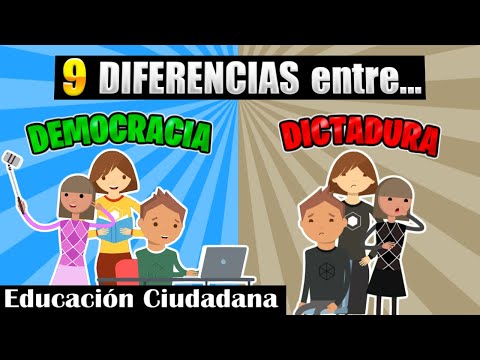
La DICTADURA | ¿Qué DIFERENCIAS existen entre una DICTADURA y la DEMOCRACIA? | Para escolares
New Section
This section introduces the topic of democracy and dictatorship, highlighting the differences between the two systems and their impact on people.
Main Differences Between Democracy and Dictatorship
- In a democracy, sovereignty resides in the people who elect their representatives through free and transparent elections. On the other hand, in a dictatorship, power is seized by a dictator or party through a coup or fraudulent elections.
- Democracy involves a division of powers with different state institutions functioning independently. Power is exercised while considering the interests and rights of the people and recognizing the authority of laws. In contrast, power in a dictatorship is concentrated, exercised according to its own interests, often ignoring or violating laws and people's rights.
- Government officials in a democracy have specified terms defined by law and are periodically renewed. In contrast, dictators remain in power indefinitely until overthrown or democracy is restored.
- Freedom of expression and independence of media are defended in democracies to ensure that all citizens' opinions are valued. However, in dictatorships, censorship prevails, suppressing any comments or ideas that do not align with the regime's political or moral approaches. Media is used solely for government benefit.
- Democracies allow for plurality of political parties representing various ideologies and interests of the people. In contrast, dictatorships usually have only one party and persecute individuals with different ideologies.
- Public officials in democracies are accountable for their actions and report them to the community at large. Conversely, authorities in dictatorships do not answer to anyone except the head of the party, lacking transparency and accountability.
- Public security forces and state powers ensure safety and perform functions beneficial to society in democracies. However, public forces often exercise extreme violence in dictatorships to ensure obedience, and state powers corrupt their functions.
- In democracies, the judiciary applies justice, while in dictatorships, it may be responsible for prosecuting and torturing individuals considered dangerous to the regime.
Curious Fact: Dictatorships
This section highlights a curious fact about dictatorships, where they tend to justify their existence and actions by proclaiming themselves as the best alternative to solve crises. They often use ingenious names or phrases to refer to their regimes.
- Dictatorships never consider themselves as such but rather tend to justify their actions based on economic or social crises at a certain time and place. They proclaim themselves as the best and only alternative.
- As an example, "The National Reorganization Process" was one of the most disastrous dictatorships in Argentina. Dictatorships often use such names or phrases that mask their true nature.
Comparative Table
A comparative table is presented summarizing the key points discussed in the video.
Please refer to the video at timestamp 5:09 for a detailed view of the comparative table.
Conclusion
This transcript provides an overview of democracy and dictatorship, highlighting their differences in terms of sovereignty, division of powers, accountability, freedom of expression, political plurality, public safety, and judicial system. It also sheds light on how dictatorships tend to justify their existence through clever naming strategies.