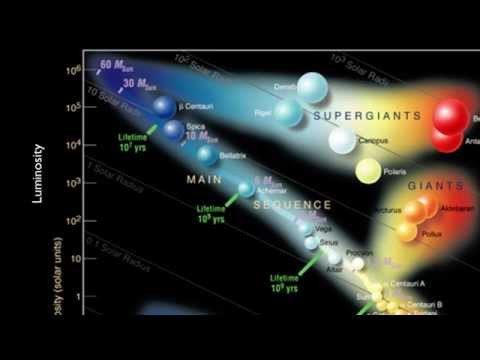
Stars and Galaxies: The Hertzsprung-Russell Diagram
Understanding Temperature and Heat in Astronomy
Key Concepts of Temperature and Heat
- Temperature measures the speed of atoms in a material, while heat quantifies energy output. Heat flows from higher to lower temperature regions.
- An analogy is presented comparing a campfire (higher temperature) to a warm compost heap (lower temperature), illustrating that despite its lower temperature, the larger compost heap can release more total energy over time.
Energy Output Comparison
- The size of an object significantly affects its total energy output; a large compost heap can emit more energy than a small campfire due to its mass, even if both have the same temperature.
- The star Prion has a surface temperature of 6,500 Kelvin and is 6.9 times more luminous than the Sun, demonstrating how luminosity relates to both size and temperature.
Luminosity vs. Size in Stars
- Despite having a cooler surface temperature of 3,000 Kelvin, Bal Juice has a luminosity of about 120,000 times that of the Sun because it is much larger.
- By comparing stellar luminosity with surface temperature, astronomers can infer star sizes without needing to travel to them.
The Hertzsprung-Russell Diagram
- The HR diagram correlates stellar luminosity with temperature; it serves as an essential tool in astronomy similar to the periodic table in chemistry.
- Luminous stars are positioned at the top of the HR diagram while dim stars are at the bottom; this layout helps visualize differences in star brightness.
Star Classification on HR Diagram
- Stars are categorized by their temperatures: blue stars (>10,000 K), red stars (<4,000 K), and most fall along the main sequence where hydrogen fusion occurs.
- Above the main sequence lie giants and supergiants like Arcturus (giant), Bal Juice (supergiant), and VY Canis Majoris (hypergiant).
Density Considerations Among Stars
- Despite Bal Juice's massive size compared to our Sun, it is only about 15 times more massive but less dense; its outer photosphere is less dense than air.
- White dwarfs represent smaller but denser remnants of stars like our Sun after they exhaust their nuclear fuel.
Differences Between Blue Super Giants and Red Super Giants
- Blue super giants have higher temperatures due to increased thermonuclear fusion rates compared to red super giants. This difference impacts their density as well.
Understanding Stellar Sizes and Interactions
The Size Comparison of Super Giants
- The speaker poses a question regarding why the average blue super giant is smaller than the average red super giant, encouraging students to engage in discussions about these concepts with classmates or instructors.
Importance of Active Learning
- Emphasizes that merely watching educational videos repeatedly is insufficient for mastering concepts; active articulation and discussion are necessary for deeper understanding.
- Suggests that if students want to excel academically, they must interact with the material actively rather than passively consuming content.
Engaging with Course Material
- Highlights that effective learning requires more than listening; it necessitates interaction and verbal engagement with the subject matter.
- Introduces the Herzsprung-Russell diagram as a foundational tool for exploring stellar life cycles, indicating that this will be covered in subsequent lessons.