Primary Elections Explained
Primary Elections and Complications New Section
This section provides an overview of primary elections in the United States and introduces five complications that make the process more complex.
Primaries vs Caucuses
- In the United States, political parties use primary elections to select their strongest candidate for president.
- Local party leaders decide whether to hold primaries or caucuses in each state.
- Primaries are similar to standard elections, where voters cast their votes anonymously.
- Caucuses are public votes where people gather in groups based on their preferred candidate and engage in debates.
Who can vote?
- In the national presidential election, all American citizens over 18 years old can vote, except for those who live abroad or in certain territories.
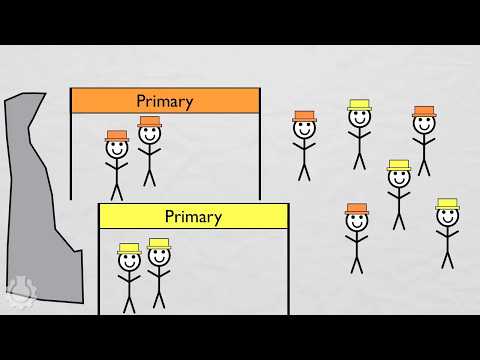
- Primary elections have different rules. Most states require voters to be official members of a party (closed primaries).
- Some states have "semi-closed" primaries where independents can choose one primary to vote in.
- A few states have open primaries where any citizen, regardless of party affiliation, can participate.
When do primaries take place?
- Primaries are spread out over a year and vary by state. There is often competition between states to be at the head of the line.
- New Hampshire has a law ensuring its primary is always at least a week ahead of others.
- Iowa's caucus is technically the first event, but New Hampshire allows it due to its caucus format and considers it less significant.
Votes That Aren't Votes
- Instead of citizens directly voting for candidates, they vote for delegates who will represent them at the National Convention.
- Delegates may be required to vote according to citizens' preferences or have freedom to choose independently.
- Delegates include local party VIPs such as state representatives and officials.
Super Delegates
- Super delegates are top members of the party, such as congressmen and former presidents.
- They have significant influence in the nomination process at the National Convention.
The transcript is already in English, so there is no need to switch languages.
New Section
This section explains the role of delegates and super delegates in the decision-making process for selecting a presidential nominee.
Delegates and Super Delegates
- Delegates representing citizens who voted in state primaries or caucuses travel to the national convention.
- Most delegates are bound to vote according to their state's preferences, while some have the freedom to vote as they choose.
- At the national convention, delegates meet with super delegates who represent the party's best interests.
- Together, they make the final decision on selecting the presidential nominee.
New Section
This section highlights the beginning of the race for presidency after the nomination process.
Race for Presidency
- After the nomination process, the race for presidency begins.
- Individuals can choose to skip all previous steps and jump directly into this phase.