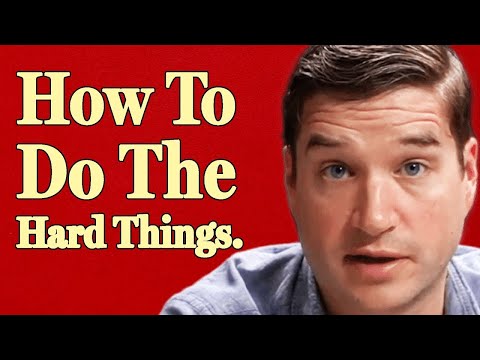
Tips For Doing Hard Things | DEEP DIVE | Episode 178
Introduction
The speaker introduces the topic of tips for doing hard things and mentions that he will be relaying advice from a video by author Brandon Sanderson.
Sanderson's Talk on Doing Hard Things
The speaker talks about Sanderson's talk on doing hard things and how it differs from the media's message of "you can do anything you want to."
Three Tips for Dealing with Hard Things
- Sanderson gives three tips for dealing with hard things.
Tip 1 - Make Better Goals
The first tip is to make better goals, which involves setting goals that are achievable and within your control.
Examples of Bad Goals
- Sanderson gives an example of a bad goal, such as wanting to be a successful novelist without any concrete steps towards achieving it.
Setting Achievable Goals
- Instead, one should set achievable goals that they have control over. For example, writing a certain number of manuscripts as an act of practice and committing to being more ambitious with each manuscript.
Conclusion
The speaker provides insights into Brandon Sanderson's talk on doing hard things and his three tips for dealing with them. The first tip is to make better goals by setting achievable ones that are within your control.
Focusing on Lead Indicators
The speaker discusses the concept of lead indicators, which are things that can be tracked and controlled to achieve successful lag indicators. He gives an example of a lead indicator for writing.
Choosing Lead Indicators
- Focus on lead indicators instead of lag indicators.
- Choose lead indicators that can be tracked and controlled.
- Example of a lead indicator for writing is setting a goal for deep work hours per week.
Learning How You Work
The speaker talks about how important it is to learn how you work when it comes to doing hard things like writing. He shares tips from Sanderson, a professional writer, on figuring out what works for you.
Figuring Out What Works For You
- Learn how you work when it comes to doing hard things.
- Effort is required to trick your brain into doing cognitively demanding work.
- Sanderson uses daily word count tracking in a spreadsheet as his method.
- Scheduling philosophy and ritual play a big role in getting yourself to do the work.
Rituals and Philosophy
The speaker emphasizes the importance of scheduling philosophy and rituals when it comes to doing hard things like writing. He shares examples of over-the-top rituals writers use to get themselves into the right mindset.
Scheduling Philosophy and Rituals
- Get rid of any decision your mind has about when you're going to do the work.
- Rituals can help get your mind into the right mindset for doing hard work.
- Examples of over-the-top rituals writers use to get themselves into the right mindset.
Sanderson's Tips for Achieving Big Goals
In this section, Sanderson shares his third tip for achieving big goals: breaking them down into manageable pieces. He emphasizes the importance of figuring out what those smaller goals are and seeking guidance from experts in the field.
Breaking Down Big Goals
- Sanderson advises breaking down big goals into manageable pieces.
- Figuring out what those smaller goals are is where all the magic happens.
- This is particularly important in creative fields like writing, where people often lack training on how to identify smaller goals.
- Asking a professional writer for advice may not be helpful; instead, ask for their story and find out what specific steps they took to achieve their goal.
Creating a Detailed Roadmap
- Sanderson suggests creating a detailed roadmap with specific feedback on each manuscript or project.
- It's important to get the reality of what actually matters for your endeavor from people who have come before you.
- Seek guidance from experts in your field and ask about their experiences rather than just asking for advice.
- Extracting information from experts can help you understand what really matters and create a realistic plan to achieve your goal.
Sanderson's Personal Experience
- Sanderson shares his personal experience of getting started in writing by seeking guidance from an agent who walked him through step-by-step what he needed to do to get a book deal with a major publisher.
- Following that plan took him two years but ultimately led to success as a senior in college.
Thank you for the detailed instructions. I will follow them to create a clear and concise markdown file.
Doing Hard Things
In this section, the speaker talks about how doing hard things is a complicated endeavor that requires a lot of nuanced feedback.
The Nuances of Doing Hard Things
- Doing hard things is not easy and requires a lot of effort.
- It is important to receive feedback on your progress when doing hard things.
- Feedback should be nuanced and specific to help you improve.
- Nuanced feedback can help you identify areas where you need to improve and make adjustments accordingly.
Turn any video into a summary like this
YouTube links, meetings, lectures. With transcripts, search, and chat.