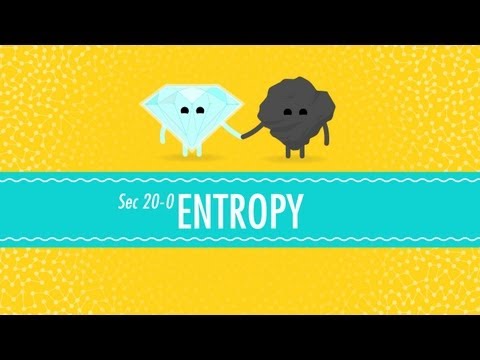
Entropy: Embrace the Chaos! Crash Course Chemistry #20
The Chaos of the Universe
In this section, the speaker discusses how the universe tends towards disorder and explains why chaos is a fundamental aspect of the universe.
The Nature of Disorder
- The universe tends towards disorder due to the countless ways things can be arranged in a disorganized state.
- Probability dictates that it is more likely for things to be in a disorganized state rather than an organized one.
- The Second Law of Thermodynamics states that any spontaneous process increases the disorder or randomness of the universe.
Order and Disorder in Everyday Life
- Putting one system in order requires other systems to become disordered.
- Example: Breaking down food molecules into energy for cleaning, which results in less ordered nutrient molecules and energy being lost as heat.
Entropy: Measure of Disorder
- Entropy is a measure of molecular randomness or disorder.
- Despite disorder being perceived negatively, entropy plays a crucial role in making chemical reactions possible and predicting useful work extraction from reactions.
Embracing Chaos
This section explores the concept of spontaneity and its relation to increasing disorder in chemical reactions. It also introduces entropy as another state function that helps explain spontaneous reactions.
Spontaneous Processes and Disorder
- Spontaneous processes occur without requiring outside energy to keep them going.
- According to the Second Law of Thermodynamics, any process that increases the disorder of the universe happens spontaneously.
Factors Affecting Spontaneity
- Other factors may interfere with spontaneous processes, preventing disorderly events from always occurring.
- Example: Diamond turning into graphite would be thermodynamically spontaneous but doesn't happen due to stable bonds.
Entropy as a State Function
- Entropy is another state function like enthalpy; it doesn't depend on the pathway taken to reach a state.
- While entropy cannot be directly measured for reactants or products, it can be calculated.
Calculating Change in Entropy
- The change in entropy during a reaction can be calculated by subtracting the sum of reactant values from the sum of product values.
- The formula for calculating change in entropy is similar to that of enthalpy, using "S" (entropy) instead of "Delta H" (enthalpy).
Explaining Spontaneous Reactions
This section delves into how spontaneous reactions occur even when no energy is given off and explains how to calculate changes in entropy.
Understanding Energy Changes
- Some reactions occur spontaneously without giving off energy or extracting energy from the environment.
- Changes in entropy help explain these seemingly contradictory reactions.
Demonstrating a Reaction
- A demonstration with barium hydroxide octahydrate and ammonium chloride shows a reaction that absorbs heat from the surroundings, making everything feel cold.
Calculation of Entropy Change
- Entropy change can be calculated similarly to enthalpy change by subtracting reactant values from product values.
- Absolute values are used for individual reactants and products, while "Delta" notation is kept for calculating changes in entropy.
New Section
This section explains the concept of heat absorption and entropy change in a chemical reaction.
Understanding Heat Absorption and Entropy Change
- The process of two solids combining to form liquids and gases is a big part of understanding heat absorption, but it's not the whole story.
- To better understand this concept, we need to calculate the amount of heat absorbed and the change in entropy.
- Enthalpy change can be determined using Hess's Law and standard enthalpies of formation. Coefficients from the balanced chemical equation are used to determine the number of moles for each substance.
- Standard enthalpies of formation are looked up in tables to calculate the change in standard enthalpy.
- The change in standard enthalpy for the given reaction is found to be +166 kilojoules, indicating that thermal energy was absorbed.
- Entropy change is calculated using the same approach, with coefficients from the balanced chemical equation and standard entropies from tables.
- The change in standard entropy for the reaction is found to be 590 joules per Kelvin, indicating an increase in disorder.
- It's important to note that while standard enthalpy is measured in kilojoules, standard entropy is measured in joules per Kelvin.
New Section
This section introduces Josiah Willard Gibbs' concept of Gibbs free energy and its relation to useful work.
Introducing Gibbs Free Energy
- Gibbs free energy (also known as standard free energy) measures the amount of energy available or free to do useful work within a system.
- Like enthalpy and entropy, Gibbs free energy is a state function that can be calculated using similar methods.
- The standard free energy of formation represents the change in free energy when a substance is formed from its elements at a standard state.
- The standard free energy change of formation for a compound is the difference between its standard free energy and a baseline set by the most stable form of an element at standard state.
- If the standard free energies of formation for the products and reactants are not available, Gibbs' formula can be used to calculate the change in standard Gibbs free energy.
- According to Gibbs' formula, at constant pressure and temperature, the change in standard Gibbs free energy equals the change in standard enthalpy minus the product of temperature and the change in standard entropy.
- The direction of a reaction depends on whether it is enthalpy-driven or entropy-driven. A large change in enthalpy can determine the direction even if entropy changes in the opposite direction, and vice versa.
New Section
This section discusses whether heat transfer or disorder plays a more significant role in determining spontaneous reactions.
Heat Transfer vs. Disorder
- The importance of heat transfer (enthalpy) versus disorder (entropy) depends on various factors.
- If there is a large change in enthalpy compared to the product of temperature and entropy, then it is considered an enthalpy-driven reaction where thermal energy provides most of the free energy.
- On the other hand, if there is a large product of temperature and entropy compared to enthalpy, then it is considered an entropy-driven reaction where increasing disorder provides most of the free energy.
- In this specific case with barium hydroxide reaction at around 25 degrees Celsius (298.15 Kelvin), when comparing "T Delta S" (177 kilojoules) to "Delta H" (166 kilojoules), it is clear that "T Delta S" is higher than "Delta H," indicating that this reaction is entropy-driven due to a significant increase in disorder.
New Section
This section highlights the significance of Gibbs free energy in determining spontaneous reactions.
The Significance of Gibbs Free Energy
- Gibbs' formula not only helps calculate the change in standard Gibbs free energy but also determines whether a reaction is spontaneous or not.
- All systems tend to move towards the lowest possible energy state, and "Delta G" represents this tendency.
- A reaction with a lower value of "Delta G" spontaneously approaches the minimum possible level of energy.
The transcript has been summarized based on the given sections.
New Section
In this section, we explore the concept of Gibbs free energy and its relation to the spontaneity of a reaction.
Spontaneity and Equilibrium
- If "Delta G" is zero, the reaction is in an equilibrium state and no discernible change occurs in either direction.
- The reaction observed in the video is spontaneous at room temperature as it releases energy instead of requiring it to get started.
- The Gibbs free energy for this reaction is calculated to be negative 11 kilojoules, confirming its spontaneity.
- The energy produced during the reaction was used to rearrange bonds, create smaller product molecules, break attractions between molecules, and increase the entropy of the system.
- Despite absorbing thermal energy, the large change in entropy alone was sufficient to drive the reaction forward.
New Section
In this section, we discuss how Gibbs formula confirms our earlier results and summarize key concepts learned throughout the video.
Confirmation with Gibbs Formula
- Using Gibbs Formula and plugging in previously calculated numbers, we find that the Gibbs free energy for the reaction is negative 11 kilojoules.
- This confirms that the reaction is spontaneous as it releases energy instead of requiring it to proceed.
- Josiah Willard Gibbs developed a formula to calculate Gibbs free energy for reactions.
- Both entropy and Gibbs free energy are state functions.
- The sign of the Gibbs free energy indicates whether a reaction is spontaneous or not.
Key Concepts Learned
- It's challenging to stay organized due to various ways of being disorganized.
- The second law of thermodynamics states that disorder or entropy happens everywhere.
- Change in entropy depends on factors such as molecular movement space, heat energy release in reactions, and surrounding temperature.
- Gibbs formula provides a way to calculate the Gibbs free energy for a reaction.
- Entropy and Gibbs free energy are state functions.
- The sign of the Gibbs free energy determines the spontaneity of a reaction.
This episode of Crash Course Chemistry was written by Edi Gonzalez. The script was edited by Blake de Pastino, and our chemistry consultant was Dr. Heiko Langner.
Turn any video into a summary like this
YouTube links, meetings, lectures. With transcripts, search, and chat.