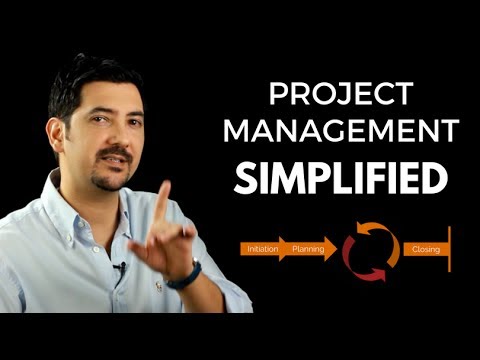
Project Management Simplified: Learn The Fundamentals of PMI's Framework ✓
Introduction
The speaker introduces the video and explains that it is a condensed 10-hour course on project management. They also explain who the video is for and how it can benefit viewers.
What is Project Management?
- A project is a temporary endeavor to create a unique solution.
- The difference between a project and operations is that a project ends, while operations are ongoing and repetitive.
- Programs are multiple projects put together, while portfolios are multiple programs put together.
Project Life Cycle vs. Project Management Process
- To run any project, you need two methodologies: a project life cycle and a project management process.
- A project life cycle is unique to each industry or need and highly customizable.
- A human development life cycle serves as an example of what a project life cycle might look like.
- A project management process involves initiating, planning, executing, monitoring/controlling, and closing the project.
Benefits of Understanding Fundamentals
- Understanding the fundamentals of project management makes everything else easier to follow.
- Watching this video without skipping will make the PMBOK guide easier to understand.
Project Life Cycle
This section covers the different phases of a typical IT-based Project Life Cycle.
Phases of an IT-Based Project Life Cycle
- High-level design
- Detailed design
- Coding
- Testing
- Installation
- Turnover
Project Life Cycle and Process Groups
In this section, the speaker discusses the project life cycle and process groups. The project life cycle is customizable, and there is no single way to define its ideal structure. On the other hand, process groups are not customizable if you follow PMI's Project Management Body of Knowledge.
Customizable Project Life Cycle Phases
- A project life cycle may have one or multiple phases that are unique to your own project needs.
- There is no single way to define the ideal structure for a project.
- For small projects, we simplify things by attaching process groups to a single phase of the project life cycle instead of every single phase. This makes things easier to run the project with less complication.
Process Groups
- The five process groups are initiation, planning, executing, monitoring and controlling, and closing. These are set in stone and cannot be changed in order if you follow PMI's Project Management Body of Knowledge.
- Confusion arises when people confuse process groups with a project life cycle. If you don't get this right, you will fail the exam.
PMP Certification
- Getting a PMP degree won't help as much as you think because it's just a framework and not a methodology. Instead of spending hundreds of hours and money on a certificate that you won't even use, learn project management fundamentals instead.
- Most multinational firms have their in-house methodology to follow; therefore, learn everything shared in this video about project management fundamentals since it's an incredible practice but getting certified is debatable when considering investment vs reward equation.
Introduction to Project Charter and Stakeholder Identification
In this section, the speaker introduces the concept of project charter and stakeholder identification in project management. The speaker explains that project charter is a simple document outlining the objectives, scope, cost, time, key stakeholders and milestones of a project. The speaker also emphasizes that stakeholder identification is an important process in the initiation stage of a project.
Project Charter
- The first process in the initiation process group is to develop a project charter.
- A project charter outlines the objectives, scope, cost, time, key stakeholders and milestones of a project.
- At the initiation stage, it's important not to have too many details in the document as it will be needed later for planning.
- The reason for creating a simple project charter is to get buy-in from senior leadership before spending more time and money on planning.
Stakeholder Identification
- The second process in the initiation process group is stakeholder identification.
- Creating an excel list of various stakeholders that will be engaged with during the project is called Stakeholder Register.
- Primary stakeholders include sponsors, project managers, members of the project team and management team.
Planning Process
In this section, the speaker discusses the planning process and its three main questions: What are we going to do? How are we going to do it? How to know when the project is done?
Collecting Requirements
- Collecting requirements involves understanding what stakeholders want.
- The project charter is used as a basis for gathering more detailed specifications.
- Gathering requirements can be difficult due to conflicting stakeholder demands and unknown budget, quality, or schedule constraints.
- Various methods can be used for collecting requirements, but group meetings are recommended.
Defining Scope
- Defining scope involves determining what is and isn't included in the project.
- Weak project managers may include too much in the scope, leading to an impossible plan.
- The scope baseline consists of three things: scope statement, work breakdown structure (WBS), and WBS dictionary.
Work Breakdown Structure
In this section, the speaker explains what a Work Breakdown Structure (WBS) is and why it is important in project management.
Importance of WBS
- A WBS breaks down a project into smaller and more manageable pieces.
- It is a top-down effort that decomposes deliverables into work packages.
- Work packages must be "things" according to PMI's framework, but in practice, they can also include tasks.
- The depth of the breakdown depends on whether cost and time requirements can be confidently estimated.
Creating a WBS for the Boat Project
In this section, the speaker creates a WBS for the boat project as an example.
Segments of the Boat Project
- The segments of the boat project are Design, Manufacturing, Electronics, Rigging, and Testing.
- Each segment is labeled with 1.1 for design, 1.2 for manufacturing, etc.
Work Packages for Design Segment
- Acquire IMOCA 60 design
- Adjust design for scaling down
- Complete final design
Work Packages for Manufacturing Segment
- Decide on materials
- Procure materials
- Frame hull and deck
- Sub-segments: framing hull and framing deck
- Laminate hull and deck
- Sub-segments: laminate hull and laminate deck
- Assemble hull and deck together
- Sanding and painting (cosmetics)
Work Packages for Electronics Segment
- Decide on components and procure them
- Merge under one work package
- Assembly
Work Packages for Rigging Segment
- Decide on materials and procure them
- No further breakdown needed
- Install items
Work Packages for Testing Segment
- Test electronics
- No further breakdown needed
- Test rigging
- No further breakdown needed
- Pool trial to ensure the boat floats and no water goes inside
Project Scope and WBS Dictionary
In this section, the speaker discusses the importance of defining work packages properly to prevent scope creep. The WBS dictionary is introduced as a tool that puts a definition to every single work package, preventing scope from being stretched.
Importance of Defining Work Packages Properly
- Work packages must be defined properly to prevent scope creep.
- Scope creep occurs when the boundaries of the project extend beyond what was originally planned.
- As a project manager, it is important to prevent scope creep during the planning stage because once planning is over, execution begins.
Introduction to WBS Dictionary
- The WBS dictionary completes the project scope baseline.
- The WBS dictionary puts a definition to every single work package.
- This tool prevents scope from being stretched by ensuring that each work package is properly defined.
Time Management and Cost Management
In this section, the speaker introduces time management and cost management as essential knowledge areas for project managers. He also explains how to estimate how long a particular work package will take and how Gantt charts can be used for smaller projects.
Essential Knowledge Areas for Project Managers
- Time management and cost management are essential knowledge areas for project managers.
- Other knowledge areas such as human resources, communications, risk management, quality, and procurement are intuitive and do not require explanation.
Estimating Work Package Duration
- If you cannot confidently estimate how long a work package will take to complete, break down your WBS further to the activity level.
- Estimating work package duration involves sitting down with your project team and giving assumptions.
- Once you have estimated work package durations, the next step is to put them in a sequence.
Gantt Charts for Time Management
- Gantt charts are an easy way to list activities or work packages in a suitable time scale.
- Each work package or activity is represented by a bar that shows the start date, duration, and end date of the activity.
- MS Projects can be used for complex projects, but smaller projects only require a Gantt chart.
Project Management Overview
This section provides an overview of project management, including the five process groups and ten knowledge areas.
Introduction to Project Management
- Project management is the application of knowledge, skills, tools, and techniques to project activities to meet project requirements.
- The five process groups are initiation, planning, execution, monitoring and controlling, and closing.
- The ten knowledge areas are integration management, scope management, time management, cost management, quality management, human resource management, communications management, risk management procurement management.
Planning Process Group
- The planning process group involves developing a plan for how the project will be executed.
- Project crashing is a technique used to speed up a project by adding additional resources at a cost.
- Cost management involves creating a budget for the project by estimating costs for each work package using bottom-up estimating.
Execution Process Group
- The execution process group involves completing the work defined in the project plan and managing information exchange as the project manager.
- Managing stakeholder expectations and preventing scope creep are important aspects of executing a project successfully.
Monitoring and Controlling Process Group
- The monitoring and controlling process group involves measuring performance against the plan and managing change requests.
- Monitoring scope and schedule are key components of this process group.
Project Management: Closing Process Group
In this section, the speaker discusses the importance of verifying if a project is within budget and schedule. They also touch on earned value calculations and how they are primarily used for construction and software projects. The speaker explains that most projects show exponential growth instead of linear progression.
Verifying Budget and Schedule
- Always verify if you were within the allowance.
- Look for root causes if you exceeded the budget or schedule.
- Solve those problems so they won't repeat.
- Document everything.
Earned Value Calculations
- Earned value is Total Project Budget Multiplied by % complete of the project.
- It's primarily used for construction and software projects.
- In real life, it doesn't hold much value other than few industries because the value gained cannot always be assessed along the progression of the project.
- Most projects show exponential growth instead of linear progression.
Closing Process Group
- After finishing a product, there is still some work to be done before closing a project.
- Hand over to client (if applicable).
- Finish procurements by making final payments and completing cost records.
- Gather final lessons learned by documenting what went wrong and what was learned from it.
- Release resources by letting team members go back to their own teams.
- Celebrate!