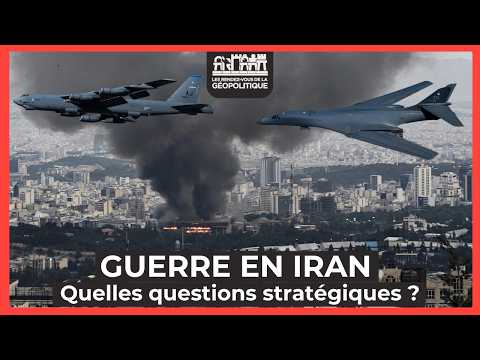
Guerre en Iran. Quelles questions stratégiques ?
War in Iran: The Strategic Implications
Introduction to the Current Situation
- Recent events necessitate a shift in focus for the Rendez-Vous de la Géopolitique agenda towards the ongoing airstrikes in Iran. This session is recorded on the sixth day of these strikes, highlighting the urgency and complexity of the situation.
Strategic Questions Over Immediate Analysis
- The discussion will center around key strategic questions rather than immediate reactions to events, emphasizing the long-term implications of Israel and USA's actions against Iran. Understanding these consequences requires examining current strategic implications first.
Challenges in Analyzing Ongoing Events
- Drawing lessons from unfolding events is challenging due to their immediacy; thus, posing instructive questions is preferred over providing definitive answers at this early stage of conflict. It’s noted that war takes time while media reactions are often fleeting.
Clarification of Terms and Conflict Scope
- A clarification regarding terminology indicates that despite its duration, we are indeed discussing a war involving direct confrontations among three states with significant military resources deployed, surpassing previous operations like June 2025.
Key Strategic Issues Identified
- Five critical aspects warrant attention:
- Objectives of the three main belligerents.
- Historical precedents relevant to current geopolitical logic.
- American societal reaction to conflict outbreak.
- Military resources available to US forces versus stated objectives.
- Strategic shifts anticipated within China as a result of this conflict.
Objectives of Belligerents
Israel's Clear Objective
- Israel aims for the complete dismantlement and eradication of Iran's political system, which is straightforward and does not require further elaboration.
Complexity of Iran's Objectives
- In contrast, Iran’s objectives are more complex; primarily focused on survival during attacks while establishing a long-term position amidst escalating tensions. Notably, Iran has initiated extensive airstrikes against neighboring countries showcasing its military capabilities.
Interpretations of Iranian Actions
- Two interpretations arise regarding Iran's airstrikes:
- Disorganized Response: Some view these actions as chaotic due to internal disarray within Iranian leadership amid external pressures.
- Strategic Control: Alternatively, others argue that these strikes represent a controlled strategy aimed at achieving specific goals through destabilization efforts across regional actors and energy facilities.
Layers of Iranian Strategy
- Four concentric circles outline Iran’s strategic intentions:
- First Circle: Destabilizing regional actors by targeting energy production and consumption sites to pressure adversaries into ending hostilities quickly.
- Second Circle: Leveraging sentiments among minority Shia communities within its sphere (notably majority Shia in Iraq) aiming for broader influence amidst conflict dynamics.
Understanding Iran's Regional Influence and U.S. Objectives
Iran's Strategic Positioning
- The complacency of regional observers leads them to focus on Iran, entangling them in broader conflicts.
- Iran is cultivating an appeal that resonates with both Shia and Sunni populations, framing its actions as a defense against the USA and Israel.
- This sophisticated approach aims to create a rift between Gulf monarchies and their public, potentially shifting domestic opinions against their leadership.
Potential Outcomes of Iranian Instability
- A fourth circle of analysis suggests that if Iran's state structure collapses, it could lead to either a revolution or civil war.
- Gulf governments are wary of revolutions nearby due to fears of contagion effects triggering similar movements within their own borders.
U.S. Objectives in the Region
- The U.S. has unclear objectives regarding its involvement with Iran, wavering between multiple goals.
- Primary objectives include preventing Iran from developing nuclear weapons and intercontinental ballistic missiles (ICBMs).
- Another potential goal is regime change, reminiscent of past interventions like the 2003 Iraq invasion.
Misinterpretations of U.S. Intentions
- There is a flawed assumption that U.S. intervention aims to weaken China's crude oil supply; this perspective misinterprets geostrategic realities.
- While over 80% of Iranian oil exports go to China, this only represents about 11% of China's total imports in recent years.
Geopolitical Implications for China
- Substituting Iranian oil with Russian supplies may deepen China's alignment with Moscow, which could finance Russia’s war efforts in Ukraine.
- If conflict persists, China might covertly support Iran while signaling Tehran about the risks associated with closing the Strait of Hormuz.
Possible Changes in U.S.-Iran Relations
- Washington may not seek outright regime change but rather aim for a "palace coup," encouraging changes in Iranian policies without altering leadership entirely.
- This strategy could involve persuading Iranian leaders to abandon aggressive policies like nuclear development or missile programs for political survival.
Geopolitical Dynamics and the Iranian Conflict
Understanding Iran's Alignment
- The speaker asserts that Iran is more aligned with the United States than with China or Russia, highlighting the complexity of American objectives in international relations.
Multiple Objectives in Geopolitics
- Emphasizes that rather than a singular goal, there are manifold objectives at play, influenced by evolving international dynamics and geopolitical contexts.
Four Geopolitical Logics
Historical Patterns
- To comprehend the conflict's development, four distinct geopolitical logics must be considered, which have historical precedence and can help identify emerging trends.
Perception of Foreign Forces
- A critical observation is made: prolonged foreign military presence often leads local populations to view these forces as invaders rather than liberators, regardless of initial justifications.
Air Power Limitations
- It is noted that modern history lacks examples of wars won solely through air power; Liddell Hart’s quote underscores this limitation: "you cannot take prisoners with a bomber flying through the sky."
Centrifugal Forces Post-Conflict
- If the Iranian regime were weakened or dismantled, managing resulting centrifugal forces (notably from groups like Kurds and Baluchis) would pose significant challenges for Washington.
Risk of Geopolitical Anarchy
- Drawing on Zbigniew Brzezinski's concept from The Grand Chessboard, the potential for a strategic vacuum following instability in Iran could lead to widespread disorder across the region.
Implications of Instability
- The implosion of Iran could trigger seismic shifts affecting not only its 90 million inhabitants but also neighboring regions like the Middle East and Pakistan, complicating U.S. objectives further.
Temporal Control in Geopolitics
Importance of Time Management
- The control over time will significantly influence events; understanding who benefits from temporal advantages is crucial for strategic planning.
Public Sentiment Indicators
- Two key indicators to monitor during wartime include public approval ratings regarding presidential decisions and reactions to casualties over time.
Initial Public Support
- Current polling shows only 21% support among Americans for involvement in Iran, indicating strong opposition against entering another protracted conflict reminiscent of past "forever wars."
Impact of Casualties on Approval Ratings
- The emotional impact stemming from casualties will likely erode public support; personal stories behind fallen soldiers can shift perceptions dramatically over time.
Historical Contextualization
Legacy of Vietnam War
- Reflecting on Vietnam, it was not merely casualty numbers but personal narratives that undermined U.S. support—an important lesson for current military engagements.
Presidential Accountability
- The speaker references John F. Kennedy’s quote about victory needing many fathers while defeat being an orphan; thus emphasizing that winning this war is essential for presidential credibility.
This structured summary encapsulates key insights from the transcript while providing timestamps for easy reference.
Assessment of U.S. Military Deployment
Strategic Objectives and Resource Allocation
- The distinction between victory and defeat is crucial as the war progresses, necessitating an evaluation of whether strategic objectives are achievable based on available resources.
Key Characteristics of Military Readiness
- Four essential characteristics must be highlighted regarding U.S. military deployment: ammunition availability, pilot operational readiness, resource assembly time, and aircraft carrier status. The first characteristic discussed is ammunition supply.
Ammunition Supply Concerns
- A significant burn rate of ammunition has been observed; over 100 Tomahawk missiles were used in the first five days of conflict, surpassing annual production capacity forecasts for 2026. This raises concerns about sustainability in munitions supply.
- The production timeline for a Tomahawk missile can take nearly two years, emphasizing the urgency to assess both quantity and production time for effective military operations.
Pilot Operational Readiness
- Most U.S. pilots are reportedly required to conduct nearly three sorties daily, indicating a high demand that could strain operational effectiveness if the conflict extends over a medium duration or results in casualties among pilots.
Resource Assembly Timeline
- Historical context reveals that it took approximately 5 to 6 weeks for the U.S. to assemble necessary resources before operations commenced on February 28, raising questions about current operational readiness amidst ongoing conflicts.
Aircraft Carrier Status and Limitations
- Despite having eleven aircraft carriers, only two are currently operational due to maintenance or resupply needs; this limits the U.S.'s ability to engage effectively across multiple fronts simultaneously during wartime conditions.
- The inability to wage war on two fronts concurrently poses significant challenges reminiscent of historical military dilemmas faced by forces divided between multiple theaters of operation (e.g., Germany in WWI). This highlights strategic limitations within current military engagements involving Iran and other regions.
Geopolitical Implications of the US-Iran Conflict
The Pacific Perspective
- The discussion emphasizes the need to broaden perspectives, particularly regarding the Pacific region in light of geopolitical events involving China and Iran.
- It is noted that the war initiated by the US in Iran may elevate Taiwan's significance in Pacific geopolitics, presenting a strategic opportunity for China.
- The speaker suggests that US involvement in Iran could lead to a distraction, allowing China to take more assertive actions concerning Taiwan.
Regional Dynamics and Alliances
- While Iran lacks formal alliances with Russia and China, their individual interests may still align against US influence due to shifting attention from America.
- The assertion that Iran stands alone is technically accurate; however, it overlooks potential indirect support from Russia and China's military capabilities.
Military Support and Testing Grounds
- China’s ability to supply military equipment like radar systems allows it to support Iran while simultaneously testing its technology against American forces.
- The ongoing conflict has significant repercussions on international relations, highlighting the importance of monitoring these developments over time.
Nuclear Proliferation Concerns
- A key takeaway is the risk of nuclear proliferation as countries perceive nuclear arsenals as effective deterrents against external intervention.
- Historical context shows that past US interventions have reinforced nations like Iran's belief in needing nuclear capabilities for self-defense.
Fragmentation of Western Unity
- The concept of a unified West appears increasingly fragmented, as evidenced by differing strategic focuses between regions such as Europe and the Western Hemisphere.
- Recent strategic documents highlight this division, indicating a shift in how America views its allies and global responsibilities.
European Strategic Challenges
- Europe seems disjointed amid current geopolitical tensions; Italy's defensive measures contrast with other European governments' lack of clear strategies.
- Criticism arises towards European governments using international law as an excuse for indecision rather than taking proactive stances on pressing issues like Iranian compliance.
Geopolitics and Justice: Insights from Antigone
The Role of Law and Justice in Geopolitics
- The speaker reflects on the wars in the former Yugoslavia during the early 1990s, suggesting that these events highlight a need for deeper understanding of justice beyond mere legal frameworks.
- They recommend Jean Anouilh’s drama "Antigone" as a valuable resource, implying that it illustrates the concept that moral imperatives can transcend legal obligations.
- A key argument is presented: realpolitik, characterized by power dynamics, may serve justice more effectively than international law does.
- The conclusion emphasizes the importance of recognizing geopolitical realities and their impact on justice, suggesting a pragmatic approach to international relations.
- The speaker proposes to conclude this discussion with an acknowledgment of these insights into geopolitics and justice.