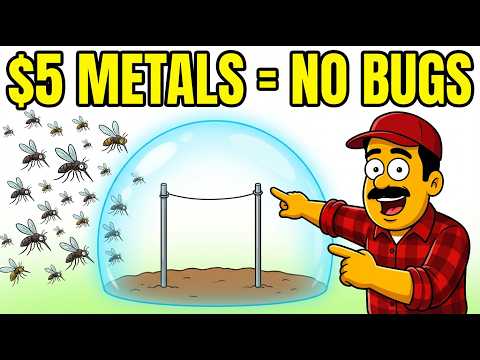
Two Metals in the Ground Create an Invisible Wall Bugs Won’t Cross
How to Use Copper and Zinc for Pest Control
Introduction to the Concept
- The speaker introduces a simple pest control method using two pieces of metal, a wooden stake, and damp soil, which can be built for around $20. This method is contrasted with the expensive pest control industry that generates billions selling short-term chemical sprays.
Materials Needed
- To construct the pest control stakes, you need:
- Bare 16-gauge copper wire (approximately 125-130 ft) costing about $13-$15.
- Galvanized steel wire (100-ft roll of 14-gauge) priced at $8-$10.
- Bamboo stakes or wooden dowels (3 ft long), costing around $5 for a pack of ten.
- Total cost for materials is approximately $20-$25, yielding three complete stakes with leftover wire.
Assembly Instructions
- Wrap 3 ft of copper wire in a loose spiral around the lower portion of one stake and do the same with zinc wire.
- Ensure both metals contact the soil when inserted but do not touch each other above ground.
- Drive the stake into damp soil (6 to 12 inches deep) and pour water around it to activate moisture as an electrolyte. Rain will recharge it automatically thereafter.
Practical Application
- For effective coverage at campsites, position three stakes in a triangle near your tent, cooking area, and fire—covering roughly 225 sq ft.
- For standing water areas like rain barrels or bird baths, drop a coil of bare copper wire directly into the water to achieve high mosquito larval mortality without toxic compounds.
Personal Experience & Scientific Validation
- The speaker shares personal observations from their property where one rain barrel fed by copper showed no mosquito larvae while another plastic barrel became infested.
- This led them to discover research confirming that copper residue effectively prevents mosquito breeding—a realization that highlights how buried knowledge has been overlooked over time.
Historical Context: The Science Behind Electroculture
Early Experiments
- In Paris in 1747, Abbe Jean-Antoine Nollet conducted experiments showing that electrified seeds germinated faster than non-electrified ones; he noted insects avoided electrified pots without theorizing why this occurred.
Development of Earth Battery Concept
- Alexander Bain in Edinburgh (1841) created an earth battery using copper and zinc plates in wet soil which powered his clocks while also eliminating biting flies nearby—an observation documented but largely ignored by scientific communities afterward.
Further Applications & Ignored Findings
- Robert Foster expanded on Bain's findings by applying similar methods across barley fields resulting in minimal pest damage; however, these results were again disregarded despite being published as remarkable by The Royal Society.
This structured markdown file provides an organized overview of key concepts discussed within the transcript while linking back to specific timestamps for further exploration or review.
Electroculture: A Forgotten Agricultural Technique
The Success of Electroculture
- Crops grown using electroculture techniques, such as oat crops, reached heights over 7 feet without artificial fertilizers.
- Grapevines previously devastated by the phylloxera plague fully recovered and yielded abundant harvests.
- Entire farms operated pest-free using only copper, zinc, and wet earth, demonstrating a sustainable agricultural method.
Historical Context and Decline
- An international scientific conference in 1912 confirmed the effectiveness of electroculture, leading to discussions on large-scale adoption.
- The onset of World War I disrupted European agriculture and destroyed existing electroculture infrastructure.
- Post-war industrial capacity shifted towards chemical production for agriculture, rendering electroculture economically irrelevant despite its proven efficacy.
Economic Implications
- The transition to chemical solutions was driven by profit motives; cheaper and more effective natural methods like electroculture were sidelined.
- Observers noted that the effectiveness of electroculture threatened profits from synthetic chemicals that required frequent purchases.
Modern Scientific Validation
- In 2015, Dr. Norbert Becker's study demonstrated that copper ions in water could achieve near-complete mortality in mosquito larvae.
- Copper ions disrupt biological processes in soft-bodied larvae without allowing them to develop resistance as they do with synthetic chemicals.
Practical Application Today
- To utilize this knowledge practically, one can drop coils of copper wire into standing water sources to control mosquito populations effectively.
- This method requires no additional treatments or chemicals; it leverages the continuous release of copper ions for larval mortality within 24 to 72 hours.