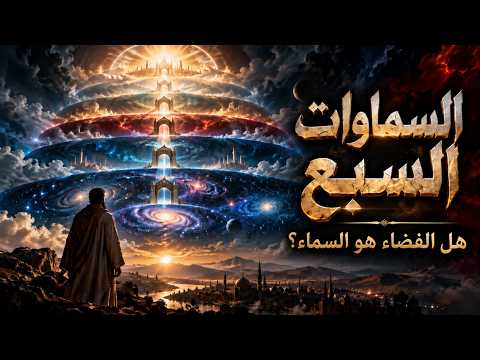
السماوات السبع | أين هي… ولماذا لا تظهر في خريطة الكون؟ | البوابة - شريف علي
Understanding the Concept of Heaven in Islamic Texts
The Nature of Heaven
- The discussion begins by questioning the meaning of "heaven" and its connection to cosmic distances, raising inquiries about the jinn's destination.
- An ifrit introduces himself as strong and trustworthy, suggesting a hierarchy among jinn and prompting further exploration into what constitutes heaven.
- The Quran describes heaven as a structure rather than mere space, presenting an architectural dilemma when considering it as part of the universe.
Layers of Heaven
- The Quran mentions seven heavens in layers, with the nearest one adorned with stars, indicating a structured cosmology rather than a singular vastness.
- Questions arise regarding whether all observable galaxies fall within this lowest heaven or if higher heavens exist beyond our current understanding.
Textual Interpretations
- Emphasis is placed on returning to textual descriptions to understand heaven's nature without preconceived notions from modern science.
- Key points include that while there are seven heavens above us, they are not defined as planets or universes but have distinct characteristics according to scripture.
Linguistic Analysis of "Heaven"
Definitions and Context
- The term "heaven" does not automatically equate to cosmic space; context determines its meaning in various Quranic verses.
- Linguistically, "heaven" relates to height; thus, it can refer to different phenomena depending on context—like rain or birds held in the atmosphere.
Structural Descriptions
- When discussing seven heavens specifically, striking terms like "structure," "protected roof," and "canopy" indicate that heaven is more than just empty space.
Relationship Between Earth and Heaven
Cosmic Connections
- Modern scientific models do not align with traditional views of layered heavens; instead, they describe an expansive universe without clear divisions between layers.
- The Quran links stars specifically to the nearest heaven rather than implying they belong across all seven layers.
Jinn Ascension Challenges
- If stars are connected only to the first heaven, questions arise about how far away other heavens might be compared to observable galaxies.
Eavesdropping Jinn: A Unique Perspective
Jinn Abilities
- The narrative includes jinn attempting ascension toward heaven for eavesdropping purposes but raises questions about their ability to traverse vast cosmic distances effectively.
Speed Comparisons
- An example involving Solomon highlights an ifrit's speed capabilities but suggests that even supernatural speeds may not suffice for interstellar travel.
Reevaluating Distance Perceptions
Journey Measurements
- Ancient accounts suggest a 500-year journey between earth and each successive sky. This measure contrasts sharply with modern perceptions of astronomical distances.
Implications for Understanding Heaven
- These measurements imply that heavenly realms may be much closer than contemporary interpretations suggest.
Insights from Isra and Mi'raj
Sequential Ascent
- During the Prophet Muhammad’s night journey (Mi'raj), he ascends through each layer of heaven sequentially, emphasizing structured transitions rather than abstract distances.
Final Revelations
- Each ascent involves requests for entry at every level, reinforcing that these realms are distinct yet interconnected stages within a larger cosmological framework.
The Journey of Mi'raj: Ascent and Return
The Structure of the Journey
- The Mi'raj journey is characterized by repeated movements between levels, including meetings with Moses and requests for reductions in prayer.
- The concept of heaven being initially closed is significant; Gabriel's request to open it highlights a recurring theme in both Hadith and Quranic texts regarding the gates of heaven.
- The narrative suggests that heavens are layered, prompting deeper questions about their nature beyond mere spatial concepts.
Understanding Heaven as a Structure
- God describes the earth as a bed and heaven as a structure, indicating a contrast between terrestrial and celestial realms.
- Ancient commentators interpreted terms related to height and structure in context, suggesting an elevation rather than simply "outer space."
Modern Scientific Perspectives vs. Textual Descriptions
- Descriptions like "protected canopy" challenge modern scientific views where space is not seen as a ceiling but rather an expansive cosmic area.
- Observations indicate that moving away from Earth does not lead to encountering walls or limits but continues within cosmic space.
Language and Perspective in Quranic Descriptions
Addressing Human Perception
- Some argue that descriptions like "canopy" reflect human perspective; however, other terms complicate this view by implying structural qualities.
Layers of Heaven
- The text presents multiple descriptors—structure, layers, doors—that suggest complexity beyond visual interpretations of "roof."
Defining the Concept of Sky
Complexity Beyond Simple Definitions
- Condensing "sky" into one definition proves challenging; the Quran does not specify its material or geometric shape.
Geometric Challenges Presented by Text
- A verse stating God holds the sky from falling onto Earth raises questions about how we perceive space relative to Earth.
Reconciling Ancient Cosmology with Modern Science
Historical Context of Cosmological Models
- Different eras had distinct maps of the universe; attempts were made to align these with ancient texts describing seven heavens.
Shifts in Astronomical Understanding
- Ptolemaic models placed Earth at the center; later discoveries radically changed our understanding, leading to new interpretations.
Exploring Interpretations of Seven Heavens
Questions Surrounding Correspondence with Astronomy
- Various interpretations arise regarding whether seven heavens correspond to atmospheric layers or ancient planets—none fully capture textual meanings.
Limitations of Current Scientific Models
- Science has yet to prove specific divisions like seven universes; thus, seeking direct correlations may misinterpret textual intent.
Rethinking Our Approach to Heavenly Concepts
Fundamental Questions on Interpretation
- Perhaps asking where each heaven lies isn't essential; instead, we should consider if they must align with current astronomical maps.
Conclusion on Cosmic Understanding
- We cannot treat "heaven" merely as synonymous with "space"; it encompasses more profound meanings beyond what telescopes reveal.
Turn any video into a summary like this
YouTube links, meetings, lectures. With transcripts, search, and chat.