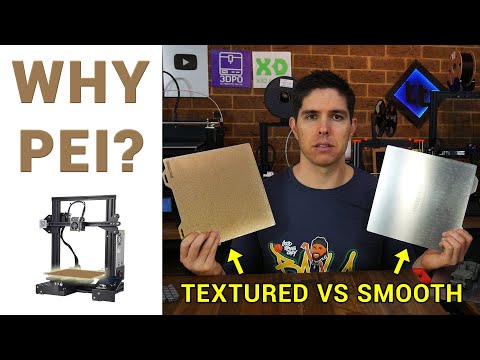
Guide to PEI 3D printer beds: Why and when to use smooth vs textured
3D Printer PEI Beds: Pros and Cons
This video explores the merits of PEI beds with a focus on when to use smooth versus textured for performance and durability.
What is PEI?
- Polyetheremide (PEI) is a type of thermoplastic that is particularly well-suited for 3D printing.
- For FDM 3D printing, PEI is most commonly used as a surface for the print bed.
Smooth vs Textured PEI Beds
- There are two types of PEI beds - smooth sticker sheets and textured beds applied by manufacturers.
- Textured PEI beds are created by electrostatically charging an item before blowing powder over it. The coated part then goes into an oven where the powder will be heated, melting it together into a uniform coating.
Pros and Cons of Using PEI Beds
Flexibility
- A pro for using PEI is that it's flexible enough to go on a spring seal sheet, making it easy to remove prints. However, if your bed is warped, the pei sheet will conform to the shape of the bed which means it will still be warped.
Durability
- A big pro for using PEI is that it's durable in most circumstances. If you have textured glass or build tack surfaces and your level or auto bed leveling system is off and the nozzle makes contact with the bed, it's going to permanently damage the bed. On a build tack surface if the hot nozzle touches it, it's going to melt straight through. However, with PEI sheet or PEX variant, the print surface is still completely usable even if the nozzle engraves a pattern in the surface.
Self-Release
- PEI sheets will self-release the part as they cool down just like glass with PLA at least. If you allow the bed to cool, the part will naturally self-release. However, this is not ideal if you're relying on power out protection just like with glass.
When to Use Smooth vs Textured PEI Beds
- The video focuses on when to use smooth versus textured for performance and durability.
- The flexibility of smooth PEI beds makes them easier to remove prints from but can be a downside if your bed is warped. Textured PEI beds are more durable but may not be as easy to remove prints from.
Overall, PEI beds have their own strengths and weaknesses that should be considered when deciding whether or not to use them for 3D printing.
Cleaning and Maintaining PEI Beds
In this section, the speaker discusses how to clean and maintain PEI beds.
Cleaning PEI Beds
- Use a fingernail or hard piece of plastic to scrape off any filament that's built up in the crevices.
- Apply a solvent such as isopropyl alcohol or acetone and scrub with steel wool or fine sandpaper to remove grime and stuck-on filament.
- Wipe down the bed with paper towel to remove any debris.
Other Bed Materials
- The speaker has used a variety of PEI beds from different manufacturers, including Wham Bam, Prusa, TH3D Easy Flex Plates, Big Tree Tech, and generic smooth PEI sheets.
- There is a lot of variation between different brands of bed materials, filaments, and printers. The following recommendations are a starting point for experimentation.
Printing PLA on PEI Beds
In this section, the speaker discusses printing PLA on PEI beds.
Smooth vs Textured Surfaces
- PLA sticks equally well to smooth or textured surfaces.
- The decision comes down to aesthetics - whether you want a shiny/glossy underside or a textured pattern that suits the object being printed.
First Layer Adhesion
- Use a bed temperature of 60°C for PEI (70°C for PEX).
- The first layer should be a little more squished than when printing with BuildTak.
- For tricky prints that may curl up, coat the PEI sheet with a thin layer of hairspray to improve first layer adhesion.
Printing TPU and PETG on PEI Beds
In this section, the speaker discusses printing TPU and PETG on PEI beds.
Printing TPU
- TPU is easy to stick to the bed, and smooth or textured surfaces can be used depending on preference.
- No need to heat the bed for TPU, as it can stick too well if heated.
Printing PETG
- Use a textured PEI sheet for dedicated PETG printing.
- For BuildTak, run the bed at 80°C. For PEI or PEX, drop it as low as 70°C.
- Raise the Z offset.
Tips for Using PEI Print Surface
In this section, the speaker provides tips for using a PEI print surface with different filaments.
Bed Preparation for PETG Filament
- Wait until the bed has cooled down before removing parts.
- A Prusa PUI powder-coated sheet is recommended for permanent PETG printing.
- PETG can damage some bed surfaces, such as borosilicate glass.
Bed Preparation for ABS and ASA Filaments
- Smooth PEX sheet is recommended for ABS and ASA filaments.
- A good bed temperature for ABS is usually 100 degrees Celsius.
- Hairspray can be used to get extra grip on the smooth PEX sheet.
Bed Preparation for Nylon Filament
- Nylon does not bond strongly with PEI and won't damage the bed.
- Painter's tape may be used instead of PEI.
- The speaker does not recommend using PEI as a suitable bed surface for nylon filament.
Bed Preparation for Exotic Filaments like Peak
- Peak requires a nozzle temperature of 400 degrees Celsius to print.
- Dimafix print bed adhesive was applied to a smooth PEUI sheet, which worked well with peak filament.
- Be careful when using high temperatures, as it can easily damage the printer bed if the first layer nozzle clearance is too low.
Smooth vs Textured Print Surface
In this section, the speaker discusses the differences between smooth and textured print surfaces and their suitability based on personal preference.
Smooth Print Surface
- Provides maximum grip when combined with hairspray or another adhesive.
Textured Print Surface
- Provides more durability than a smooth surface.
Conclusion
The video provides tips on how to use different filaments with a PEI print surface. The speaker recommends waiting until the bed has cooled down before removing parts and using a Prusa PUI powder-coated sheet for permanent PETG printing. Smooth PEX sheets are recommended for ABS and ASA filaments, while painter's tape is suggested instead of PEI for nylon filament. The speaker also discusses the differences between smooth and textured print surfaces based on personal preference.
Turn any video into a summary like this
YouTube links, meetings, lectures. With transcripts, search, and chat.