umh1723 2012-13 Lec02c Clasificación de las corrientes eléctricas utilizadas en Fisioterapia
Classification of Electrical Currents in Electrotherapy
Overview of the Topic
- The discussion focuses on the classification of electrical currents commonly used in electrotherapy, specifically within Unit 1, Topic 2 of the course.
- Previous points (1 to 4) have been covered, and the current focus is on real examples of impulse sequences or electrical currents used in electrotherapy.
Classification of Currents
- The presentation will classify low, medium, and high-frequency currents utilized in electrotherapy, including galvanic current which lacks frequency and thus falls outside this classification.
Galvanic Current
- Graphically represented as a constant flow of electrons; therapeutic intensity corresponds to a horizontal line known as "useful period," while an inclined line indicates circuit closure (non-therapeutic).
- Defined physically as continuous (no alternation), monophase (single-phase representation), and constant state since therapeutic intensity remains unchanged over time.
- Lacks impulse emission and frequency classification; it is solely described as continuous monophase and constant state.
Effects and Precautions
- High galvanic component leads to polar effects beneath electrodes; chemical burns are a risk due to these effects necessitating caution during application.
Modified Galvanic Current
- Introduction of interrupted galvanic current at 8,000 Hz aims to reduce the galvanic component's impact by creating a rectangular interrupted waveform. This modification enhances patient tolerance while minimizing chemical effects.
Characteristics of Interrupted Galvanic Current
- Classified as continuous, monophase but variable state due to fluctuating intensity over time; impulses are rectangular and interrupted at 8,000 Hz.
Transition to Variable Currents
- Moving forward with variable currents classified into low, medium, and high frequencies based on their characteristics; all future representations will show intensity variation over time.
Faradic Current
- Named after Michael Faraday; also referred to as induced current due to its properties: alternating, biphasic, asymmetric with triangular impulse shape that is interrupted—classified as low frequency.
Frequency Calculation for Faradic Current
- Characterized by an impulse duration of 1 ms and pause duration of 19 ms leading to a total period of 20 ms; calculated frequency equals 50 Hz indicating it is indeed low frequency.
Neofaradica Current
Electrodiagnosis and Neofaradica Current
Understanding Eletrodianóstico de Estimulación
- The concept of electrodiagnosis of stimulation is introduced, defined as a continuous, monophase current that is variable in nature. It consists of triangular-shaped impulses that are interrupted and classified under low-frequency currents, being a variant of faradic current.
Characteristics of Neofaradica Current
- Neofaradica current can also be utilized with rectangular impulse shapes. With impulse durations as short as one millisecond, the differences between rectangular and triangular impulses are minimal.
- This neofaradica current is characterized as continuous (not alternating), monophase, variable in intensity over time, consisting of rectangular impulses that are interrupted and non-modulated. It maintains low frequency with an impulse duration of 1 ms and a pause duration of 19 ms.
Objectives and Applications
- The neofaradica current serves two main purposes: diagnostic (in electrodiagnosis of stimulation) and therapeutic (to stimulate muscles to prevent atrophy in certain pathological states).
- An example provided includes faradic impulse trains used for muscle stimulation to prevent atrophy. The graphical representation shows continuous currents with increasing amplitude up to a maximum before decreasing.
Frequency and Impulse Parameters
- The low-frequency characteristic is maintained with parameters such as an impulse duration of 1 ms, pause duration of 19 ms, leading to a period equivalent to 20 ms and a frequency calculated at 50 Hz.
Grouping Concepts in Impulses
- Two levels of concepts regarding impulses are discussed:
- Level one includes individual parameters like impulse duration, pause duration between impulses, period, frequency, and intensity.
- Level two involves grouped concepts related to trains or packages of impulses including train duration, pause between trains, period for these trains, and their frequency.
Triangular Pulsating Current
Characteristics Overview
- A triangular pulsating current is described as continuous (monophase), variable in nature with triangular or exponential shaped impulses that are interrupted but not modulated. It belongs to the low-frequency group.
Traver Current
Historical Context
- Traver current is named after a German physiologist who standardized therapy using this electrical form. It’s classified similarly to previous currents but features rectangular pulses with specific durations.
Technical Specifications
- The Traver current has an impulse duration of 2 milliseconds with pauses lasting 5 milliseconds. Its total period equals 7 milliseconds leading to a calculated frequency around 142 Hz.
Diadynamic Currents
Introduction to Diadynamic Currents
- Diadynamic currents represent another category within low-frequency currents primarily aimed at analgesic therapy developed by French physician Pierre Bernard.
Variations Within Diadynamic Currents
Understanding Diadynamic Currents
Overview of Impulse Duration and Frequency
- The duration of the impulse is 10 milliseconds, while the pause duration is 0 milliseconds, leading to a frequency calculation of 100 Hz (1,000 ms / 10 ms).
- Monofásica fija (MF) is introduced as a continuous, monophase current with sinusoidal impulses lasting 10 ms and pauses also lasting 10 ms, resulting in a frequency of 50 Hz.
Characteristics of Long Period Current
- Long period current is characterized by being continuous and monophase with sinusoidal impulses that are uninterrupted but modulated in intensity.
- With an impulse duration of 10 ms and no pause, the period for this current type is also 10 ms, yielding a frequency of 100 Hz.
Short Period Current Dynamics
- Short period currents are defined as continuous monophase currents with sinusoidal emissions that are modulated in frequency. They exhibit varying frequencies over time.
- A modified version known as induced short periods has similar characteristics but includes modulation in both frequency and intensity.
Rhythm Sincopado: Final Form of Diadynamic Currents
- Rhythm sincopado consists of continuous monophase currents with interrupted sinusoidal impulses lasting for 10 ms followed by equal pauses.
- This results in a total period of 20 ms, categorizing it within low-frequency currents.
Introduction to TENS Currents
- The discussion shifts to TENS (Transcutaneous Electrical Nerve Stimulation), which can apply various electrical forms for sensory stimulation through the skin.
- Although commercially associated with specific types, TENS encompasses any transcutaneous electrical stimulation capable of producing sensory effects.
Varieties of TENS Applications
- Three main varieties exist based on their objectives: analgesic form, muscle strengthening form, and healing form.
Understanding the Absence of Polaridad in Electric Currents
Concept of Absence of Polaridad
- The absence of defined polaridad is explained as the electric charge between positive and negative phases canceling each other out, leading to no defined polarity.
- Despite lacking a galvánico component, the negative pole can exhibit a greater therapeutic effect due to its higher amplitude compared to the contralateral phase.
TENS Current for Analgesic Purposes
- The TENS modality used for muscle strengthening differs significantly from that used for analgesia; it is classified as an alternating, biphasic, symmetrical current with low frequency.
- Biphasic and symmetrical forms ensure equilibrium in positive and negative phases, meaning electrode placement does not affect functionality since they do not behave as traditional poles.
Healing Effects of TENS Current
- The TENS current aimed at wound healing is also characterized by being an alternating, biphasic, symmetrical current formed by rectangular impulses within a low-frequency group.
Transitioning to Medium Frequency Variable Currents
Introduction to Medium Frequency Currents
- This section marks the transition from low-frequency variable currents to medium-frequency variable currents, specifically focusing on two types: interferential current and Russian stimulation current.
Characteristics of Interferential Current
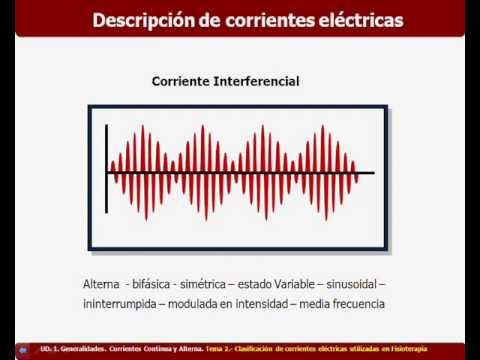
- Interferential currents are emitted in trains or impulse packets; they consist of sinusoidal impulses that are uninterrupted and modulated in intensity.
- Classified similarly as alternating, biphasic, symmetrical currents; these currents maintain balance without concern for electrode placement due to their lack of defined polarity.
Exploring Russian Stimulation Current
Features of Russian Stimulation Current
- Russian stimulation current is characterized by continuous angular impulses grouped into packets or trains. It shares similar properties with previous currents discussed—alternating, biphasic, symmetrical—and operates under variable conditions.
Conclusion on High-Frequency Variable Currents
Overview of High-Frequency Currents