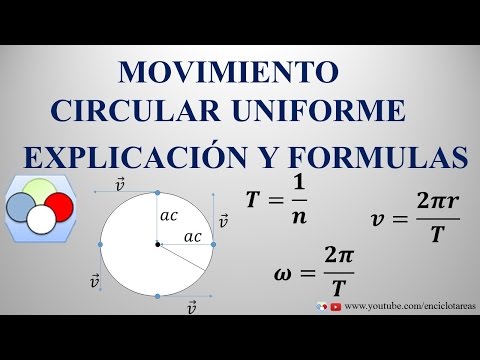
Movimiento Circular Uniforme (MCU)- Explicación y Fórmulas
Understanding Uniform Circular Motion (UCM)
Introduction to UCM
- The video introduces the concept of Uniform Circular Motion (UCM), explaining that it occurs when an object moves along a circular path with constant speed.
- Although the speed is constant, the direction of velocity changes continuously, resulting in centripetal acceleration directed towards the center of the circle.
Key Magnitudes and Formulas in UCM
- Period (T): Defined as the time taken for one complete revolution. It is calculated as T = 1/n , where n is the number of revolutions.
- Linear Displacement (s): Represents the arc length covered in a given time period, calculated using s = 2pi r , where r is the radius. The unit of measurement is meters.
Frequency and Angular Displacement
- Frequency (f): Indicates how many revolutions occur in a unit time, expressed as f = n/T . It can also be represented as f = 1/T .
- Angular Displacement: This refers to a full rotation represented by 2pi .
Linear and Angular Velocity
- Linear Velocity: The relationship between linear displacement and time, given by v = 2pi r/T . It can also be expressed as v = 2pi rf .
- Angular Velocity: Defined as the rate of change of angular displacement over time, calculated using w = 2pi/T .
Centripetal Acceleration