Normative and positive statements | Basic economics concepts | AP Macroeconomics | Khan Academy
Understanding Normative vs. Positive Statements
Introduction to Normative and Positive Statements
- The instructor introduces the concepts of normative and positive statements, emphasizing their relevance in economics and philosophy.
- A normative statement is defined as an opinion or ethical belief about how the world should be, while a positive statement can be tested for truthfulness.
Examples of Statements
Example 1: Welfare Programs
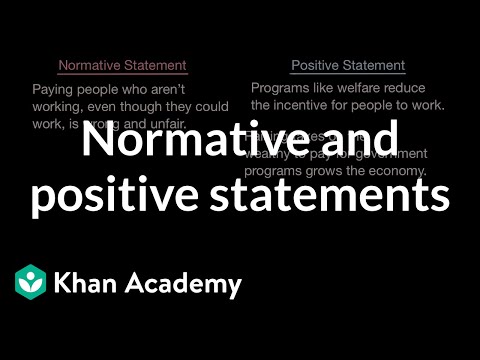
- The statement "Paying people who aren't working, even though they could work, is wrong and unfair" is identified as a normative statement due to its opinion-based nature.
Example 2: Impact of Welfare on Work Incentives
- The claim "Programs like welfare reduce the incentive for people to work" is classified as a positive statement because it can be empirically tested through surveys and comparisons.
Example 3: Taxation and Economic Growth
- The assertion "Raising taxes on the wealthy to pay for government programs grows the economy" is also a positive statement since it can be evaluated through simulations or case studies.
Example 4: Taxes Slowing Economic Growth
- The phrase "Raising taxes on the wealthy slows economic growth" is deemed a positive statement because it allows for testing against real-world data from different countries.
Example 5: Ethical Considerations in Taxation
- The declaration "The government should raise taxes on the wealthy to pay for helping the poor" is recognized as a normative statement due to its use of 'should,' indicating an opinion rather than something testable.
Conclusion
- The video concludes by reiterating that understanding these terms—normative (opinion-based) versus positive (testable)—is crucial in discussions surrounding economics and ethics.
Turn any video into a summary like this
YouTube links, meetings, lectures. With transcripts, search, and chat.