3.3 Composting technologies
Overview of Composting Technologies
Introduction to Composting Methods
- The module introduces various composting technologies commonly used in low and middle-income countries, including windrow composting, passive aerated windrow, forced aerated windrow, vessel composting, and bean composting.
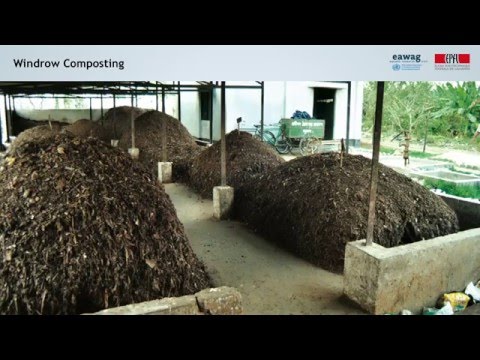
Windrow Composting
- Windrow composting involves creating elongated piles of stacked raw materials suitable for large volumes of biowaste.
- Proper aeration is crucial; oxygen must be replenished to prevent anaerobic conditions that produce foul odors. Mixing materials enhances porosity for air flow.
- Piles are typically turned manually or mechanically to maintain porosity and facilitate microbial decomposition. This method requires significant space and is labor-intensive.
Passive Aerated Windrow
- This technology uses perforated pipes within the pile to promote convective airflow without needing to turn the piles during the process.
- Pre-mixing feedstock is essential before placement on pipes; insulation with finished compost helps maintain thermophilic temperatures throughout the pile.
- It requires a slightly higher initial investment than non-aerated methods but demands less labor since turning is unnecessary.
Forced Aerated Windrow
- Similar in appearance to passive systems but includes blowers at the end of perforated pipes that inject air into the piles during active phases.
- Airflow can be adjusted based on frequency and duration settings. Insulation with finished compost ensures adequate temperature maintenance.
- This method has higher initial costs due to blower installation but offers shorter processing times and reduced labor needs compared to previous methods.
Vessel Composting
- Vessel composting confines materials within a container, allowing better control over airflow and temperature compared to other techniques.
- Various configurations exist from high-tech bioreactors to low-tech alternatives; manual or mechanical turning may be required.
- While more capital intensive, it occupies less surface area than other methods due to its compact nature.
Bean Composting
- Primarily practiced at a household level for small waste amounts; containers often have perforated walls for air circulation.
- Can also scale up for larger operations where produced compost is commercialized. Waste enters from above and exits from below as it degrades slowly.
- Requires medium investment costs with minimal maintenance; however, it may take longer than other options described earlier.
Conclusion of Module
Summary Insights
- The module concludes by summarizing key points about different composting technologies suited for developing countries while hinting at practical aspects like mixing organic waste in future discussions.