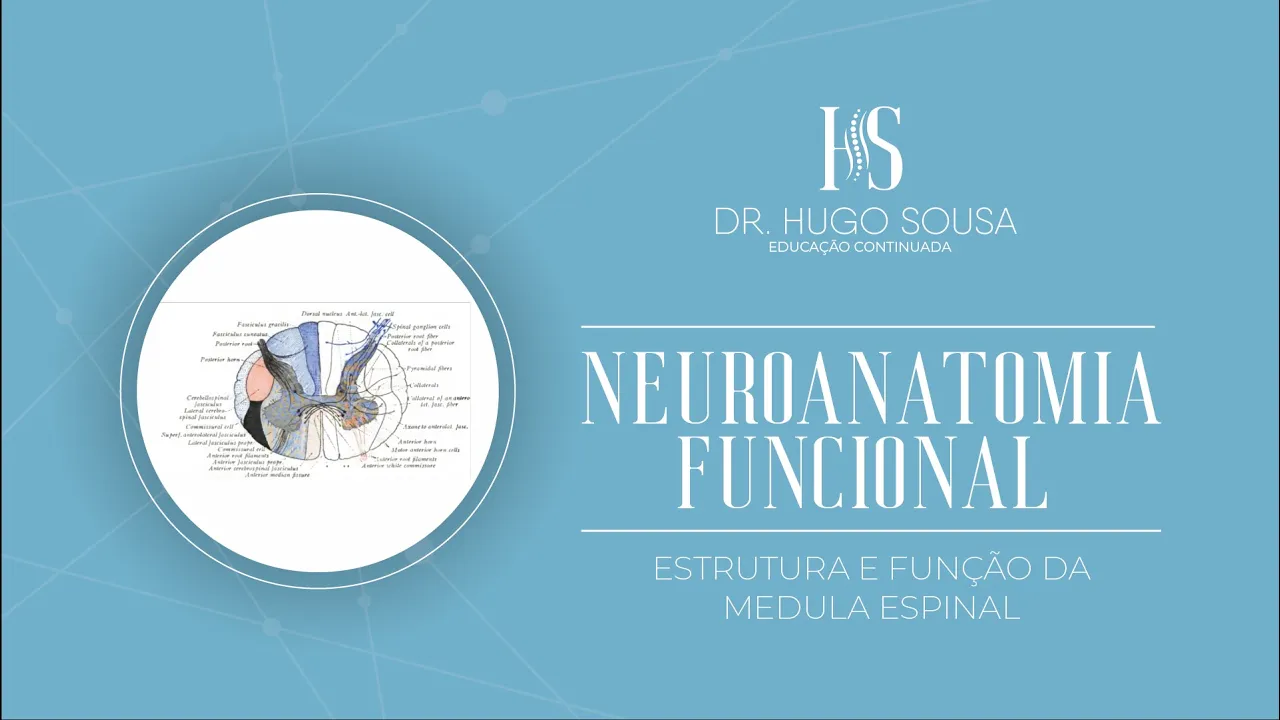
ESTRUTURA E FUNÇÃO DA MEDULA ESPINAL - PARTE 1
Understanding the Structure of the Spinal Cord
Clinical Case Introduction
- A 27-year-old man presented to the emergency department with loss of sensation in his left lower limb and paralysis in his right lower limb after a stabbing incident during a fight.
- Physical examination revealed proprioceptive loss and pain/temperature sensitivity loss in specific limbs, prompting questions about the location and level of injury.
Overview of Spinal Cord Anatomy
- The spinal cord is part of the central nervous system, consisting of white matter (peripheral) and gray matter (central). The cervical region has a higher concentration of gray matter compared to thoracic segments.
- Lumbar and sacral regions also show increased gray matter density due to neuron concentration, particularly at cervical and lumbar enlargements which serve specific plexuses for upper and lower limb innervation.
Neuronal Density and Fiber Concentration
- Greater neuronal density in cervical, lumbar, and sacral regions correlates with larger populations of neurons necessary for limb movement control. This is evident in both anterior (motor) and posterior (sensory) columns.
- Ascending pathways carry sensory information from peripheral areas to medullary centers before reaching the brain; descending pathways originate from these centers back down through the spinal cord. Higher segments have more fibers due to their need to relay information across longer distances.
Structural Observations Across Segments
- Cross-sectional images reveal distinct features: posterior columns are sensory while anterior columns are motor; intermediate gray matter exists centrally with lateral horns present only in thoracic/lumbar segments where sympathetic neurons reside.
- The presence of intermediate gray matter indicates higher neuron density in certain regions, forming lateral columns that play critical roles in reflexes and motor control within those segments.
Classification of Spinal Neurons
Neuronal Types and Functions
Overview of Neurons
- The transcript discusses two main types of neurons: radicular and cordonal. Radicular neurons carry both visceral and somatic information, while cordonal neurons consist of projection neurons.
Projection Neurons
- Projection neurons extend beyond the organ in question, specifically within the central nervous system (CNS), which includes the spinal cord, brainstem, cerebellum, and cerebrum divided into diencephalon and telencephalon.
Tracts and Fascicles
- Cordonal projection neurons form tracts and fascicles; for example, the lateral spinothalamic tract originates in the spinal cord and projects to the thalamus through a lateral region.
Association Neurons
- There are also association neurons that connect segments within the spinal cord or brainstem but do not project outside these areas.
Radicular Neurons: Structure and Function
Visceral Motor Neurons
- Radicular neurons include pre-ganglionic visceral motor neurons located in the anterior horn of the spinal cord. They project through anterior root filaments to reach spinal nerves before traveling to ganglia.
Sympathetic Ganglia
- These pre-ganglionic fibers connect with sympathetic ganglia forming chains along the vertebral column. They play a crucial role in autonomic functions.
Inervation Mechanisms
Target Organs
- Pre-ganglionic visceral motor neurons innervate smooth muscle, such as those found in intestinal walls responsible for peristalsis.
Locations of Pre-Ganglionic Neurons
- Pre-ganglionic sympathetic neuron locations include intermediolateral columns from T1 to L2 regions, as well as S2 to S4 for non-sympathetic motor processes like urinary continence.
Somatic Motor Neurons
Types of Somatic Motor Neurons
- Two major types of somatic motor neurons are identified: alpha motoneurons that innervate extrafusal muscle fibers for contraction, and gamma motoneurons that innervate intrafusal fibers related to muscle tone regulation.
Muscle Fiber Innervation
Extrafusal vs Intrafusal Fibers
- Alpha motoneurons target extrafusal fibers essential for muscle contraction while gamma motoneurons focus on intrafusal fibers which help regulate tension during muscular contractions.
Long Axons in Radicular Neurons
- Radicular motoneurons have long axons extending from their cell bodies in the spinal cord to peripheral muscles via nerves they form.
Neuronal Pathways and Functions in the Spinal Cord
Overview of Spinal Cord Funiculi
- The spinal cord consists of funiculi, which are bundles that carry ascending and descending tracts. These tracts facilitate information flow through projection and association neurons.
- Projection neurons extend from the spinal cord to higher brain centers such as the thalamus and cerebellum, indicating their role in transmitting sensory and motor signals.
Types of Neurons in the Spinal Cord
- Neurons can be ipsilateral (same side) or contralateral (opposite side), with some crossing over at the spinal cord level, known as decussation.
- There are two main types of spinal cord neurons: projection neurons that connect to supraspinal centers and association neurons that link different segments within the spinal cord.
Association Neurons and Reflexes
- Association neurons can be bilateral or contralateral; they play a crucial role in coordinating reflex actions across multiple segments of the spinal cord.
- The propriospinal tract is highlighted as a significant pathway for intersegmental reflexes, facilitating coordinated muscle responses during withdrawal reflexes.
Mechanism of Withdrawal Reflex
- An example is provided where stepping on an object triggers a withdrawal reflex involving flexion at hip and knee joints, requiring coordination among various muscle groups.
- This process necessitates inhibition of antagonistic muscles to allow effective movement away from harmful stimuli.
Interneurons in Motor Modulation
- Short interneurons located within the gray matter connect sensory inputs directly to motor outputs, playing a vital role in local reflex arcs.
- Renshaw cells are identified as important interneurons that inhibit motor neuron activity, contributing to motor control modulation within the spinal cord.
Organization of Gray Matter
- The gray matter of the spinal cord is organized into layers or laminae associated with specific sensory or motor functions.
- Research by Rexed has categorized these laminae based on their predominant roles, enhancing our understanding of functional organization within the spinal structure.
Specific Structures Within Gray Matter
- The gelatinous substance found in layer I relates primarily to sensory processing within the posterior column of the spinal cord.
Understanding the Medulla Spinalis and Its Functions
Overview of the Medulla Spinalis Structure
- The discussion begins with a focus on the organization of the medulla spinalis, particularly how it is structured from posterior to anterior and medial aspects.
- The presence of gelatinous substance throughout the entire length of the spinal cord is highlighted, emphasizing its relation to pain, temperature, and protopathic touch.
Sensory Functions and Proprioception
- The "nucleus proprius," represented in green, spans the entire medulla and is responsible for proprioception awareness, including movement consciousness and both epicritic (fine touch) and protopathic (crude touch) sensations.
- Dorsal nucleus (Clark's column), located at specific spinal segments (DC-8, AL3, AL4), processes proprioceptive information from muscle spindles and Golgi tendon organs.
Unconscious Proprioception
- Proprioceptive signals are sent to regions within the spinal segments without conscious awareness; this unconscious proprioception aids in motor activity regulation.
- Afferent visceral nuclei are found at the base of the posterior column in gray matter, linked to visceral sensory information such as organ distension.
Organization of Sensory Information
- Neurons related to visceral sensitivity span from T1 to L3 segments; they process various sensory inputs including pain from internal organs.
- The arrangement of laminae 1 through 6 corresponds with sensory processing areas where exteroceptive fibers terminate.
Distinction Between Sensory Types
- Laminae 5 and 6 are associated with proprioceptive information—both conscious (discriminative touch/sensations sent to cerebellum) and unconscious types.
- Lamina 9 contains neurons projecting towards skeletal muscles; it plays a crucial role in motor function by innervating striated muscles.
Motor Neuron Groups in Anterior Column
- In the anterior column, motor neurons are categorized into medial and lateral groups; these groups have distinct roles based on their location along the spinal cord.
- The medial group innervates axial skeleton muscles while lateral group neurons specifically target appendicular limb muscles.
Turn any video into a summary like this
YouTube links, meetings, lectures. With transcripts, search, and chat.