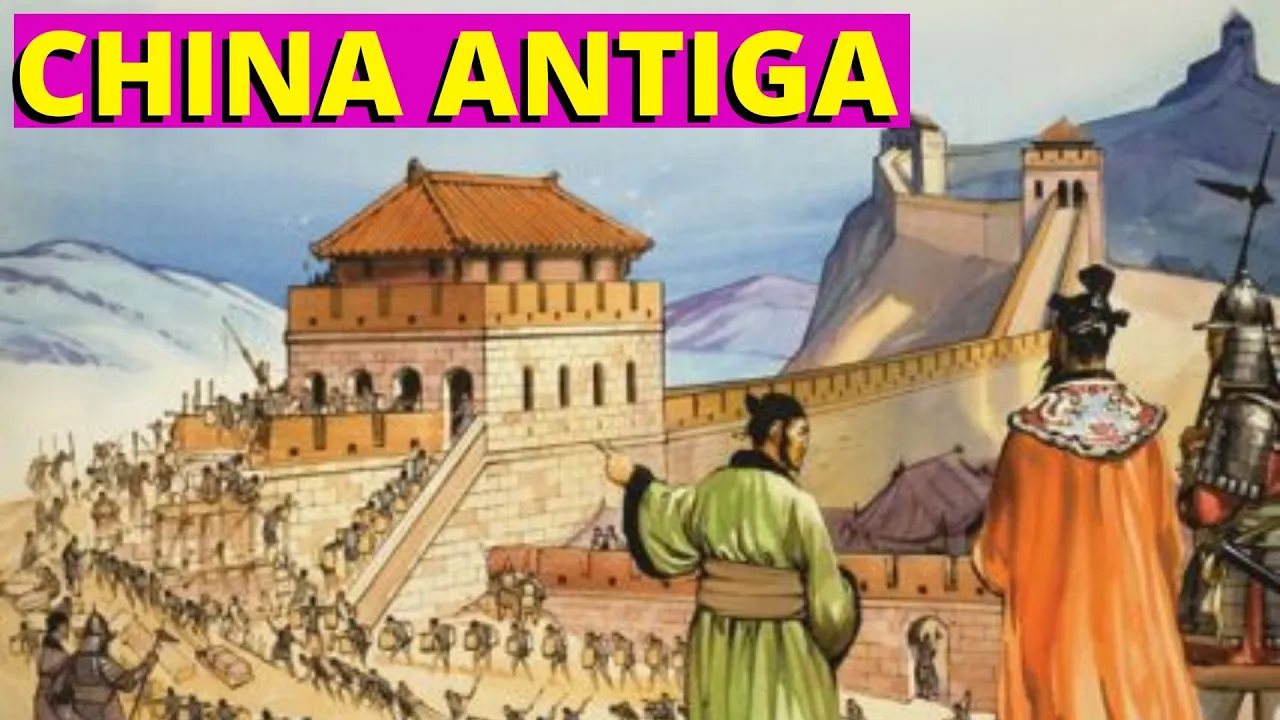
A civilização chinesa.
Chinese Civilization: Formation and Development
This section delves into the early stages of Chinese civilization, exploring the formation and development of dynasties, key figures, technological advancements, and philosophical ideologies that shaped ancient China.
Early Settlement in China
- Around 5000 BC, human groups settled in the Yellow River valley, establishing agricultural centers.
- Villages in the Yangtze River valley began cultivating rice, leading to the emergence of proto-states unified under Yu the Great in 2200 BC.
Dynastic China
- The Shang dynasty introduced writing, a calendar, and silk-making techniques during their reign.
- The Zhou dynasty expanded Chinese territory but faced challenges during the Warring States period.
Philosophical Ideologies
- Confucius emphasized moral conduct for individuals and rulers to ensure good governance.
- Lao-tse focused on nature and spirituality through Taoism, advocating harmony with the universe.
Imperial China
- Emperor Zheng standardized currency and writing while facing resistance from traditional nobility.
- The Han dynasty ushered in a period of prosperity supporting agriculture, commerce, and Confucian teachings.
Technological Advancements
- Under the Han dynasty, inventions like the compass and movable type printing facilitated scientific progress.
The Ancient Trade Routes: Silk Road and Japan in Antiquity
This section delves into the historical significance of the Silk Road, tracing its origins from prehistoric migrations to the role of Persians in establishing it as a trade route. It also explores the impact of Chinese expeditions and the subsequent Ming dynasty's influence on maritime trade. Additionally, it provides insights into Japan's ancient history, focusing on its interaction with China and the development of a feudal society.
The Silk Road and Its Evolution
- The Silk Road connected present-day Syria to Xiang in China, serving as a crucial path for prehistoric migrations and later trade routes.
- Persian caravans played a pivotal role in transforming this route into the renowned Silk Road through their extensive travels.
- Chinese expeditions under Zhang Qian intersected with Persian caravans, leading to the establishment of what is now known as the Silk Road.
- The Mongol invasion under Kublai Khan marked a significant period along the Silk Road's history, influencing trade dynamics between East and West.
- Admiral Zheng He's expeditions during the Ming dynasty expanded Chinese maritime reach but were later halted due to internal conflicts within China.
Japan's Historical Development
- Japan's ancient history is divided into periods like pre-Jomon, Jomon, and Yayoi, with influences from China shaping societal aspects such as writing and agriculture.
- The emergence of noble clans like Yamato led to a feudal society in Japan where power was concentrated among emperors, shoguns, daimyo, and samurai.
- Tokugawa leyasu's shogunate marked a turning point by restricting foreign influence like Christianity in Japan during the 17th century.
China Today: Growth and Poverty
This segment discusses China's historical decision to isolate itself from external influences during the Ming dynasty. It highlights how this isolation impacted economic growth while briefly touching upon European interactions with Canton for trade purposes.
Ming Dynasty Isolation
- A ruler of the Ming dynasty closed off China from external contact by banning ship construction and dismantling shipyards to limit interactions with European nations deemed "barbaric."
Chinese History Overview
This section provides a brief historical overview of China, highlighting key events such as the Opium Wars, the establishment of communism under Mao Tse-tung, and subsequent economic changes.
Chinese History Timeline
- The mid-19th century saw English forces defeating the Chinese in the Opium Wars, leading to the forced opening of new ports for foreign trade and British control over Hong Kong.
- By 1916, Sun Yat-sen led a rebellion that deposed the last emperor and established the Republic.
- In 1949, after a prolonged civil war, Mao Tse-tung's communists took power and implemented communism in China.
Modern China: Economic Growth and Challenges
This part discusses modern China's economic growth post-Mao era, its current status as a rapidly growing country with social inequalities and environmental challenges.
Modern China Dynamics
- Post-Mao's death in 1976, China shifted towards capitalist-type measures resulting in annual growth rates exceeding 9%.
- With 1.4 billion inhabitants, China is now the world's fastest-growing country and second-largest economy after the United States.
- Despite economic success, social inequalities persist with widening gaps between rich and poor in this "market socialist" economy.
Conclusion: Future Prospects and Recommendations
The conclusion emphasizes future prospects for China while acknowledging social disparities and environmental concerns.
Future Outlook
- Scholars predict that China may surpass the United States economically in upcoming years due to its rapid growth trajectory.
- However, alongside economic progress, social inequalities are deepening as wealth disparities widen within this market socialist system.
Closing Remarks: Learning Resources
The closing remarks encourage further learning through reading resources provided by the speaker.
Learning Resources
- Viewers are encouraged to subscribe for more content on Indian civilization while accessing additional material on various social networks mentioned by the speaker.