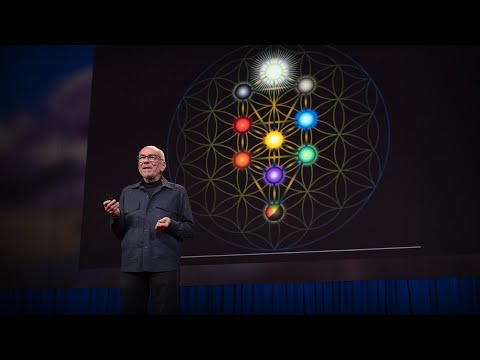
A Mysterious Design That Appears Across Millennia | Terry Moore | TED
New Section
This section introduces Roger Penrose, a renowned scientist who made significant contributions to the field of mathematics and tiling. It discusses the concept of Penrose tiling, which is a pattern constructed using only two shapes that can be expanded infinitely without repetition.
Roger Penrose's Contribution to Mathematics
- Roger Penrose, a prominent scientist, won the 2020 Nobel Prize in Physics for his work on reconciling black holes with Einstein's theory of relativity.
- In the 1970s, Penrose made a contribution to mathematics known as tiling.
- Tiling involves putting tiles together to form specific patterns.
- Penrose developed a remarkable pattern using only two shapes that could be expanded infinitely without repetition.
- This pattern became known as Penrose tiling.
Peter Lu's Discovery
- Peter Lu, a graduate student in physics at Princeton, discovered a similar pattern on a 14th-century madrassa in Uzbekistan while on vacation.
- After analysis, he concluded that this was an instance of Penrose tiling dating back 500 years before Penrose's discovery.
- The scientific community was amazed by this finding and it received widespread attention.
Significance of the Pattern
- The question arises as to why ancient cultures considered this pattern important enough to incorporate it into their architecture.
- Anthropology provides insights into the worldview of these cultures and their perception of life's complexity and unpredictability.
- Life is seen as complicated and aperiodic, where every event and decision leads to an unpredictable future.
- Despite this complexity, there is an underlying unity that holds everything together.
Hidden Unity in Design
- The design found by Peter Lu is based on Penrose tiles reducible to specific shapes.
- Medieval craftsmen used construction lines to create these shapes, which are not visible in the final work.
- By weaving these shapes together and focusing on the construction lines, an underlying structure and unity become apparent.
Ancient Worldview
- The concept of hidden underlying unity was common throughout ancient civilizations in various parts of the world.
- Different terms were used to describe this unity, such as "first cause," "singular substance," and "undifferentiated aesthetic continuum."
- These designs found in different cultures reflect their fundamental values and worldview.
Architecture as a Message
- Architecture is often considered a book written in stone.
- The designs found in ancient cultures are not mere decorations but convey important messages about how they perceived themselves, the world, and their values.
Conclusion
The transcript discusses Roger Penrose's contribution to mathematics through his development of Penrose tiling. It highlights Peter Lu's discovery of a similar pattern dating back centuries before Penrose. The significance of this pattern lies in its representation of life's complexity and unpredictability while maintaining an underlying unity. The design found in ancient cultures reflects their worldview and fundamental values. Architecture serves as a medium for conveying messages across time and space.
Turn any video into a summary like this
YouTube links, meetings, lectures. With transcripts, search, and chat.