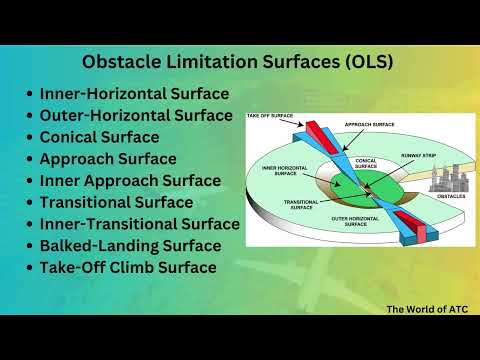
Obstacle Limitation Surfaces (OLS) - 1. Inner Horizontal Surface
Overview of Obstacle Limitation Surfaces
Introduction to the Topic
- The discussion focuses on Annex 14, specifically obstacle limitation surfaces, which aim to keep airspace around aerodromes free from obstacles for safe airplane operations.
- The goal is to prevent aerodromes from becoming unusable due to the growth of surrounding obstacles.
Historical Context and Definition
- Previously known as the National Airfield Clearance Policy (NACP), it has now been revised to focus on obstacle limitation surfaces.
- These surfaces define limits for objects projecting into airspace around an aerodrome.
Types of Obstacle Limitation Surfaces
- There are nine different types of obstacle limitation surfaces covering a radius of 15 kilometers (15,000 meters) around an aerodrome.
- A detailed video will be created for each surface type, including inner horizontal surface, outer horizontal surface, conical surface, approach surface, inner approach surface, transitional surface, inner transitional surface B, landing surface, and takeoff climb surface.
Inner Horizontal Surface Explained
- The inner horizontal surface involves marking two circles at both thresholds of the runway with a radius of 4 kilometers (4,000 meters).
- After drawing these circles, their tangents are joined to create a larger oval shape that must remain at least 4 kilometers away from the runway threshold.
Height Restrictions within Inner Horizontal Surface
- Within this oval shape defined by the inner horizontal surface, obstacles cannot exceed a height of 45 meters if they are within 4 kilometers of a runway threshold.
- It is noted that there are other surfaces inside this inner horizontal area that will be discussed later.
Turn any video into a summary like this
YouTube links, meetings, lectures. With transcripts, search, and chat.